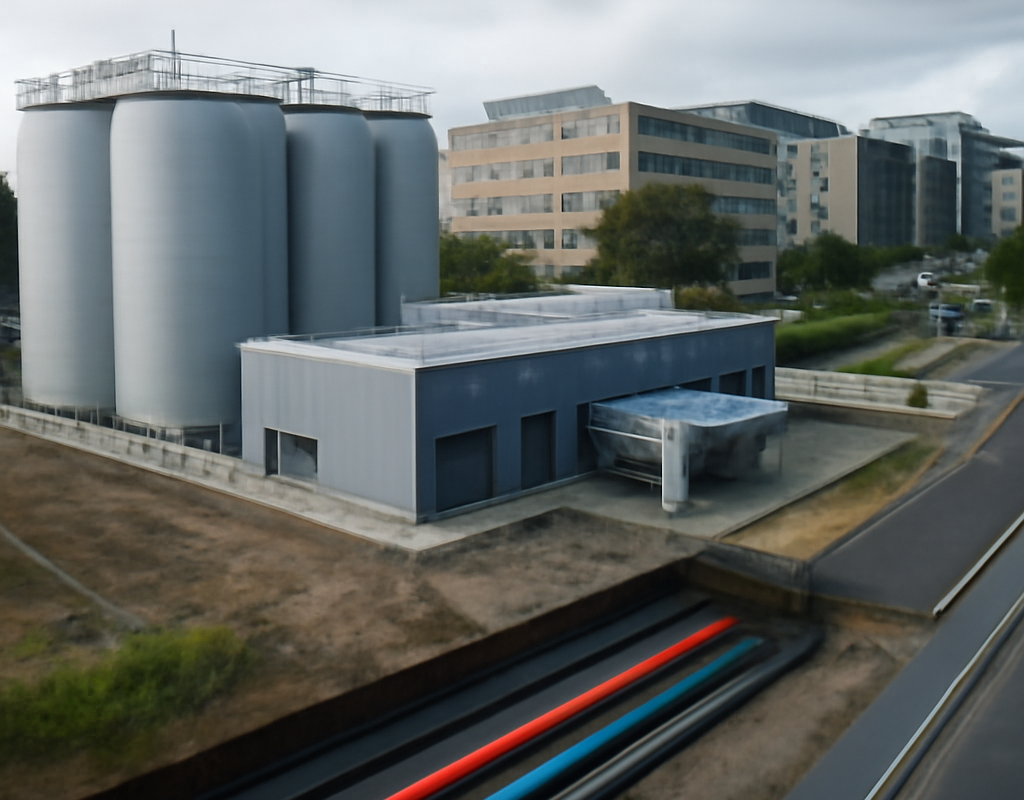
Ireland’s first large-scale district heating scheme is expected to begin supplying buildings in Galway city in 2029, following the granting of planning permission for the project. Developed by HeatGrid Ireland, the system is designed to provide lower-carbon heat to major local customers before expanding into homes and housing estates.
Galway district heating scheme receives planning approval
The planned Galway district heating scheme will be built on the former Galway Crystal manufacturing site. HeatGrid Ireland intends to install 7.8 kilometres of super-insulated underground pipework linking the heating facility with a cluster of major buildings in east Galway.
Potential early customers include:
- Three hospitals
- Factories and a hotel
- A university campus
- A leisure centre
- The regional Garda headquarters
HeatGrid chief executive David Connolly said the company is now engaging with prospective customers about signing up. Prices could only be developed in detail after planning permission was secured, he said.
How the Galway district heating scheme will work
At launch, the Galway district heating scheme will rely on large air-to-water heat pumps powered by electricity. The facility will also include eight storage tanks, each holding 90,000 litres of water.
These tanks will allow water to be heated during periods when electricity demand is lower, renewable generation is strong or wholesale prices are reduced. The stored heat can then be distributed through the underground network when required.
The design allows the network to incorporate heat from several sources in the future. HeatGrid has indicated that this could include industrial waste heat, forestry waste and other renewable or low-carbon sources.
Backup gas boiler included
A gas boiler is planned as a backup if electricity supplies are disrupted. Some objections to the project raised concerns about the potential carbon emissions from this equipment.
However, planners concluded that the boiler would not operate regularly and that the overall development would reduce emissions associated with heating across the district.
HeatGrid says the network could decarbonise large buildings more efficiently than carrying out extensive individual retrofits. Instead of major works in every building, customers would connect to the shared system with comparatively limited changes on site.
Expansion planned across east Galway
The initial network is intended to serve major buildings close to the former industrial site. HeatGrid has designed the system so it can later reach smaller commercial customers, housing estates and additional premises.
The company aims to expand into smaller customers and residential areas within five to 10 years of the initial rollout. Its longer-term ambition is for the network to cover Renmore and much of east Galway.
HeatGrid expects heat supplies to begin in 2029, although the project could be delayed until 2030 if construction or customer agreements take longer than planned.
District heating projects planned elsewhere in Ireland
The Galway project is part of a wider move towards district heating in Ireland. HeatGrid Ireland is also developing proposals for schemes in Limerick and Portlaoise.
Ireland already has a smaller operating network in Tallaght. It uses waste heat from an Amazon data centre to provide heating for South Dublin County Council offices and the Tallaght campus of Technological University Dublin.
A separate Dublin proposal is progressing through the planning process. It would use heat produced at the Dublin Waste to Energy facility, commonly known as the Poolbeg incinerator, to serve homes and buildings in the docklands.
The Galway scheme recently shared in €5 million of Government support awarded across nine projects. The funding reflects official interest in expanding district heating as part of the transition away from fossil-fuel heating.
Why district heating matters for Ireland
Most Irish homes and buildings still depend heavily on oil or gas for heating. That leaves consumers and organisations exposed to fuel supply disruptions and sharp price increases.
District heating can use a central energy system to serve multiple buildings, potentially making it easier to integrate renewable electricity, industrial waste heat and other low-carbon sources. Large customers may also avoid the disruption and expense of installing separate heating systems in every building.
District heating is already widely used in parts of Europe, where tens of millions of homes and buildings are connected to such networks. The Galway development could provide an important test of whether the model can be expanded successfully in Irish cities.
What happens next for the Galway project?
With planning permission in place, HeatGrid’s immediate priority is to finalise agreements with potential customers and establish pricing. Construction and installation of the network must then be completed before heat can be supplied.
The project’s future scale will depend on customer take-up, the economics of connecting new buildings and the availability of suitable low-carbon heat sources. If the first phase proceeds as planned, Galway could become a model for larger district heating networks elsewhere in Ireland.
The key takeaway is that the Galway district heating scheme has moved from proposal to approved development, with initial heat supplies targeted for 2029. Its success could influence how Ireland tackles fossil-fuel dependence, energy costs and building emissions in the years ahead.