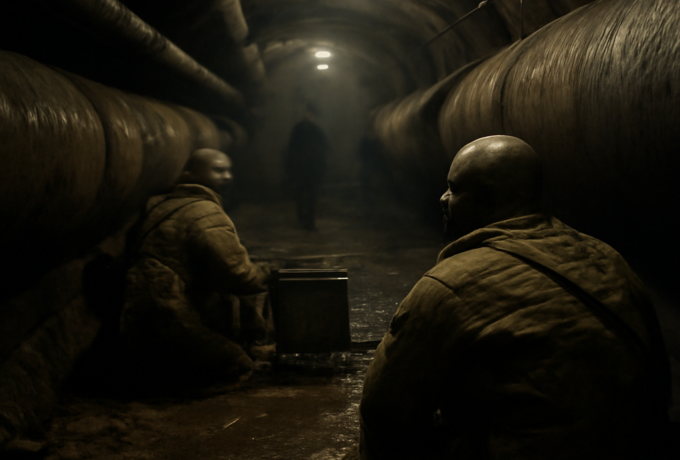
An old Soviet gas pipeline has become the unlikely setting for an underground battle in Ukraine’s Kharkiv region. For seven months, Ukrainian forces and Russian troops have been living and fighting beneath the front line near Kupyansk, using the narrow passage as protection from the drones dominating the skies above.
The BBC reported that it was the first international broadcaster to enter the pipeline, travelling underground with Ukraine’s 13th Khartiia Operational Brigade. The account offers a rare view of how modern drone warfare is reshaping combat along the front.
Why the gas pipeline matters in Ukraine’s war
The pipeline is more than a relic of the Soviet energy system. Its underground route provides Ukrainian soldiers with cover from aerial surveillance and attack drones, which have become a constant presence across much of the battlefield.
With a diameter of just over one metre, the pipe is too narrow for soldiers to walk through normally. Those inside must crawl, making movement slow and physically demanding. Despite those conditions, its covered position offers an important advantage in an environment where exposure above ground can be dangerous.
The subterranean route has reportedly been used as a place from which Ukrainian forces can operate while reducing their vulnerability to drones. It also highlights the increasingly important role of concealment, tunnels and other protected positions in the conflict.
Fighting beneath the Kharkiv front line
The fighting is taking place near Kupyansk, a strategically important area in the Kharkiv region. The city and surrounding settlements have remained part of the wider struggle between Ukrainian and Russian forces as both sides seek to hold or regain ground in eastern Ukraine.
According to the BBC report, Ukrainian personnel from the 13th Khartiia Operational Brigade have been living and fighting in the pipeline for seven months. Their presence underground reflects the pressure created by drone saturation along the front line.
Drones can be used for reconnaissance, artillery spotting and direct attacks. Their widespread use has made movement in open terrain increasingly risky, while also making it harder for either side to advance. The pipeline therefore provides a limited but valuable route through a battlefield where visibility from above can determine whether a position is exposed.
A difficult environment for soldiers
The conditions inside the pipe are severe. The confined space allows little room to move, rest or store equipment, and the need to crawl places an additional physical burden on anyone travelling through it.
Yet underground positions can offer protection that ordinary trenches cannot always provide. The pipeline’s structure shields those inside from direct observation by drones, although it does not remove the wider dangers of combat or guarantee safety.
- The passage is only slightly more than a metre wide.
- Soldiers must crawl rather than walk through it.
- The underground route offers cover from drones operating above the front line.
- Ukrainian forces have reportedly used it for seven months near Kupyansk.
What the pipeline reveals about modern warfare
The battle beneath Kharkiv shows how technology is changing the physical geography of war. Air power has not disappeared, but relatively inexpensive drones now influence where troops can move, how positions are supplied and whether an attack can proceed.
When the skies are filled with surveillance and attack drones, underground infrastructure can become strategically useful even when it was never designed for military purposes. Old tunnels, pipes and shelters may provide concealment, allowing units to avoid detection or move closer to contested areas.
However, such spaces also create serious risks. A narrow pipeline can restrict escape routes, communication and medical evacuation. Soldiers operating underground may also face exhaustion and difficult living conditions. The same confined environment that protects them from aerial threats can make any emergency harder to manage.
The wider significance of the Kupyansk fighting
The BBC’s report from the pipeline provides a close look at a conflict increasingly defined by adaptation. Ukrainian troops are using existing infrastructure to cope with a battlefield where drones make open movement perilous and where even small advances can require considerable effort.
It also underlines the continuing importance of the Kharkiv region in the war. While attention often focuses on major offensives and long-range strikes, frontline fighting can also take place in cramped, hidden and highly localised spaces far from public view.
The underground battle near Kupyansk is a reminder that the war in Ukraine is being fought across multiple layers: in towns, fields, skies and beneath the ground. As drone technology continues to shape the conflict, the search for protection may push forces into infrastructure never intended to become a battlefield.
Key takeaway
The old gas pipeline near Kupyansk has become a vital underground position for Ukrainian forces facing intense drone activity above ground. Its use illustrates both the ingenuity required to survive the war and the increasingly constrained nature of combat along Ukraine’s front line.