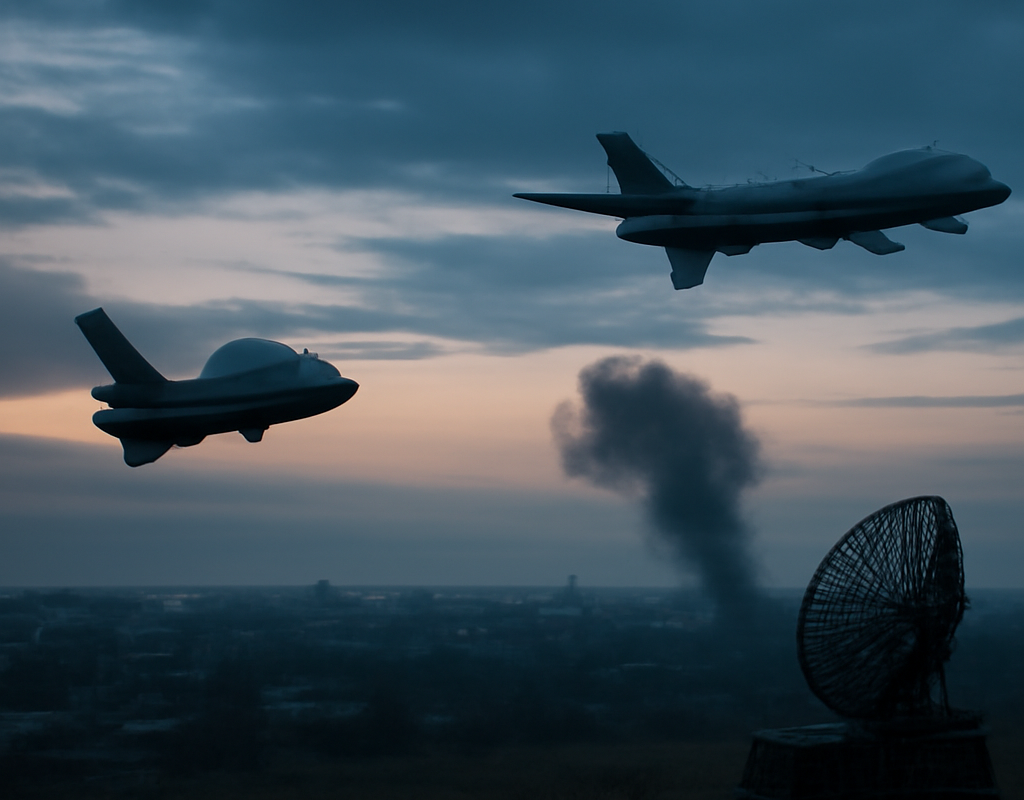
A German-Ukrainian defence company says its SPYS interceptor UAV has shot down a Russian jet-powered drone during combat testing in Ukraine. The reported interception highlights the race to counter faster attack systems being used against Ukrainian cities and critical infrastructure.
German-Ukrainian interceptor targets Geran-5 variant
Quantum WIY Industries announced on 23 November that its SPYS interceptor had successfully engaged a Russian Geran-5 K5-K attack drone. The joint venture was launched by German defence company Quantum Systems and Ukraine’s WIY Drones.
The announcement was made in a company press release shared by Quantum Systems. It described the event as a combat test conducted in Ukraine, rather than a broader independent assessment of the interceptor’s performance.
According to WIY Drones, SPYS is a high-speed interceptor UAV designed to counter both attack and reconnaissance drones. The system is intended to protect military positions, mobile units and critical infrastructure from aerial threats.
What is known about the SPYS system?
WIY says the interceptor can reach speeds of approximately 450 kilometres per hour and operate at an altitude of up to 4 kilometres. Those stated specifications place it in the same broad speed range as the Russian drone variant it was reported to have intercepted.
The company’s description suggests that SPYS is designed as a specialised layer of air defence. Rather than relying only on conventional missile systems, interceptor drones can be deployed against hostile unmanned aircraft when speed, flexibility and lower-cost defensive options are important.
Why the Russian Geran-5 K5-K matters
Ukraine’s military intelligence agency, the GUR, said in early November that Russian forces had begun using the K5-K variant of the Geran-5 in attacks on Ukrainian cities at the beginning of autumn.
The agency said the drone’s aerodynamic design and technical characteristics meant it could already be classified as a compact cruise missile. The GUR reported that the K5-K can travel at more than 450 kilometres per hour and reach an altitude of 6 kilometres.
Those figures are significant because the K5-K appears to be faster and capable of flying higher than conventional propeller-powered attack drones. The GUR contrasted it with systems such as the Geran-2, which use propeller engines.
Faster drones create new air-defence challenges
Jet-powered drones reduce the time available for detection, tracking and interception. Their higher speed can also make it more difficult for air-defence crews to protect cities, military units and energy infrastructure, particularly when attacks involve multiple targets.
The reported SPYS interception therefore points to a wider shift in Ukraine’s battlefield technology. Russia is adapting its attack systems, while Ukraine and its partners are developing quicker ways to identify and defeat them.
However, the company announcement does not provide details about the location of the test, the engagement conditions, the number of systems involved or whether the interception has been independently confirmed. Those details would be needed to assess how the system performs in different operational environments.
Defence companies focus on scaling interceptor production
Sven Kruck, co-chief executive of Quantum Systems, said the companies needed to continue developing and expanding interceptor systems to protect Ukrainian cities and critical infrastructure. He also said Russia was continuing to adapt its attack technology and that the companies were working with Ukrainian brigades to adjust their systems.
The comments reflect a central challenge in the war: air defence must evolve as quickly as the weapons it is intended to stop. Interceptor UAVs may offer one response, especially against drones that are too fast or numerous for traditional defensive methods to handle economically.
For Ukraine, the priority is not limited to protecting front-line positions. The reported targets include urban areas and critical infrastructure, meaning that the effectiveness, availability and cost of defensive systems could have direct consequences for civilian safety and essential services.
What the development means for Europe’s defence industry
The SPYS announcement also illustrates the growing role of European defence partnerships in supporting Ukraine. German engineering and investment are being combined with Ukrainian battlefield experience and drone development expertise.
That cooperation is relevant to wider European defence discussions, where unmanned systems, counter-drone technology and rapid production have become increasingly important. The reported interception does not by itself establish that SPYS is ready for large-scale deployment, but it demonstrates the type of joint development being pursued in response to changing threats.
The immediate question is whether the system can move beyond combat testing and be produced in sufficient numbers. A single successful interception is an important technical milestone, but sustained protection requires reliable supply chains, trained operators, strong detection networks and the capacity to respond to repeated attacks.
Key takeaway from the reported interception
The German-Ukrainian SPYS interceptor has reportedly shot down a Russian Geran-5 K5-K jet-powered drone during testing in Ukraine. The claim underlines how Russia’s faster unmanned aircraft are pushing Ukraine and its European partners to develop new air-defence tools. The longer-term significance will depend on independent confirmation, repeated battlefield performance and whether interceptor production can be scaled to meet the threat.