Plants may seem rooted in place and predictable, but the natural world is full of botanical surprises. From a Bornean palm that flowers underground to an Antarctic plant that survives near-freezing conditions, these examples reveal how evolution has produced ingenious solutions to difficult environments.
10 Plants With Extraordinary Survival Strategies
1. Antarctic pearlwort survives the cold
Colobanthus quitensis is one of only two native vascular plants in Antarctica. It grows in cushion-like clumps and can photosynthesise at temperatures close to freezing. The plant can also protect itself from ultraviolet radiation, self-pollinate when necessary and leave seeds dormant until conditions become more favourable.
2. Moss campion creates a living neighbourhood
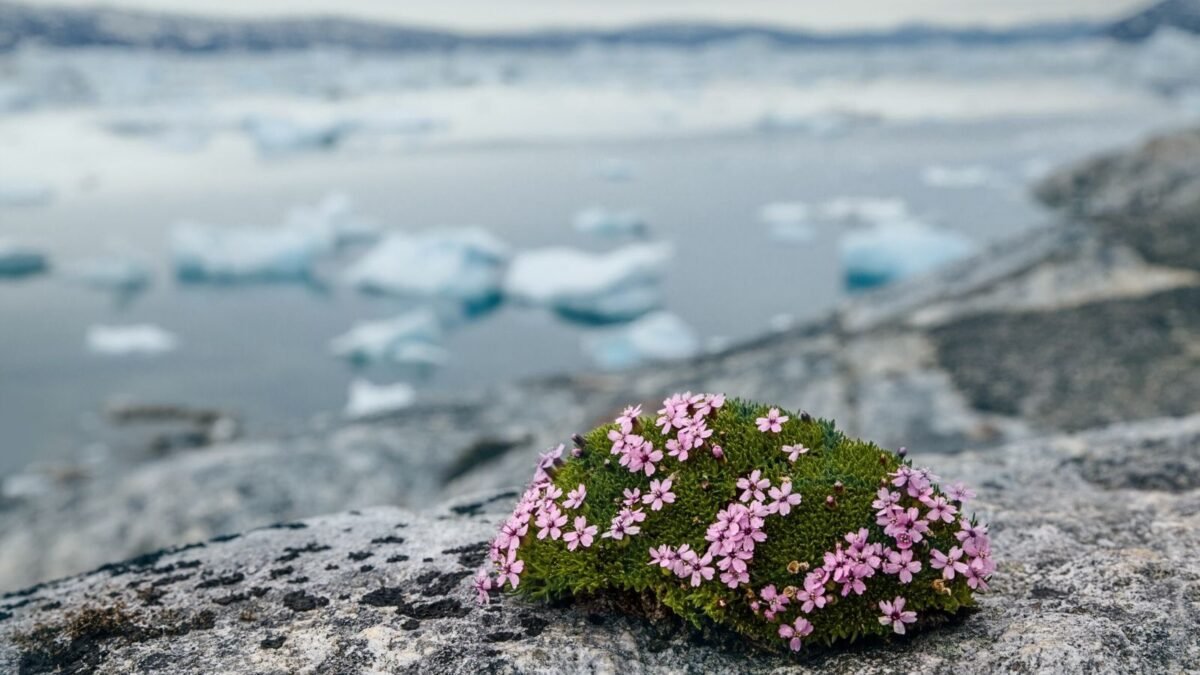
Mountain conditions are harsh, but Silene acaulis, or moss campion, forms dense cushions that shelter other plants and small animals. Research on Whistler Mountain found greater plant diversity and more arthropods within these cushions than in nearby vegetation. This makes moss campion a “nurse plant” for species that need extra protection.
3. Noble rhubarb builds a natural greenhouse
Growing at Himalayan elevations of up to 6,000 metres, Rheum nobile protects its flowers with tall, pale bracts. These translucent leaves reduce exposure to ultraviolet radiation and rain while allowing sunlight through. The enclosed flowers can be around 10°C warmer than the surrounding air on sunny days.
4. Turtle grass uses underwater pollinators
Pollination does not always depend on wind, bees or butterflies. Caribbean turtle grass, Thalassia testudinum, is visited at night by tiny crustaceans and marine worms. Sticky pollen released by male flowers can attach to these visitors and reach female flowers, even when water currents are absent.
5. A flower imitates fermented fruit
Arum palaestinum, also known as Solomon’s lily, attracts drosophilid flies with a scent resembling yeast fermentation. The flies enter the flower’s chamber and become temporarily trapped, transferring pollen as they move before eventually being released.
6. One tree has a deadly defence
The Bornean tree Macaranga trachyphylla uses tiny hooked hairs on its stems and leaf stalks to catch some caterpillars. A 2025 study found that certain caterpillars could be pierced, lose body fluids and die. However, Arhopala amphimuta appears able to move across the hooks without injury.
7. An orchid relies on animals, not wind
Unlike many orchids, Cyrtosia septentrionalis produces fleshy red fruit. Birds and masked palm civets eat the fruit and disperse viable seeds. The orchid also obtains nutrients through fungi underground rather than producing its own food through photosynthesis.
8. A plant tricks dung beetles
South African Ceratocaryum argenteum produces round seeds that look and smell like herbivore droppings. Dung beetles roll the seeds away and bury them, mistaking them for food. The seeds provide no reward, but the plant gains an effective underground dispersal service.
9. Redstem filaree plants its own seeds
Erodium cicutarium, or redstem filaree, produces seeds with corkscrew-like awns. Changes in humidity make the awns twist and untwist, gradually driving the seeds into the soil. Bristles help prevent them from moving backwards.
10. A palm flowers beneath the ground
Pinanga subterranea keeps its flowers and fruit underground in the rainforests of Borneo. Although scientists formally described it in 2023, local communities had already known about and eaten its fruit for generations. Bearded pigs consume the bright red fruit, and seeds recovered from their droppings have been successfully cultivated.
What These Plant Plot Twists Reveal
These species demonstrate that survival can depend on deception, cooperation and physical adaptation. Plants may use animals as pollinators, seed carriers or accidental gardeners, while others create their own shelter or endure conditions that appear impossible for flowering plants.
The most surprising lesson is that plants do not need to move quickly to be inventive. Their evolutionary strategies unfold slowly, but the results can be every bit as remarkable as the strangest attractions in nature.
Final takeaway
From underground flowers to self-burying seeds, these plants show that nature rarely follows a simple script. The next time you explore a garden, forest or mountain landscape, remember that the most extraordinary story may be growing quietly beneath your feet.