

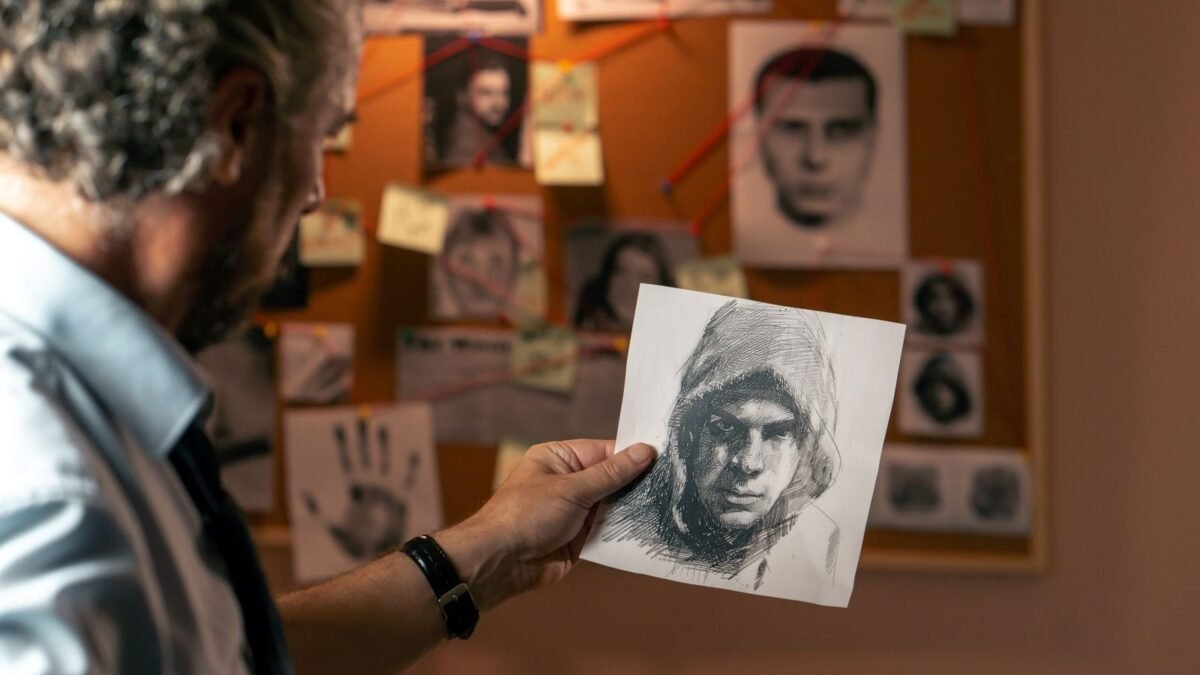
A single remembered face can transform a criminal investigation—but it can also send detectives down the wrong path. These are the top 10 criminal sketches and eyewitness descriptions that redirected searches, created false leads, or helped investigators identify suspects.
From the Zodiac case and the Oklahoma City bombing investigation to the Night Stalker and Gilgo Beach murders, each story shows why police sketches are powerful yet imperfect investigative tools. Although this subject is unrelated to irish entertainment news or the best craic in Ireland, it offers a compelling look at how memory, media coverage, and evidence interact in major cases.
Top 10 Criminal Sketches That Altered Investigations
10. The Doodler
Between 1974 and 1975, several men were murdered in San Francisco, while others survived attacks linked to a suspect known as the Doodler. Their descriptions led to a composite sketch of a slender young Black man who reportedly studied art and drew men he met in gay bars.
The sketch helped police locate a man carrying a sketchbook and a knife. However, surviving witnesses were unwilling to testify publicly because of the stigma and potential exposure they faced at the time. The investigation produced a suspect but never resulted in a conviction.
9. The Oakland County Child Killer
During the investigation into four child murders in Michigan between 1976 and 1977, a witness described a man near a blue AMC Gremlin with a white stripe. Police circulated both a composite image and a drawing of the vehicle.
Later officials questioned whether the composite combined details from different people and whether the car was even connected to the crimes. The case demonstrates how an uncertain observation can become a fixed part of public memory.
8. The Green River Killer
Witness accounts and vehicle information placed Gary Ridgway near the Green River killings. Investigators questioned him, but polygraph results in the 1980s helped reduce suspicion. DNA testing eventually changed the direction of the case, linking evidence collected in 1987 to Ridgway in 2001.
He was arrested later that year and ultimately pleaded guilty to 48 murders. The initial descriptions had brought him to investigators’ attention, but other evidence pushed him out of focus for years.
Read more: Explore top Ireland travel and culture stories and the latest Irish entertainment news and media updates.
7. “John Doe No. 2”
Following the 1995 Oklahoma City bombing, witness descriptions suggested that Timothy McVeigh may have had an accomplice when renting the Ryder truck. Investigators created a composite sketch and launched a major search for “John Doe No. 2.”
The search included people who resembled the drawing, including Army private Todd Bunting, who prosecutors later said was innocent. The sketch created a substantial investigative detour and illustrated the danger of treating an uncertain description as proof.
6. The Zodiac’s Escape
After cab driver Paul Stine was killed in San Francisco in 1969, three teenagers described the suspect. A radio error incorrectly broadcast that police were seeking a Black man.
Officers later reported seeing a white man near the scene but did not stop him because he did not match the broadcast description. The man may have been the Zodiac, although the encounter has never been conclusively resolved.
5. D.B. Cooper
The FBI created and revised composite sketches of the man who hijacked Northwest Orient Flight 305 in 1971 before parachuting from the aircraft. Internal criticism suggested that one image made Cooper look too young and did not accurately represent his complexion.
Because the sketch generated hundreds of people who resembled it, investigators risked spending time on superficial matches rather than stronger evidence. Cooper was never definitively identified.
4. The Delphi Murders
In the 2017 Delphi murders, audio and video recorded by Liberty German provided investigators with crucial evidence. Police first released a sketch showing an older man, then issued a notably different sketch in 2019.
Authorities explained that the images represented two different people and urged the public to focus on the newer version. Richard Allen was later arrested and convicted, although prosecutors said the sketches were not used to identify him.
3. The Gilgo Beach Murders
A witness connected to Amber Costello’s disappearance described a man and a green Chevrolet Avalanche. The information remained unresolved for years until a task force revisited the case in 2022.
Investigators traced vehicle-registration records and identified Rex Heuermann as a suspect. DNA and additional evidence followed. In April 2026, Heuermann pleaded guilty to seven charged murders and admitted killing an eighth woman.
2. The Description That Identified Albert DeSalvo
In 1964, a Boston woman described a man who entered her home while pretending to be a police officer. Her account helped police locate Albert DeSalvo. After his photograph appeared in newspapers, other women reported similar assaults.
DeSalvo later claimed responsibility for the Boston Strangler murders, but he was never convicted of those killings, and questions remained about his confession. The description changed an assault investigation without conclusively proving the broader allegations.
1. The Night Stalker
A composite sketch circulated during the 1985 Night Stalker investigation prompted a woman who knew Richard Ramirez to contact police. She believed he resembled the suspect shown in the image, helping investigators connect him to the attacks.
After police released Ramirez’s name and photograph, residents recognized him in East Los Angeles, chased him, and held him until officers arrived. In this case, an imperfect sketch helped convert public awareness into a decisive tip.
Explore more: Discover top places to visit in Ireland, an Ireland travel bucket list, and more Irish culture and lifestyle features.
What Do These Criminal Sketches Show?
These cases reveal that eyewitness descriptions are starting points, not final proof. A sketch can generate a vital lead, but investigators must test it against forensic evidence, records, video, DNA, and verified testimony.
- Descriptions can be affected by stress, lighting, distance, and time.
- Media coverage can make an uncertain image seem definitive.
- Vehicle details may become as influential as a suspect’s face.
- Modern forensic testing can overturn earlier assumptions.
Conclusion
These top 10 criminal sketches show how one face, phrase, or vehicle description can reshape an entire investigation. Sometimes a sketch helps identify a dangerous offender; in other cases, it creates a false trail. The key takeaway is that eyewitness memory can open a case—but corroborating evidence is what makes an identification reliable.
Article/Image Courtesy: Listverse