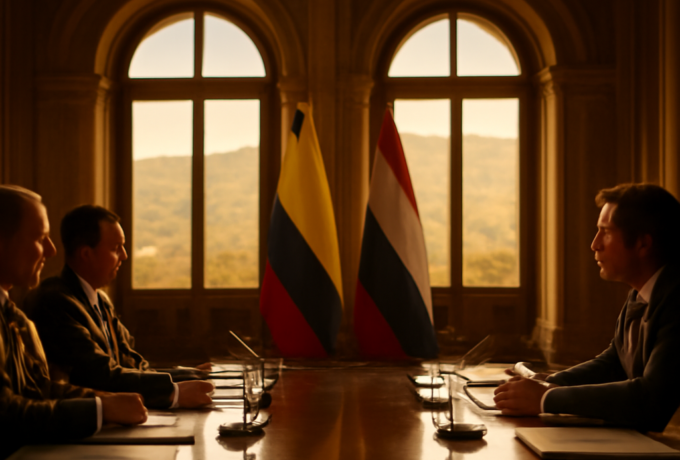
Donald Trump, Vladimir Putin and Xi Jinping have issued a joint declaration saying that nuclear war “cannot be won and must never be fought” after their first three-way presidential meeting. The 90-minute talks took place in Shenzhen, China, on the sidelines of the Asia-Pacific Economic Cooperation summit.
The meeting brought together the leaders of the United States, Russia and China at a significant moment in global diplomacy, although their public messages also revealed sharply different priorities over Ukraine, nuclear weapons and international institutions.
Trump, Putin and Xi agree on peace and nuclear risks
The declaration called for greater cooperation between the three countries and included commitments to increase the production and supply of petroleum. The leaders also said they wanted to reform the United Nations so it could respond more effectively to global challenges.
They addressed the immunity of state officials and said the International Criminal Court and similar institutions must not misuse their jurisdiction. The statement did not resolve the major disputes separating Washington, Moscow and Beijing, but it established a shared diplomatic language around peace, energy and international governance.
Trump said the three countries had a “special responsibility” to maintain dialogue because of their size and nuclear capabilities. He argued that the leaders were in a unique position to discuss reducing nuclear weapons and preventing other countries from developing them.
Different priorities behind the Shenzhen summit
Although the three presidents presented the meeting as constructive, each arrived with distinct strategic objectives.
Xi Jinping’s call for major-power cooperation
Xi said that positive engagement between major powers was not optional but a requirement. For China, hosting the meeting provided an opportunity to present itself as a central diplomatic power and to demonstrate that it could bring influential leaders together.
Chinese state broadcaster CCTV described the discussions between Xi, Trump and Putin as positive, constructive and highly productive. Xi also referred to the countries’ shared history of fighting together during the Second World War and stressed the importance of protecting peace.
Putin focuses on Ukraine and energy security
Putin highlighted the possibility of ending the war in Ukraine, as well as food and energy security. He later said Ukraine and European countries were not yet prepared to make the compromises needed for a settlement, while claiming that Russia had invited European Union representatives to Moscow to understand their position.
Those remarks came as Kyiv was experiencing another Russian drone attack. Putin has continued to reject ceasefire proposals from Ukraine and has maintained demands that Kyiv and its European allies regard as unacceptable.
The Russian president also threatened a “far more painful” response after Ukrainian attacks damaged the bridge connecting Russia with occupied Crimea. His comments did not refer to Russia’s prolonged attacks on Ukrainian infrastructure and civilian areas.
Trump and Putin revive their personal diplomacy
Trump held a separate meeting with Putin before the trilateral talks. It was their first face-to-face meeting since August 2025, and Trump referred to the Russian leader as his “friend”. He said they had already discussed the war in Ukraine and expressed hope that Putin and the other side wanted to bring the conflict to an end.
Trump also met Xi separately and described the relationship between them as “very special”. The warm public language contrasted with the unresolved disagreements over Russia’s invasion of Ukraine, nuclear proliferation and the future balance of power.
Why the summit matters beyond the declaration
The meeting was reportedly proposed by Putin and represented his first appearance at an international gathering attended by leaders from countries including Canada, Japan and Australia since Russia’s full-scale invasion of Ukraine began.
Some Russian newspapers described the summit as a diplomatic victory because it placed Putin alongside the leaders of two of the world’s most powerful countries after years of efforts by Western governments to isolate Moscow.
Putin rejected comparisons with the 1945 Yalta Conference, where the Soviet, British and American leaders met near the end of the Second World War. He argued that Yalta had formalised realities created by the war rather than dividing the world, adding that present-day conflicts would also have to be understood through realities on the ground.
A declaration without a clear Ukraine breakthrough
The joint statement offered broad commitments on peace, energy, nuclear weapons and international institutions, but it did not announce a ceasefire or a negotiated settlement in Ukraine. The public remarks instead underscored how far apart the participants remain on the conflict.
The Shenzhen talks are therefore best understood as an important diplomatic signal rather than a completed peace process. The three leaders have shown that direct engagement remains possible, but the next test will be whether their declarations produce practical steps to reduce military tensions.
Key points from the summit:
- The three leaders held their first trilateral meeting in Shenzhen.
- They declared that nuclear war must never be fought.
- They backed greater cooperation on petroleum supplies and UN reform.
- Trump and Putin discussed the war in Ukraine before the meeting.
- No ceasefire or peace agreement for Ukraine was announced.
The Trump, Putin and Xi summit marks a notable moment in world diplomacy, but its lasting significance will depend on whether the shared language of peace is followed by concrete action.