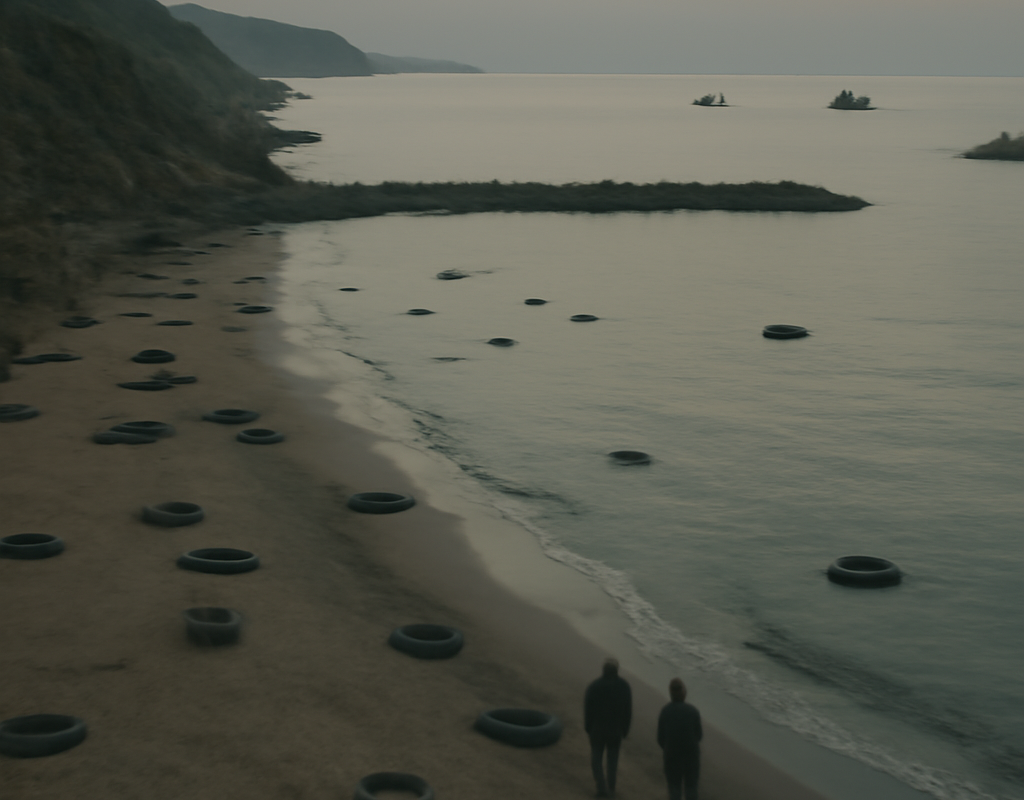
A Spanish police report is examining whether the mass migrant crossing at Ceuta’s Tarajal beach in July involved advance logistical planning, after officers identified thousands of identical inflatable rings in aerial images and photographs.
The report estimates that between 8,000 and 10,000 black inflatable rings with a printed design were used during the crossing. Investigators say the volume and uniform appearance of the equipment raise questions about how it was obtained and distributed before migrants entered the water.
Why the inflatable rings matter in the Ceuta investigation
According to the report, officers considered it unlikely that the migrants themselves could have bought so many identical rings from shops or online retailers on the same day. The assessment is based on the apparent lack of available stock for a sudden purchase of thousands of units.
Instead, the analysis points to the possibility that a large batch was acquired earlier and later distributed at selected locations. That remains an investigative theory rather than a completed finding, and the report does not establish who may have purchased, transported or supplied the rings.
Images taken from the air, along the border area and from social media show the rings being widely used during the crossing. However, investigators have not been able to identify a specific shop or supplier from the available photographs.
Different accounts about where the rings came from
People interviewed after the crossing gave differing accounts. Some said they bought the rings in Fnideq, the Moroccan town near Ceuta, while others said they obtained them on Tarajal beach before reaching the breakwater.
Those accounts may help investigators establish how the equipment reached the crossing area, but the information provided so far does not confirm a coordinated supply operation. The central question is whether the rings were bought individually, gathered through several sellers or distributed through a pre-arranged network.
Judge seeks details of maritime rescues
National Court judge María Tardón has requested information from the Maritime Rescue Coordination Centre in Tarifa about rescues carried out on 30 and 31 July, when the mass crossing took place.
The request includes:
- The times and locations of the rescues
- The identities of people brought to safety
- The rescue units involved
These records could help establish the sequence of events, the number of people assisted at different points and the role played by rescue services during the crossing. They may also allow investigators to compare official rescue data with photographs and videos from the beach and breakwater.
Investigation also focuses on a Ford Focus
The judge has separately asked Hazte Oír, which has joined the proceedings as a popular prosecution, to provide photographs and videos of a Ford Focus with a Spanish registration plate.
According to the complaint, the vehicle was parked on the Tarajal breakwater during the early hours of 30 July. Its two occupants allegedly assisted some of the people attempting the crossing, although the available report does not establish the identities of those individuals or the full nature of their actions.
Investigators are seeking clearer images to identify the occupants and determine what assistance was provided. As with the inflatable-ring evidence, those questions form part of an ongoing judicial inquiry and should not be treated as proof of wrongdoing.
What the evidence shows so far
The case combines visual analysis, witness accounts and official rescue records. The thousands of matching rings are the most unusual element described in the report, but their presence alone does not prove who organised or financed their use.
The next stage will depend on whether maritime rescue records, photographs and videos can connect the equipment and the people seen at the breakwater to a wider chain of events. Until that evidence is assessed by the court, the claims remain allegations and investigative leads.
Key takeaway from the Ceuta crossing inquiry
The Ceuta investigation is examining whether the widespread use of identical inflatable rings indicates advance preparation for the July crossing. A judge is also seeking rescue records and images of two people linked to a vehicle at the Tarajal breakwater. The court’s requests may clarify how the crossing unfolded, but no final conclusions about organisation or responsibility have been reported.