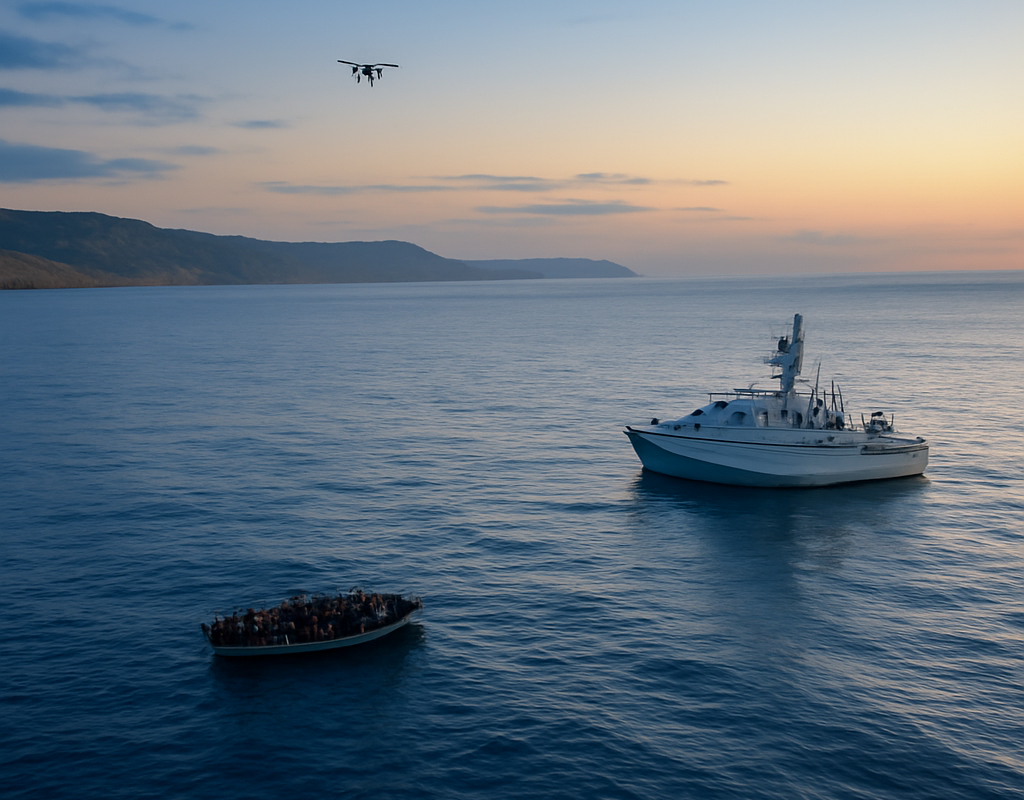
Crete is becoming one of Europe’s busiest and most dangerous maritime migration routes. New EU news from the island shows how Frontex patrol vessels, aircraft and drones are supporting Greek authorities as arrivals from Libya increase and rescue teams face mounting pressure.
Frontex operation responds to rising arrivals in Crete
About 24,000 migrants reached Crete during the first 10 months of 2026, compared with roughly 17,000 across the whole of 2025. Most boats are reported to leave eastern Libya and travel hundreds of kilometres across open water towards Gavdos or Crete’s southern coast.
The increase comes even as irregular migration is declining on several other routes into the European Union. For Greek authorities and Frontex, the shift has made the waters south of Crete a key focus of Europe’s border and rescue operations.
Frontex, formally the European Border and Coast Guard Agency, provides vessels, aircraft, surveillance equipment and personnel in cooperation with Greece. Greek authorities retain operational command, while the agency assists with monitoring, maritime responses and return operations involving people without a legal right to remain in the EU.
Search for missing migrants highlights dangers at sea
The risks of the route were illustrated during a search operation near Chrissi Island on 4 November. A migrant found alone on the island, about 15 kilometres from Crete’s southern coast, said he had travelled with around 60 other people. His account prompted a wider search for those who might still be missing.
Local Coast Guard officials in Heraklion said that 13 boats carrying approximately 400 migrants had entered their area of responsibility over a 48-hour period. Around 20 people were also found dead during the same period, underscoring the severe human cost of the journey.
Rescue work can be particularly difficult when boats are overcrowded, poorly equipped or affected by changing weather. People on board may have little experience at sea, while sudden movement can destabilise an already unsafe vessel.
What patrol crews face during rescues
One of the vessels supporting Greek operations is the Latvian patrol ship Valpas. Its 20-member crew typically spends 72 hours at a time on patrol, with the ship serving as both workplace and temporary home. The vessel has operated south of Crete for approximately 18 months.
Captain Ozers described the danger of passengers standing at the same time during a rescue, which can cause a boat to capsize. He recalled an operation in which two people fell overboard at night. The crew used lifebuoys and flotation devices while first securing the larger group, then manoeuvred towards those in the water.
Weather adds another layer of risk. Boats may depart in calm conditions before encountering stronger winds and rougher seas. Coast Guard Commander Ioannis Orphanos said the area is vast, conditions can be adverse and some passengers may not know how to swim.
Drone surveillance gives Frontex an earlier warning
Frontex’s maritime operation also depends on aerial monitoring. At Tympaki airfield, the agency operates a Heron 1 long-endurance surveillance drone equipped with radar, high-resolution cameras and thermal imaging.
The drone can remain airborne for more than 20 hours, allowing it to monitor extensive areas of the Libyan Sea during both daylight and darkness. Live images are transmitted to the Hellenic Coast Guard’s operations centre in Piraeus and to Frontex headquarters in Warsaw. Greek authorities continue to direct the operational response.
Early detection is important because many vessels used by smuggling networks are not seaworthy. Faulty engines, overcrowding and poor weather can quickly turn a crossing into a sinking or mass-rescue emergency. Finding boats sooner can give crews more time to coordinate assistance and bring passengers to safety.
Temporary accommodation facilities face pressure
People arriving on Crete are transferred to four tightly controlled temporary accommodation facilities while they await transport to mainland Greece. Continued arrivals are placing pressure on the island’s capacity to manage new cases.
The situation is also creating political and social tensions. Some residents and local authorities oppose migrants remaining in their communities, adding to the operational challenge facing Greece. Crete must therefore manage both the immediate demands of maritime arrivals and growing resistance on land.
What the Crete route means for European migration policy
The developments are relevant to wider European migration policy, including border surveillance, search and rescue, reception capacity and cooperation with countries outside the EU. More patrols and better technology may improve the chances of detecting boats, but they do not remove the dangers of the journey or address why people attempt the crossing.
For readers following Europe news today, the Crete operation shows how quickly migration pressure can shift between routes. It also highlights the balance Frontex and national authorities must maintain: controlling the EU’s external borders while responding to emergencies and protecting lives at sea.
Conclusion
Frontex patrols around Crete are expanding in response to a sharp rise in arrivals from Libya, but the continued crossings demonstrate that surveillance alone cannot resolve the crisis. The central test for the EU is whether its border operations can combine effective monitoring, adequate reception arrangements and a reliable commitment to maritime rescue.