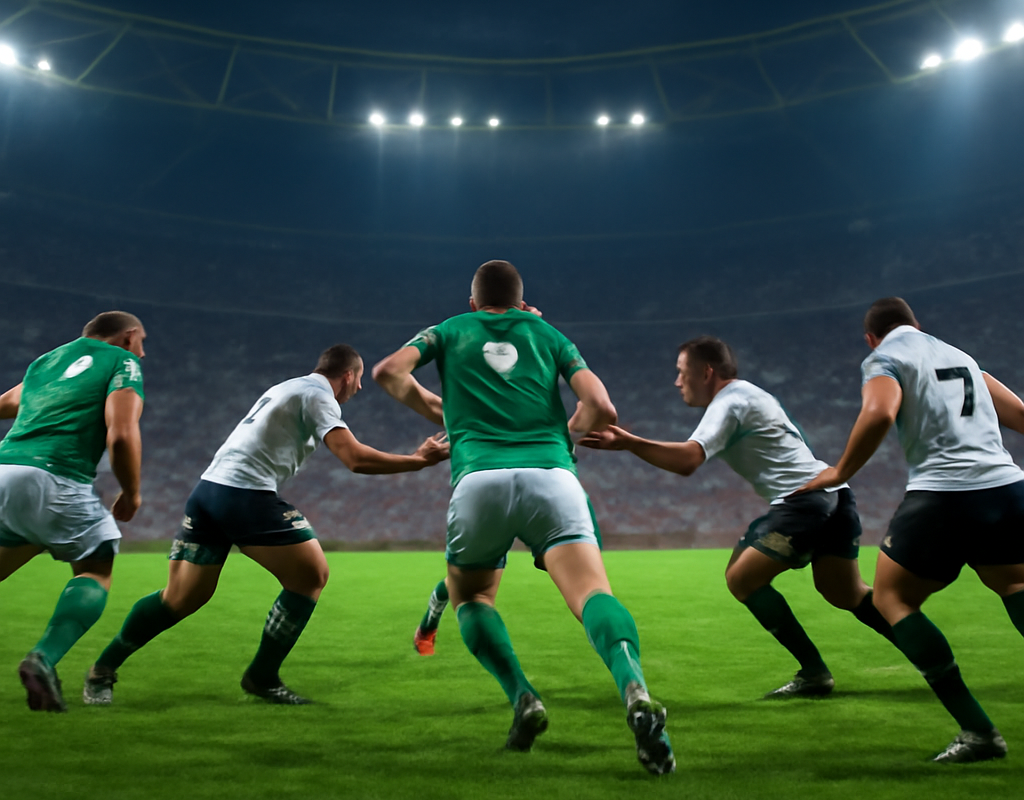
Ireland recovered from a testing first half to defeat Fiji 43-15 in their Nations Championship meeting at the Aviva Stadium on Saturday night. The result gives Andy Farrell’s side valuable momentum before their upcoming test against the world champion Springboks.
Fiji posed a serious challenge for long periods, leading 12-7 during the opening half-hour before Ireland edged in front. Ireland were only 17-15 ahead at half-time, but a far more authoritative second-half performance produced four unanswered tries and settled the contest.
Ireland’s second-half control proves decisive
The match was far less straightforward than the final score suggests. Fiji brought speed, physicality and attacking ambition, exploiting gaps around the breakdown and forcing Ireland into a loose, unsettled contest.
Once Ireland improved their control after the interval, however, their set piece and defensive pressure began to tell. Ronan Kelleher, Andrew Porter, Tommy O’Brien and Nick Timoney all crossed in the second half as Ireland steadily pulled away.
- Half-time score: Ireland 17-15 Fiji
- Final score: Ireland 43-15 Fiji
- Ireland try-scorers: Tommy O’Brien, Rob Baloucoune, Ronan Kelleher, Andrew Porter and Nick Timoney
- Fiji try-scorers: Josua Tuisova and Peceli Yato
Baloucoune and O’Brien provide the attacking spark
Rob Baloucoune was one of Ireland’s most dangerous players, scoring twice before the break. His pace and finishing gave Ireland an important outlet while Fiji were enjoying their strongest spell.
Tommy O’Brien also scored two tries, opening the scoring and adding another in the second half. The first came after Ireland moved the ball smartly from a lineout, with Mack Hansen creating the space for O’Brien to finish on the edge.
Sam Prendergast played a prominent role in Ireland’s attacking shape. Although his goal-kicking was inconsistent at times, his passing created several opportunities, including the move that sent Baloucoune over for his second try. He also produced an inventive grubber for O’Brien’s later score.
Fiji punish Ireland’s lapses before the break
Ireland appeared ready to take control after O’Brien’s early try, but Fiji responded with two scores in a short spell. Tuisova powered through the Irish defence after a strong Fijian attack, while Yato finished another move after Ireland struggled to resource the breakdown.
The visitors’ pressure exposed some problems in Ireland’s defensive organisation and ruck work. Ireland also had two disputed grounding decisions reviewed by the television match official, adding to the sense of frustration during a chaotic passage of play.
Fiji remained within two points at half-time after Ben Volavola converted a late penalty. That score ensured Ireland had no room for complacency when the teams returned for the second half.
Set-piece strength and bench impact turn the game
Ireland’s scrum was a major positive, particularly with South Africa next on the schedule. The pressure generated by the front row helped create territory and possession, while Kelleher’s try after a lineout maul extended Ireland’s lead soon after the restart.
Andrew Porter then finished from close range after Ireland sustained pressure near the Fijian line. The score moved Ireland 29-15 ahead and marked the point at which the result began to look secure.
James McNabney made an immediate impact after coming on, carrying strongly and adding intensity to Ireland’s defence. His involvement was cut short when he was forced off for a head injury assessment following contact with replacement prop Inoke Ravuiwasa, who was shown a yellow card.
Darragh Murray and Craig Casey also added energy from the bench as Ireland continued to stretch Fiji. Timoney, who had returned after McNabney’s departure, capped his influential performance with Ireland’s final try in the closing stages.
Jamie Osborne injury adds concern
The main injury concern for Ireland was Jamie Osborne, who left the field inside the opening four minutes with an apparent problem around his right pectoral area. Stuart McCloskey replaced him, with Bundee Aki moving to outside centre.
James McNabney’s departure after his head injury assessment was another setback, although the wider Irish squad avoided further apparent knocks in a physically demanding match.
What Ireland’s win means before the Springboks
Ireland will take confidence from the way they eventually subdued a much-improved Fiji side. Their scrum functioned well, several senior players produced strong performances and the attack showed variety through passing, kicking and width.
There are still areas to refine. Ireland lost control for stretches, conceded two tries from defensive lapses and faced difficult moments at the breakdown. Those issues will be tested even more severely against South Africa.
Still, a 43-15 victory provides an encouraging platform. Ireland’s ability to turn a close contest into a comfortable win was the defining feature of the night, and the next challenge will reveal how far that progress has taken them.
Key takeaway from Ireland’s Fiji victory
Ireland’s 43-15 win over Fiji was built on a decisive second-half surge, a powerful scrum and excellent contributions from Baloucoune, O’Brien, Porter and Timoney. The performance was not flawless, but Ireland found the control required to secure an important Nations Championship victory before facing the Springboks.