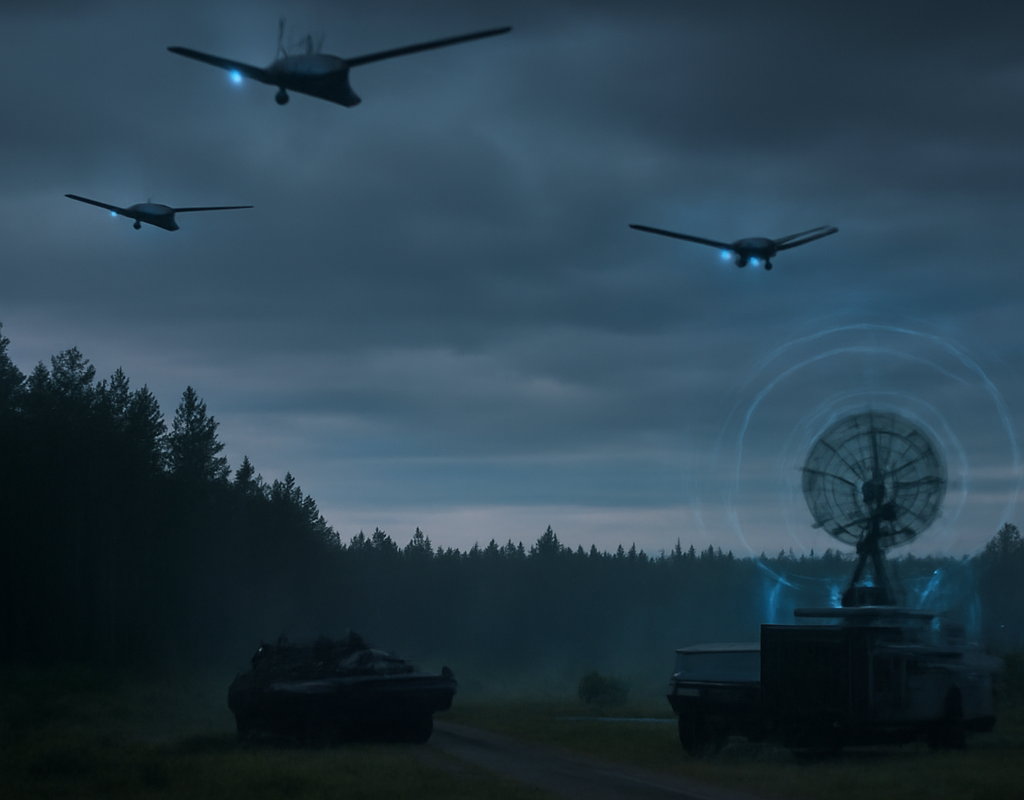
Germany is testing kamikaze drones and artificial intelligence-assisted targeting systems in Lithuania as the Bundeswehr prepares for a more technology-driven approach to defending NATO’s eastern flank. The trials took place near the Belarusian border during the multinational Freedom Shield exercise.
The tests reflect wider European defence efforts to combine unmanned aircraft, battlefield sensors and human decision-making. They also show how Lithuania’s strategic position is shaping Germany’s military planning as Berlin prepares to station a permanent combat brigade there.
Germany tests loitering munitions near Belarus
German troops conducted the trials at the Rūdninkai military training area, close to Lithuania’s border with Belarus. The exercise involved loitering munitions developed by German defence technology companies Helsing and Stark Defence.
Often called kamikaze drones, loitering munitions can remain airborne while searching for a target. Once an authorised engagement is made, the aircraft dives into the target and destroys itself. During the Lithuanian trials, the drones were used against simulated armoured vehicles with inert warheads rather than live explosives.
The Bundeswehr is assessing how the systems could work alongside existing military capabilities, including:
- artillery and precision fires;
- reconnaissance drones and surveillance platforms;
- armoured formations; and
- command-and-control systems.
Compared with a conventional missile launched at a preselected target, a loitering munition can give operators more time to observe changing battlefield conditions before an attack is authorised. That flexibility has increased interest in the technology across Europe.
What the drone trials reveal about modern warfare
The war in Ukraine has demonstrated how unmanned systems can threaten tanks, artillery, supply vehicles and other high-value equipment. Relatively low-cost drones have become a central part of battlefield operations, forcing armies to rethink how they protect conventional forces.
However, combat experience has also exposed important weaknesses. Drones can be disrupted by electronic warfare, lose communications or be intercepted by counter-drone systems. As a result, military planners are not treating unmanned weapons as a standalone solution.
The German trials are instead focused on integration: determining how drones can support artillery, reconnaissance and manoeuvre units while operating in an environment where communications may be contested.
AI platform tested alongside unmanned weapons
German personnel also evaluated Clarity, an artificial intelligence-supported military intelligence and targeting platform developed by Helsing. The system is designed to process information from multiple sources, potentially including drones, surveillance equipment and other battlefield sensors.
AI-assisted software may help military personnel identify relevant activity more quickly by sorting large volumes of data and presenting commanders with a clearer operational picture. In theory, this could shorten the time between detecting a potential target and deciding how to respond.
Human authorisation remains central to the process described in the trials. The technology is being assessed as a decision-support tool rather than as a replacement for military commanders. Its usefulness will depend on the quality of the data, the reliability of communications and the ability of personnel to recognise inaccurate or incomplete information.
Why Lithuania matters to Germany’s defence plans
Lithuania occupies a strategically sensitive position on NATO’s eastern frontier. It borders Belarus, a close Russian ally, and lies near Russia’s heavily militarised Kaliningrad region.
Germany has committed to permanently stationing a combat brigade in Lithuania. Panzerbrigade 45 is expected to reach full operational capability by 2027, with around 5,000 military personnel and supporting civilian staff. The formation is intended to reinforce Lithuania’s defence and strengthen NATO’s deterrence posture in the region.
Testing new systems in Lithuania gives German forces an opportunity to examine equipment in an environment connected to their future operational responsibilities. Freedom Shield also includes manoeuvre operations, electronic warfare and cooperation between different military branches.
Europe’s wider shift towards technology-led defence
The exercise comes as European governments focus on military readiness, ammunition production and the protection of NATO territory. Germany’s drone and AI work forms part of a broader debate about how traditional forces should adapt to a battlefield shaped by sensors, electronic warfare and autonomous or remotely operated systems.
Russia has rejected claims that it plans to attack NATO territory and has criticised the alliance’s military expansion near its borders. Nevertheless, the opposing positions have increased the strategic importance of exercises and deployments in countries such as Lithuania.
The Bundeswehr’s tests do not yet establish how effective the systems will be in combat. German officials have acknowledged that battlefield drone success rates can be substantially lower than selective footage of successful strikes may suggest. The trials are therefore intended to provide practical evidence about performance, limitations and integration.
Key takeaway from Germany’s Lithuania trials
Germany’s kamikaze drone trials in Lithuania show that European defence planning is moving beyond traditional platforms. The future effectiveness of NATO forces may depend on how well they connect drones, sensors, AI-supported analysis and human judgement. The technology offers potential advantages, but its real value will be measured by reliability under electronic interference, operational pressure and changing battlefield conditions.