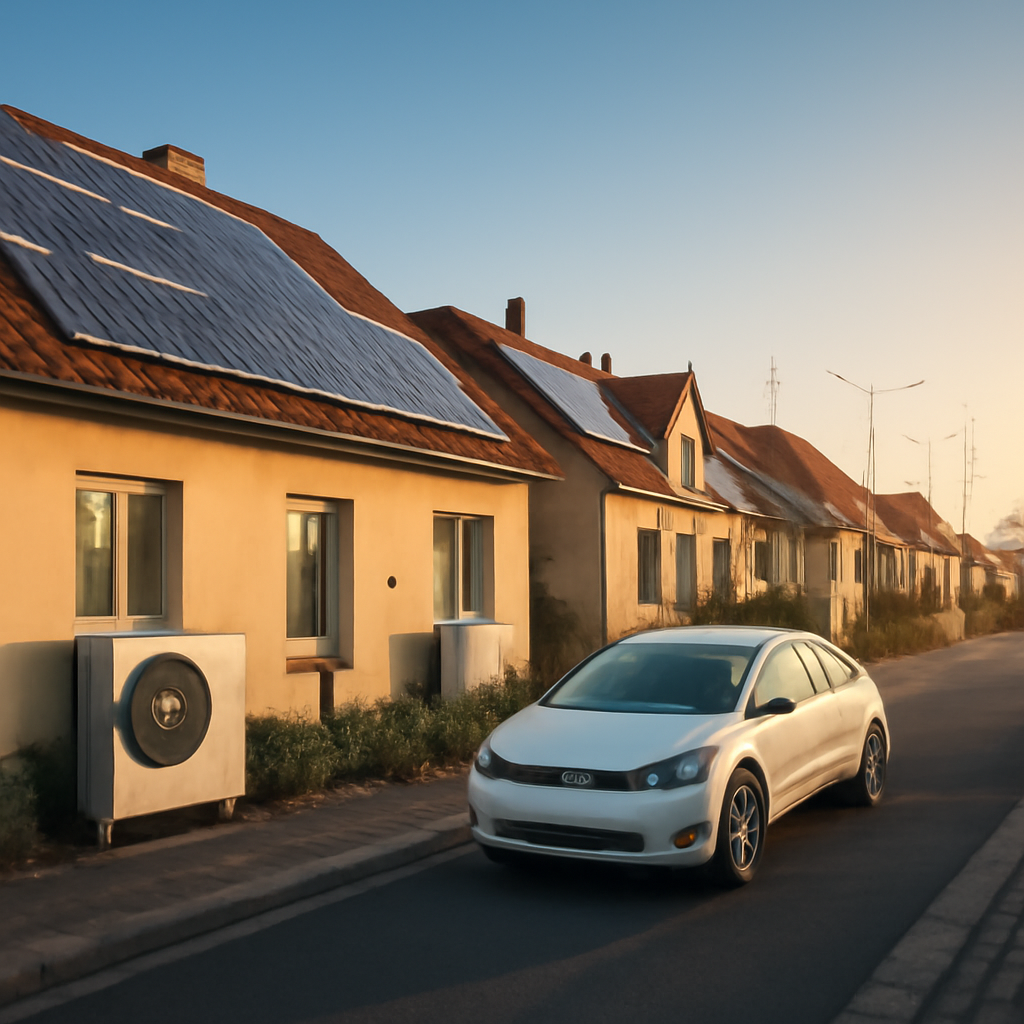
Europe’s energy transition is increasingly being built into everyday life, from household heat pumps and rooftop solar to electric vehicles that can support the power grid. The latest EU news in the clean-technology space points to a wider shift: reducing fossil-fuel use now depends not only on large wind and solar farms, but also on smarter homes, better batteries and more flexible infrastructure.
Recent developments highlighted across Europe show both the opportunities and the obstacles. High installation costs, grid bottlenecks, recycling challenges and uneven national policies continue to slow progress, even as new technologies offer potential savings and lower emissions.
Heat pumps and solar are changing household energy use
Heat pumps are becoming an important tool for Europeans seeking alternatives to expensive gas heating. By moving heat from the air or ground into a building, the systems can provide heating with electricity rather than relying directly on fossil fuels. Their performance and financial value depend on installation costs, building efficiency, electricity prices and available national support.
Rooftop solar is another central part of Europe’s clean-energy transition. Although solar panels can reduce dependence on electricity from the grid, adoption remains uneven across countries and households. Pairing panels with batteries or heat pumps can allow more locally generated power to be used at home, rather than exported when demand is low.
Solar installations can also provide less obvious benefits. Panels may shade roofs and help reduce indoor temperatures during hot weather, while solar car parks can combine vehicle storage with electricity generation. These projects illustrate how clean-energy infrastructure can be integrated into existing urban spaces.
Electric vehicles could become part of the power system
Electric vehicles are usually discussed as a transport solution, but their batteries may also help manage demand on Europe’s electricity networks. With vehicle-to-grid technology, compatible cars could return electricity to a home or the wider grid during a supply interruption or a period of high demand.
This approach could give EV owners an additional use for their vehicles, but it requires suitable chargers, technical standards, electricity-market arrangements and safeguards for battery life. It is not yet a universal feature of electric cars, and availability will vary by manufacturer, country and energy provider.
The growing number of electric vehicles also creates a major recycling challenge. Batteries contain valuable materials that can potentially be recovered, but recycling capacity and collection systems must expand as more first-generation EV batteries reach the end of their useful service. Reusing older batteries for stationary energy storage is another possible route before recycling.
Europe’s clean-energy challenge is also a grid challenge
More wind and solar capacity does not automatically mean that all generated electricity can be used. Renewable projects can face long connection queues, while transmission networks may lack the capacity to carry power to where it is needed. At times, operators may have to reduce renewable output, a process known as curtailment.
That problem has encouraged discussion of a more flexible energy system combining:
- Grid expansion and faster connections for renewable projects
- Large-scale and household battery storage
- Smart meters that help match consumption with supply
- Flexible demand from heating, charging and industry
- Better coordination between electricity networks and national markets
Smart meters can help households see when electricity is being used and, where market arrangements permit, shift consumption to cheaper or cleaner periods. However, installation rates remain very different across European countries, showing that the energy transition is also an issue of national implementation and consumer access.
Waste heat and new technologies offer untapped potential
Europe also loses large amounts of energy as waste heat from factories, data centres, transport systems and buildings. Capturing and reusing that heat could reduce demand for new fuel and improve the efficiency of district-heating networks. The practical value depends on whether a suitable heat source is close enough to homes or businesses and whether the necessary infrastructure exists.
Other projects are exploring less conventional solutions. Researchers and companies are investigating ways to produce solar power in marine environments, harvest water from dry air and use biological processes to replace petrochemical dyes. These technologies are at different stages of development and should not be treated as immediate replacements for established energy systems.
What does the clean-energy shift mean for Europe?
The developments covered in current European news reveal a common pattern: technology alone cannot deliver the transition. Public policy, planning decisions, consumer incentives, electricity-market design and investment in networks will determine how quickly innovations move from pilot projects into widespread use.
For households, the biggest benefits may come from combining measures rather than adopting one technology in isolation. A well-insulated home with solar generation, a heat pump, smart controls and battery storage can use electricity more efficiently, although the upfront expense may remain a barrier.
For businesses and governments, the priority is to create the conditions for investment while ensuring that the costs and benefits are shared fairly. This includes permitting renewable projects, upgrading grids, supporting recycling and protecting consumers from misleading claims about savings.
Conclusion
The latest EU news on clean technology is less about one breakthrough than about connecting many solutions. Heat pumps, rooftop solar, smart meters, electric-vehicle batteries and waste-heat systems could collectively make Europe’s energy system more efficient and resilient. The decisive next step will be turning promising projects into affordable, reliable infrastructure that households and businesses can use at scale.