

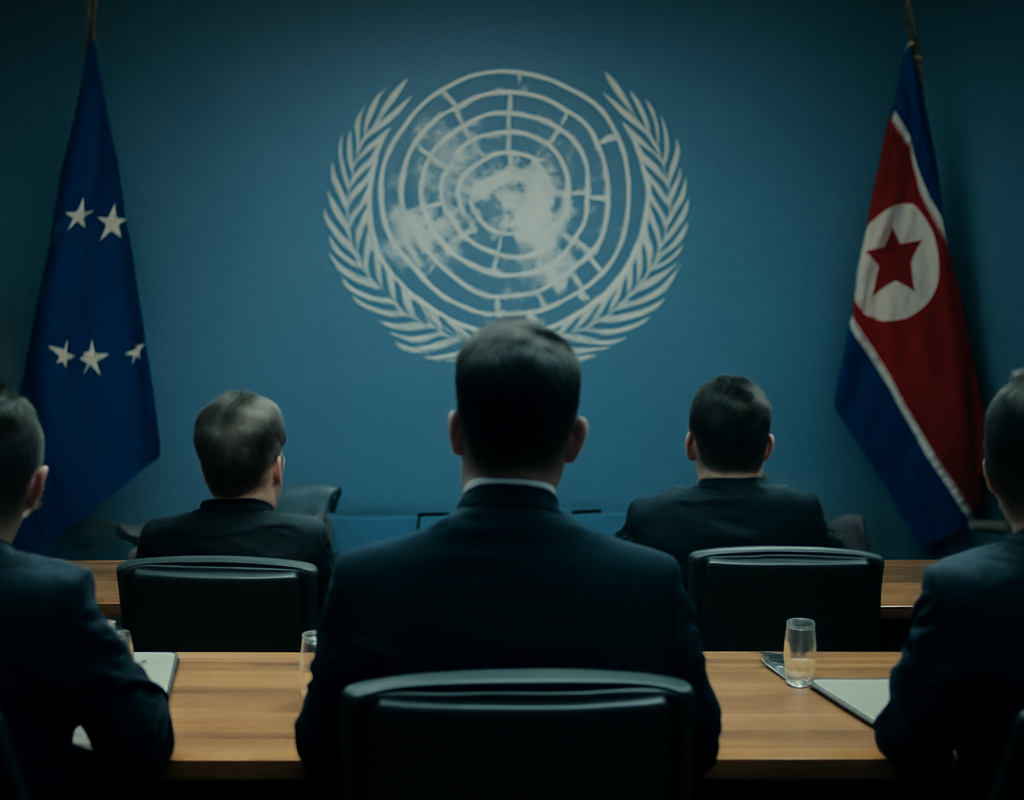
North Korea has criticised the European Union over a draft United Nations resolution on its human rights record, accusing the bloc of political provocation and telling it to “mind its own business”. The dispute is expected to move forward at the UN General Assembly later this month.
The statement, carried by North Korea’s official Korean Central News Agency on 5 November 2026, reflects a long-running confrontation between Pyongyang and Western governments over allegations of serious rights violations. The EU-backed text is expected to be considered first by the General Assembly’s Third Committee before going to the full assembly for approval.
What North Korea said about the EU draft
North Korea’s mission to the United Nations said the European Union had again submitted a draft resolution that “flagrantly” distorted the country’s human rights policies and situation. It described the initiative as a “farce” and a politically motivated provocation.
The statement also rejected the idea that Western countries had a special authority to define or defend human rights. North Korean officials pointed to demonstrations and social problems in European cities, including Paris and Brussels, arguing that the EU should address its own alleged shortcomings rather than criticise Pyongyang.
The comments represent North Korea’s position and do not alter the status of the UN process. The draft remains subject to consideration by UN member states, and the full General Assembly has yet to vote on it.
How the UN process works
The resolution is expected to be discussed by the Third Committee, the General Assembly body responsible for social, humanitarian and cultural issues, including human rights. If approved there, the text would proceed to the full General Assembly for a final vote.
That procedure means the current measure is not yet a formally adopted UN General Assembly resolution. The draft may still be debated, amended or opposed before the process concludes.
The General Assembly has adopted resolutions condemning North Korea’s human rights record annually since 2005. Such resolutions are politically significant but are not the same as binding decisions by the UN Security Council.
What the resolution is expected to address
North Korea has faced repeated criticism from UN bodies and rights organisations over allegations including:
- Restrictions on freedom of expression and access to information
- Severe limits on political and civic activity
- Alleged prison camps and other forms of detention
- Limited transparency surrounding the criminal justice system
- Broader concerns about the treatment of people held by the state
North Korea rejects these allegations and routinely accuses foreign governments of using human rights as a tool of political pressure. The latest statement follows that established diplomatic pattern.
UN assessment of North Korea’s rights record
The Office of the United Nations High Commissioner for Human Rights said last year that the human rights situation in North Korea had not improved over the previous decade and had worsened in several respects. That assessment forms part of the wider international record cited by governments supporting continued scrutiny of the country.
North Korea, formally the Democratic People’s Republic of Korea, disputes the findings and maintains that outside criticism is politically motivated. The country’s limited openness makes independent assessment difficult, particularly in relation to detention, judicial procedures and conditions inside state institutions.
Why the EU’s role matters
The dispute is part of the EU’s broader foreign policy and human rights work. The bloc regularly raises human rights concerns in international institutions and uses multilateral forums to support scrutiny of countries accused of serious violations.
In this case, the EU is involved in promoting and supporting a draft UN text rather than unilaterally imposing a new EU law or sanction. The eventual wording and outcome will depend on the UN General Assembly process and the positions taken by member states.
The development is relevant to European affairs because it highlights the EU’s diplomatic approach towards North Korea, a country with which the bloc has longstanding disagreements over human rights, security and its nuclear programme. It also illustrates the limits of diplomatic language: the EU can help bring a resolution forward, but enforcement depends on the wider international response.
What happens next?
The anticipated sequence is:
- The draft is considered by the UN General Assembly’s Third Committee.
- Member states debate the text and may propose changes.
- If the committee adopts the draft, it is sent to the full General Assembly.
- The General Assembly holds a final vote later in the process.
Until that vote takes place, the resolution should be described as a draft rather than an adopted UN decision. North Korea is expected to continue opposing the initiative and defending its own record.
Conclusion
The latest EU human rights dispute with North Korea centres on a draft UN resolution, not a final international ruling. The EU is helping advance scrutiny of Pyongyang’s record, while North Korea has rejected the criticism as political interference. The next significant step will be the Third Committee’s consideration, followed by a vote of the full UN General Assembly if the draft progresses.