

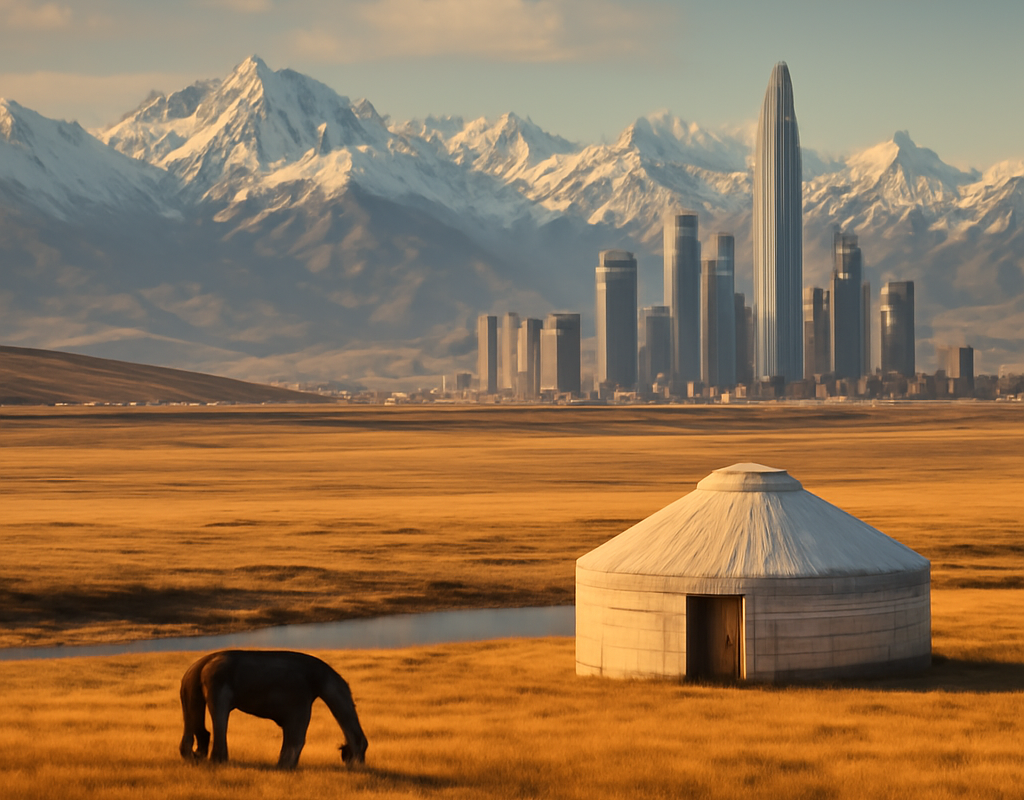
Standfirst: Euronews’ Modern Nomads series presents Kazakhstan through its traditions, natural landscapes and fast-changing cities. The partnership-led editorial project moves from nomadic heritage and UNESCO sites to artificial intelligence, tourism, sport and the creative industries.
From fermented mare’s milk and ancient manuscripts to alpine lakes, music festivals and a Soviet-era spaceport, Modern Nomads offers a wide-ranging portrait of Kazakhstan. The series places the Central Asian country’s cultural inheritance alongside its ambitions in technology, tourism, environmental protection and international exchange.
A series connecting tradition with contemporary Kazakhstan
Produced in partnership with MDQ, the programme follows a reporter travelling across Kazakhstan to explore how history and modern development coexist. Rather than presenting the country through a single theme, the episodes examine different aspects of its identity, including food, religion, sport, heritage, nature and urban life.
The result is a broad editorial window into a country shaped by nomadic traditions but increasingly presented as a regional centre for business, education, culture and innovation. Episodes set in Astana and Almaty sit alongside reports from remote landscapes and historic locations.
From the steppe to UNESCO heritage
Several episodes focus on Kazakhstan’s historical and cultural landmarks. Turkistan is presented as a major centre of religious and cultural heritage, with attention to its ancient streets, mausoleum, historic baths and newer visitor attractions.
Another episode examines rock-hewn mosques that have received UNESCO recognition, while others explore rare manuscripts, archaeological discoveries and the memory of victims of Soviet-era famine and political repression.
The series also highlights cultural practices that have survived across generations:
- Kymyz: fermented mare’s milk, described as a traditional Central Asian drink with a long history in Kazakh hospitality and nomadic culture.
- Kazakh cuisine: a food tradition combining dairy and meat-based dishes with contemporary culinary influences.
- Puppet theatre and opera: artistic forms being adapted for new audiences while retaining links to national stories and customs.
- The Tazy: a Kazakh sighthound presented as both a culturally important breed and a symbol of national heritage.
Natural landscapes and responsible tourism
Nature is another central theme. Modern Nomads travels to Kolsai Lakes National Park, known for alpine scenery and protected ecosystems, and to Burabay National Park, where forests, lakes and mountain landscapes support outdoor recreation and tourism.
The series also visits the Korgalzhyn State Nature Reserve, where flamingos gather, and Katon Karagay, a remote area associated with glaciers, wildlife and pristine waters. Mangystau receives particular attention for its striking geological formations, caves and canyon landscapes, adding a tourism dimension to a region also known for its oil and gas industry and Caspian Sea location.
Environmental challenges feature alongside tourism opportunities. One episode considers efforts to change public attitudes towards waste, while another looks at the Caspian Sea and the regional concern over declining water levels. The sea is shared by Kazakhstan, Russia, Azerbaijan, Iran and Turkmenistan, making its future a matter of wider regional interest.
Astana, Almaty and Kazakhstan’s modern ambitions
The programme’s urban episodes show two different sides of contemporary Kazakhstan. Astana is explored as a capital where business travel, leisure, culture and hospitality intersect. The city is also presented as a regional hub for professionals, with attention to education, research, technology and the performing arts.
Almaty, meanwhile, is portrayed through its relationship with the mountains, contemporary art, architecture and city life. The contrast between the two cities helps explain Kazakhstan’s diverse development: one is a purpose-built political and business capital, while the other combines urban culture with access to the Tien Shan.
Technology is also part of the country’s forward-looking narrative. An episode on artificial intelligence describes plans to train one million citizens over five years, alongside the development of ALEM AI, described as Central Asia’s first International AI Centre, and the expansion of digital public services.
Sport, entertainment and international visibility
Culture in the series extends beyond museums and historic sites. Episodes cover Kazakhstan’s summer music festivals, its growing comics industry and the development of national cinema. These reports present creative industries as a way to connect local stories with international audiences.
Sport provides another route to global recognition. The programme examines Kazakhstan’s progress in chess, the return of wild horses to the steppe and the appearance of UEFA Champions League football in Almaty. The visit of Real Madrid is described as a national celebration and a boost for tourism interest.
Winter tourism is also highlighted through plans to connect ski runs across five routes and gorges in the Ile-Alatau range. Separately, Kazakhstan is developing tourism around the Baikonur Cosmodrome, the historic launch site associated with the beginning of human spaceflight, with plans involving accommodation, glamping and family facilities.
Why Modern Nomads matters
As a branded editorial series, Modern Nomads is not a conventional news investigation or a policy report. Its purpose is to introduce viewers to places, traditions and projects across Kazakhstan. The partnership label is therefore important context for readers assessing the series’ perspective.
Even so, the episodes provide a useful overview of the themes Kazakhstan is promoting internationally: cultural preservation, tourism, environmental awareness, digital skills, social inclusion and creative development. They also show the diversity of a country stretching from the Caspian Sea to the mountains and steppe of Central Asia.
Conclusion
Modern Nomads presents Kazakhstan as a country where nomadic heritage and modern ambitions are developing side by side. Its strongest takeaway is the scale of that contrast: traditional food, historic faith sites and rare wildlife appear alongside AI education, international sport, new tourism infrastructure and expanding creative industries.