

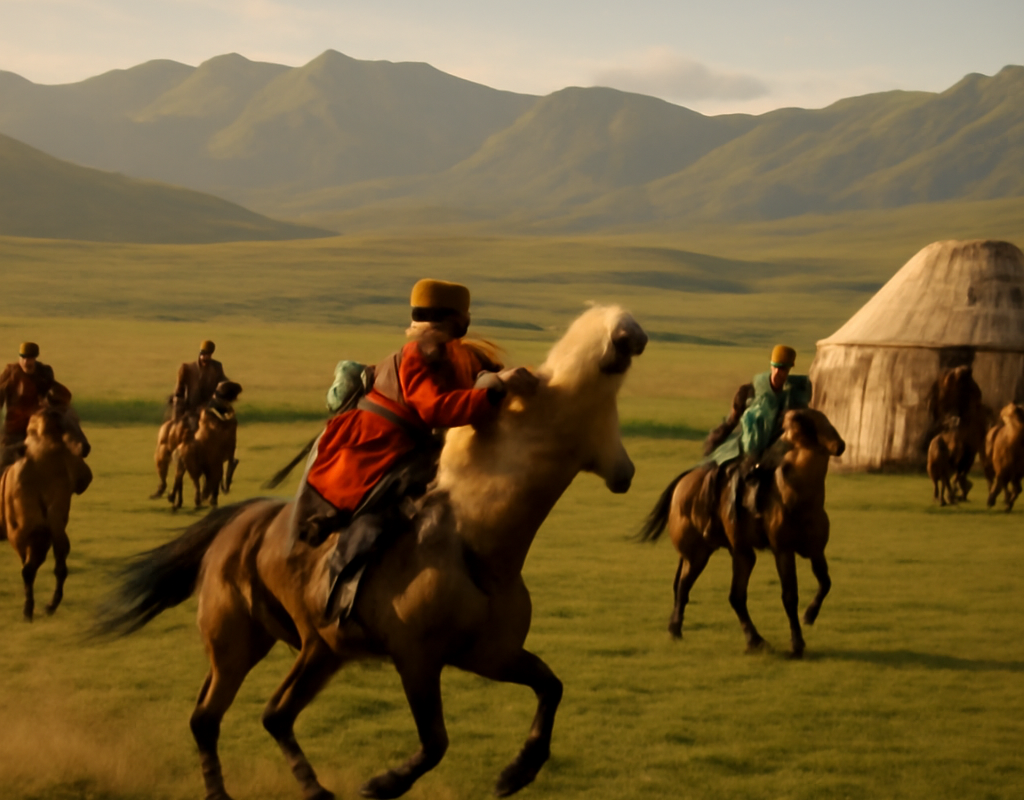
Standfirst: The World Nomad Games have transformed traditional skills shaped by life on the Central Asian steppe into an international sporting showcase. The 2026 event in Kyrgyzstan brought together more than 3,000 athletes from 109 countries across 43 sports.
What once helped nomadic communities travel, hunt, compete and defend themselves is now attracting athletes and spectators from around the world. At the sixth World Nomad Games, held in Kyrgyzstan in September 2026, horseback wrestling, endurance racing, archery and traditional games demonstrated how cultural heritage can evolve into organised international sport.
From everyday survival to international competition
The World Nomad Games began in Kyrgyzstan in 2014 as an initiative to revive and promote nomadic sports and traditions. Twelve years later, the event had grown far beyond its original regional focus. More than 3,000 competitors representing 109 countries took part in 43 disciplines.
Many participating countries do not have a direct historical connection to nomadic culture. That international reach has given the games a role not only in sport, but also in cultural diplomacy, tourism and heritage preservation.
For Kazakh, Kyrgyz, Uzbek, Turkmen, Tajik and Mongolian communities, however, these activities remain more than spectacles. They reflect skills, ceremonies and forms of social life passed from one generation to the next.
Horse and rider at the centre of traditional sports
Equestrian events are among the most recognisable features of the games. Across Central Asia, horses have long been essential to transport, hunting, communication and warfare. As a result, many traditional competitions test the combined strength, balance and coordination of horse and rider.
Kokpar and kok boru
One of the best-known events is kokpar, known as kok boru in Kyrgyzstan. In modern competition, teams of four riders compete to collect a weighted dummy carcass and carry it into a scoring circle. The dummy weighs approximately 30 to 33 kilograms, making the event a demanding test of physical power and horsemanship.
The sport continues to have a strong community following. Thousands of spectators travelled from Kazakhstan to watch the kokpar final in Kyrgyzstan, while young riders continue to learn the game as part of sporting and cultural education.
Endurance racing
Traditional Central Asian horse racing often values stamina over short-distance speed. At the 2026 games, competitors took part in a 25-kilometre race, while a separate 300-kilometre endurance marathon unfolded over three days.
These events highlight the importance of conditioning, pacing and animal welfare, as both rider and horse must manage fatigue over long distances.
Audaryspak: wrestling from the saddle
Audaryspak is a form of horseback wrestling in which two riders attempt to unseat one another while controlling their horses. Competitors push, pull and grip their opponents, combining mounted skill with upper-body strength.
The discipline has developed formal championships for young people, juniors and adults. Its growth shows how practices associated with mounted warriors can be adapted into structured competitions with rules, federations and training systems.
Wrestling traditions across the region
Wrestling remains one of the most widely practised traditional sports at the games, although its rules vary between countries.
- Mongolian bökh: Wrestlers wear the zodog and shuudag and perform a ritual dance before competing. A contest ends when a wrestler touches the ground with any part of the body above the knee.
- Kazakh kuresi: Competitors wrestle standing up while wearing jackets, aiming to throw an opponent onto their back or shoulders.
- Uzbek kurash: The discipline emphasises throws and sweeps, while ground wrestling and grips below the waist are prohibited.
The differences between these styles are part of their cultural meaning. Clothing, movement, ceremony and rules all help preserve distinct national traditions while allowing them to be presented on an international stage.
Archery preserves the techniques of mounted warriors
Traditional archery adds precision and timing to the programme. Some disciplines are practised on horseback, reflecting the techniques of warriors who once needed to fire arrows while moving at speed.
Mounted archers use specialised methods to keep arrows secure and draw the bow reliably. Thumb rings, made from materials such as leather, wood or brass, are part of the equipment used in some Central Asian traditions. These techniques differ from common European ground-archery methods and demonstrate how equipment and posture developed in response to different environments.
Traditional games teach accuracy and community values
Not every event depends on physical strength. In Kazakhstan’s Zhetysu region, schools teach games such as asyk and bes asyk to children and adults.
Asyk is played with sheep knuckle bones. Participants use one bone to strike others from a marked area, requiring accuracy, control and concentration. The game is accessible across generations and is presented as a way to develop agility and coordination.
These activities also provide a practical way to introduce younger people to cultural traditions. Schools, federations and local championships help ensure that the knowledge is not limited to performances for tourists or major festivals.
Why the World Nomad Games matter
The expansion of the World Nomad Games reflects a broader effort to protect intangible cultural heritage while making it relevant to contemporary audiences. Governments and sporting organisations across the region are supporting federations, training centres and competitions designed to increase participation.
The international format brings several benefits:
- It gives traditional sports greater visibility outside their regions of origin.
- It encourages younger generations to learn inherited skills.
- It supports cultural tourism and international exchange.
- It creates common sporting platforms while preserving national differences.
- It connects historical practices with modern rules, coaching and competition.
For many communities, the purpose is not simply to win medals or attract visitors. The revival of horse culture, wrestling, archery and traditional games is also linked to identity and historical continuity.
Conclusion
The World Nomad Games show how ancient nomadic survival skills can become modern international sports without losing their cultural meaning. From kokpar and long-distance horse racing to bökh, mounted archery and asyk, the competitions preserve a living connection to the history of the steppe while inviting athletes from across the world to participate.