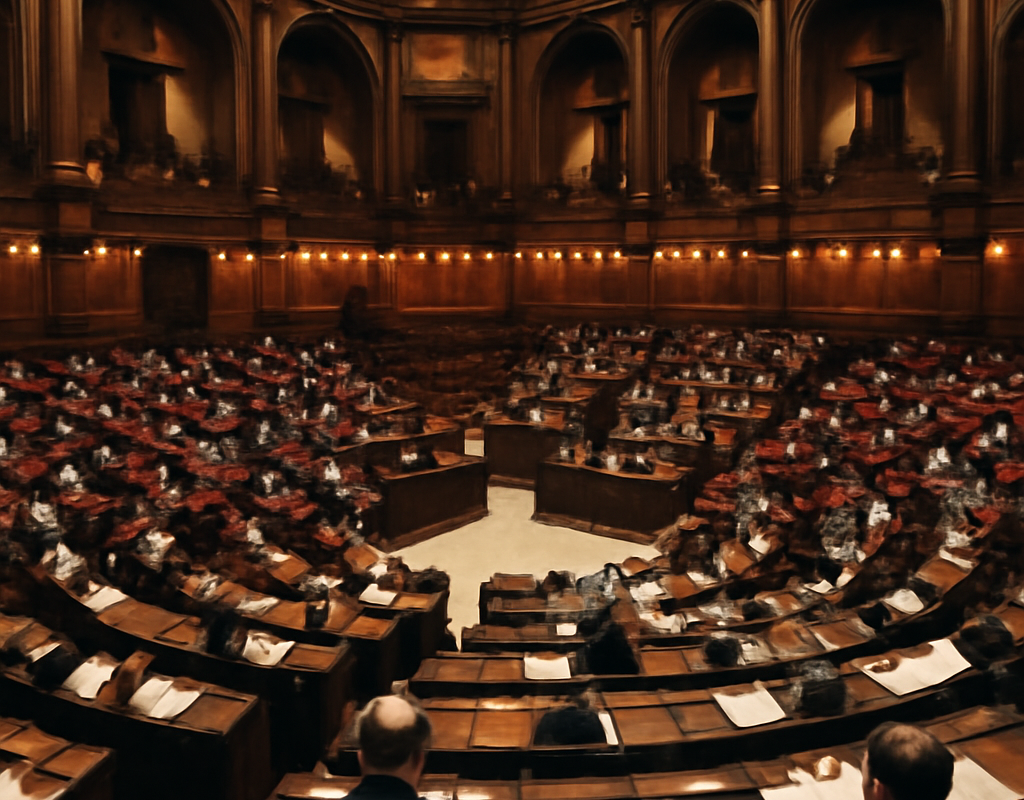
Italy’s Chamber of Deputies has given final approval to a new antisemitism law, adopting the International Holocaust Remembrance Alliance (IHRA) definition after a divisive parliamentary vote. The measure passed on 19 November with 147 votes in favour, 93 against and five abstentions, but opposition parties warned that it could blur the boundary between antisemitism and criticism of Israel’s government.
What Italy’s antisemitism law contains
The five-article bill had already been approved by the Senate in March. It states that the Italian Republic rejects all forms of antisemitism and will promote measures to combat antisemitic prejudice, while formally preserving constitutional protections for political criticism, freedom of expression, assembly and association.
The legislation also creates a national coordinator for Italy’s strategy against antisemitism. Other provisions focus on education, training and initiatives intended to prevent the spread of antisemitic hatred.
The most contentious element is the bill’s use of the IHRA working definition, adopted in 2016 alongside a series of illustrative examples. Supporters say the definition provides a practical framework for identifying antisemitic abuse and hostility towards Jewish people. Critics argue that some examples may be interpreted too broadly, potentially treating certain forms of criticism of Israel as antisemitic.
Why the vote divided Italy’s opposition
The Democratic Party voted against the bill, as did the Five Star Movement and the Green and Left Alliance (AVS). However, support for the measure crossed opposition lines. Italia Viva and Azione backed it, while Democratic Party MP Piero Fassino said he and other colleagues from the party’s reformist wing would not follow the party position.
All proposed amendments were rejected. The result exposed disagreements not only between the governing majority and opposition, but also among parties that support stronger action against antisemitism while differing over the wording used to define it.
Opposition calls for an alternative definition
Opposition MPs argued that the government should have replaced the IHRA text with another framework. Suggestions included the Council of Europe’s 2022 approach, which places greater emphasis on preventing and combating antisemitism, and the Jerusalem Declaration on Antisemitism.
The Jerusalem Declaration distinguishes between antisemitism and criticism of Israel, stating that opposition to the Israeli government or to Zionism as an ideology is not automatically antisemitic. Critics of the Italian bill say this distinction should have been written more clearly into the legislation.
AVS co-founder Angelo Bonelli described the bill as an attempt to silence criticism of Israel’s conduct and accused the government of shielding the administration of Prime Minister Benjamin Netanyahu. Democratic MP Laura Boldrini similarly argued that the legislation could censor criticism of the Israeli government rather than concentrating solely on antisemitic hatred.
Supporters reject claims of censorship
Supporters of the legislation reject the allegation that it restricts legitimate political debate. Osservatorio Israele said the bill preserves the right to criticise Israel’s government while drawing a distinction between political dissent and antisemitism.
The law’s wording explicitly refers to freedom of political criticism and freedom of expression. Its supporters therefore maintain that adopting the IHRA definition does not make criticism of Israeli policy unlawful. The dispute centres instead on how the definition and its examples may be applied by public bodies, educators and institutions.
Gaza and Italy’s fascist-era legacy enter the debate
The parliamentary discussion became particularly heated when MPs referred to the death toll in Gaza since 2023. The conflict also touched on Italy’s own history. An amendment that would have prohibited streets and monuments being named after figures associated with antisemitism was rejected.
That decision led to clashes over existing Italian streets and statues commemorating figures connected with the fascist era. The argument illustrated how the bill has become part of a wider debate involving Holocaust remembrance, historical commemoration, Israel and Palestine, and the limits of political speech.
What happens next
With final approval in the Chamber, the bill has completed its parliamentary passage. Its practical impact will depend on how the new national strategy is implemented and how public institutions interpret the IHRA definition alongside Italy’s constitutional protections.
The central question will remain whether the law can strengthen efforts against antisemitic prejudice without discouraging lawful criticism of Israeli government policy. Italy’s vote adds to a wider European debate over definitions of antisemitism and the treatment of political speech during the Israel-Gaza conflict.
Key takeaway
Italy has approved an antisemitism law based on the IHRA definition, establishing a national coordinator and education measures while retaining formal protections for political expression. The legislation’s supporters see it as a tool against antisemitic hatred; opponents fear its application could limit criticism of Israel. How that balance is maintained will determine the law’s significance in Italy’s public and political life.