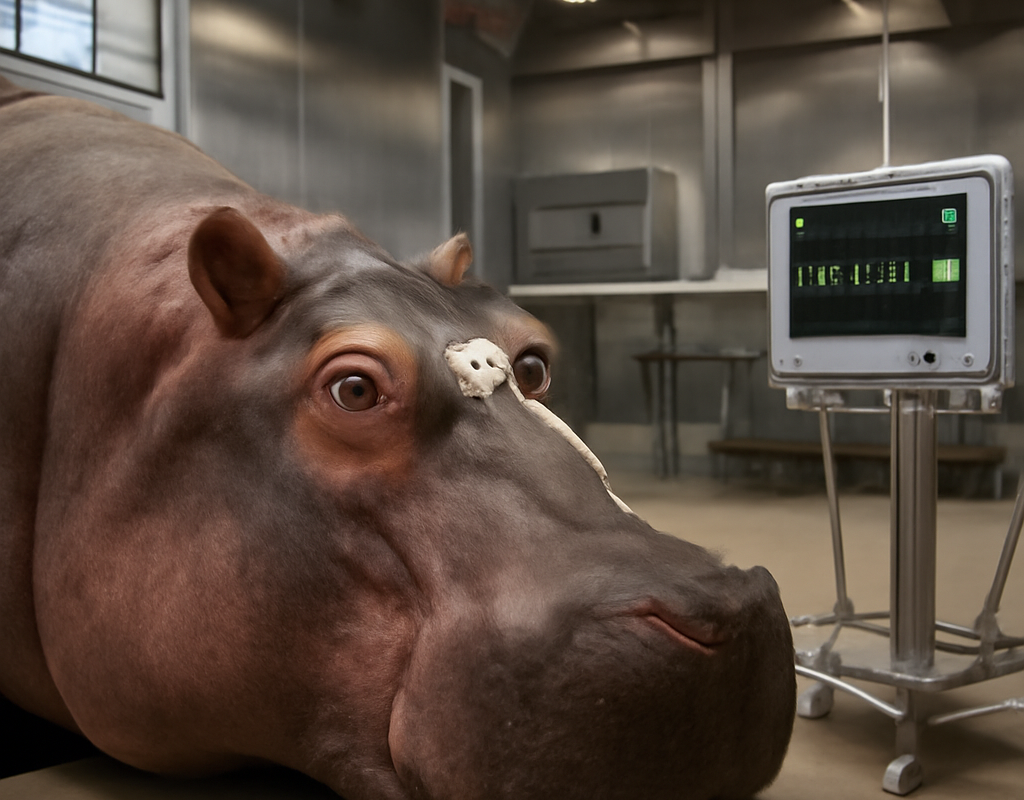
A pioneering operation at Dublin Zoo has restored vision in the left eye of Imani, an 18-year-old common hippopotamus. The €15,000 cataract surgery is believed to be the first recorded procedure of its kind involving a common hippopotamus anywhere in the world.
The treatment, detailed in Dublin Zoo’s annual report, was carried out after months of preparation by the zoo’s animal care and veterinary teams, working with external specialists. Zoo officials said the successful operation led to a marked improvement in Imani’s confidence, movement and overall quality of life.
Dublin Zoo cataract surgery gave Imani improved quality of life
Although the procedure restored sight in Imani’s left eye, veterinarians were unable to save her right eye. The operation nevertheless represents a significant development in the care of large zoo animals, for which anaesthesia, monitoring and safe handling require extensive planning.
As part of the preparation, Dublin Zoo installed new weighing scales so Imani’s weight could be measured accurately. That information was needed to calculate the appropriate anaesthetic dose before surgery.
The zoo said the procedure and the planning behind it reflected its commitment to innovative animal welfare. The work also highlights how veterinary treatment in zoos can involve specialised equipment and techniques adapted to individual animals.
Animal welfare accounted for €11.27 million in spending
The cataract operation represented only a small part of Dublin Zoo’s wider expenditure on animal care. The annual report shows that approximately €11.27 million was spent on specialised care during the year.
That total included:
- Animal feed
- Veterinary care
- Grounds staff
- Depreciation of facilities
Dublin Zoo had 31 mammal species and 14 reptile species at the end of the reporting period. The report describes the hippo surgery as one of scores of initiatives intended to improve the welfare of animals in its care.
Monitoring bracelets track movement and behaviour
Imani was also among several high-profile animals fitted with monitoring bracelets around their front legs. The devices were attached to Imani, male Asian elephant Aung Bo and female Amur tiger Luda.
The bracelets contain accelerometers that continuously record movement and behaviour. Dublin Zoo is running the pilot project in collaboration with L’Oceanogràfic in Valencia.
The data will help animal care teams assess activity levels, inform husbandry decisions and support welfare assessments. Continuous monitoring may provide useful information that is difficult to obtain through occasional observation alone.
Chilean flamingos lay eggs for first time in at least five years
The annual report also records a positive development among Dublin Zoo’s Chilean flamingos. The flock laid eggs for the first time in at least five years, marking an important behavioural milestone.
The eggs were subsequently lost after disturbance within the group, so no breeding success was recorded on this occasion. However, the zoo considers the laying activity an encouraging sign that could support future breeding efforts.
Amur tiger introduction remains ongoing
Not every breeding initiative progressed as planned. Dublin Zoo introduced Luda, a new female Amur tiger from Copenhagen Zoo, to Max, the resident male, in November.
The pair had to be separated quickly because of aggression from Max. The report says that efforts to achieve a successful introduction are continuing.
The update underlines the careful, gradual approach required when managing introductions between large carnivores. Animal compatibility, behaviour and safety must be assessed throughout the process.
What the Dublin Zoo report shows
Imani’s operation is the most unusual example in the report, but it forms part of a broader programme of veterinary care, behavioural monitoring and conservation work. From specialist surgery and activity tracking to breeding efforts, the initiatives show how animal welfare decisions are based on ongoing assessment of individual animals and groups.
The key outcome of the Dublin Zoo cataract surgery is that Imani regained useful vision in her left eye, despite the loss of sight in the other. For the zoo, the procedure demonstrates how careful preparation and specialist veterinary expertise can improve the wellbeing of even the largest animals.