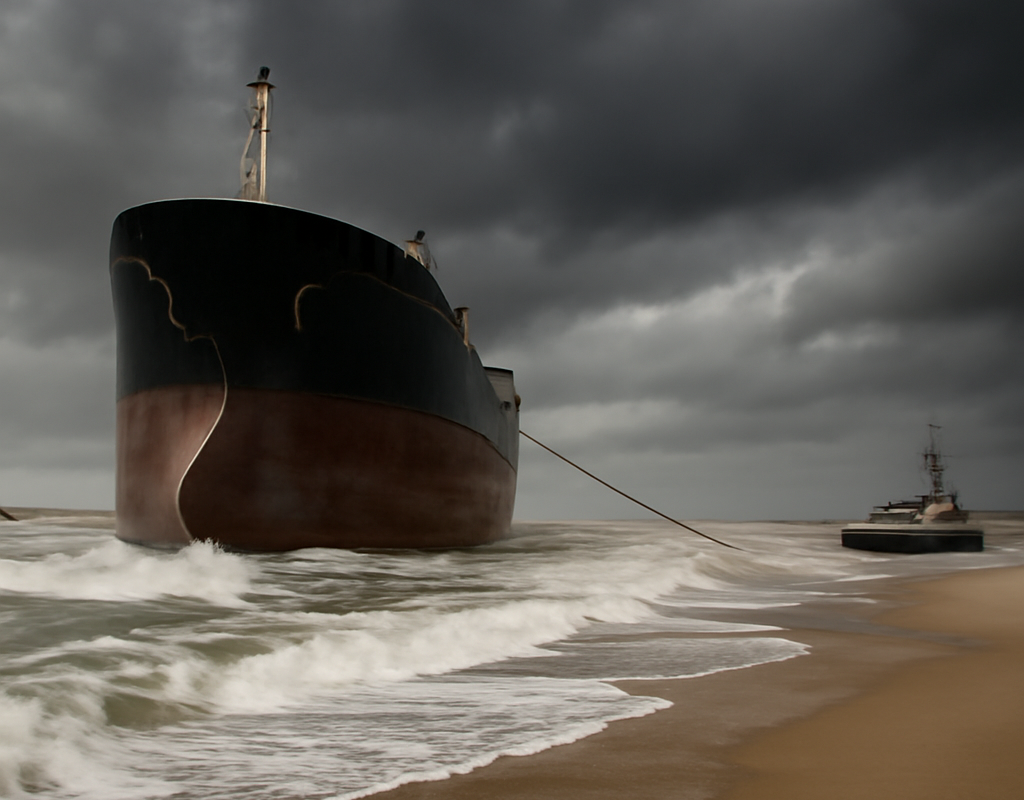
French authorities are working to refloat the cargo ship MIRO G after it ran aground off the south-western coast, with more than 100 tonnes of fuel still aboard. The incident has prompted a major salvage operation near Cap de l’Homy in Landes, where worsening weather and mechanical failures are complicating efforts to prevent the vessel from capsizing.
MIRO G stranded after severe weather
The Maltese-flagged ship became stuck on a sandbank shortly before 1am on Friday, 20 November, near the village of Lit-et-Mixe. The 169-metre vessel had encountered difficult conditions, including wind gusts of about 90km/h.
The crew dropped anchor in an attempt to hold the ship in position, but it continued to drift towards the shoreline. It eventually ran aground close to Cap de l’Homy, leading French maritime authorities to launch an emergency response.
The ship was carrying no cargo, but fuel remaining on board represents a potential pollution risk. French Navy aircraft have surveyed the surrounding waters and found no signs of pollution so far.
All 30 people evacuated without injuries
Nineteen crew members were rescued after the vessel became stranded. A further 11 people, including the captain, two other crew members, salvage specialists and company representatives, were evacuated by helicopter on Saturday as weather conditions were expected to deteriorate.
No injuries have been reported. Access to the beach at Cap de l’Homy has been restricted while the operation continues.
Salvage operation faces technical and weather problems
Salvage teams are assessing how to move the ship safely back into deeper water. The first priority has been to improve its stability and reduce the danger of it rolling over or shifting further towards the beach.
Ballast tanks have been filled with seawater to help stabilise the vessel. However, that water will eventually have to be pumped out so the ship becomes lighter and can be pulled free.
Generator failure delays pumping work
The operation has been made more difficult by the failure of both of the ship’s main generators. Those generators are needed to power the pumps used to remove the ballast water. Engineers are now working to establish an alternative electricity supply.
Without a reliable power source, the process of preparing the vessel for towing cannot proceed as planned. Salvage specialists must also work around rough seas and strong winds, which could limit the available time for any attempt to refloat the ship.
Tug cannot approach the stranded vessel
The French salvage tug Abeille Bretagne has reached the area with a 1,000-metre towline. However, shallow water prevents it from coming closer than approximately 900 metres to the MIRO G.
That distance makes the towing operation particularly challenging. Any attempt to pull the vessel free will need to be carefully coordinated, with conditions at sea and the ship’s stability considered throughout the process.
Authorities waiting for a suitable weather window
French maritime officials have said they want to use the first suitable weather window to begin the next stage of the salvage effort. However, they have warned that success is not guaranteed and that the operation could take several days or longer.
Continuing high winds and rough seas remain the main immediate obstacles. Authorities must balance the need to move the ship away from the shoreline with the risks of attempting a tow in unsafe conditions.
The absence of visible pollution is a positive sign, but the fuel on board means the environmental risk remains. A capsize or hull damage could release fuel into coastal waters, making ongoing aerial surveillance and careful salvage planning essential.
What happens next?
Engineers will continue working on an alternative power supply so ballast water can eventually be removed. Salvage crews will then assess whether the MIRO G can be pulled from the sandbank using the Abeille Bretagne and its towline.
- The ship will remain under close observation while weather conditions worsen.
- French authorities will continue monitoring the sea for signs of pollution.
- Beach access restrictions will remain in place during the emergency response.
- A towing attempt will depend on both technical readiness and a suitable weather window.
Key takeaway from this Europe news incident
The grounded MIRO G has not caused a reported fuel spill, and everyone aboard was evacuated safely. The immediate challenge is to restore power, keep the ship stable and find safe conditions for refloating it before further weather deterioration increases the danger along France’s Atlantic coast.