Estonia will close all five road border crossings with Russia from 1 December, sending families and travellers rushing to cross before the deadline. The six-month measure follows an alleged Russian-backed sabotage attempt and is likely to make travel between the two countries longer and more expensive.
Why Estonia is closing its Russia border
Estonia announced the planned restrictions on 20 November after its Internal Security Service linked an attempted arson attack to Russia’s military intelligence agency, the GRU. The incident took place on 14 November at the premises of Threod Systems, an Estonian drone manufacturer in Viimsi, north of Tallinn.
Eight Latvian citizens were detained in connection with the investigation. Estonian authorities said they suspected the group had been recruited to carry out the operation, although company security staff intervened before significant damage was caused.
The Estonian government described the incident as part of a broader pattern of alleged sabotage and hostile activity targeting Estonia and other European countries. Officials said closing the crossings would make it more difficult for Russian intelligence services to recruit or influence people travelling into Estonia and would help limit sanctions evasion.
Russia has rejected the allegations. Kremlin spokesman Dmitry Peskov called them unfounded, while Russian Foreign Ministry spokeswoman Maria Zakharova accused Estonia of violating the rights of Russian citizens. She also warned of possible political and diplomatic countermeasures and compared the planned restriction to a new “Iron Curtain”.
Estonia-Russia border closure divides families
The decision has significant consequences for people living near the frontier. Narva, an Estonian city of more than 50,000 people, stands opposite the Russian border town of Ivangorod across the River Narva. Residents on both sides have longstanding family, social and economic links.
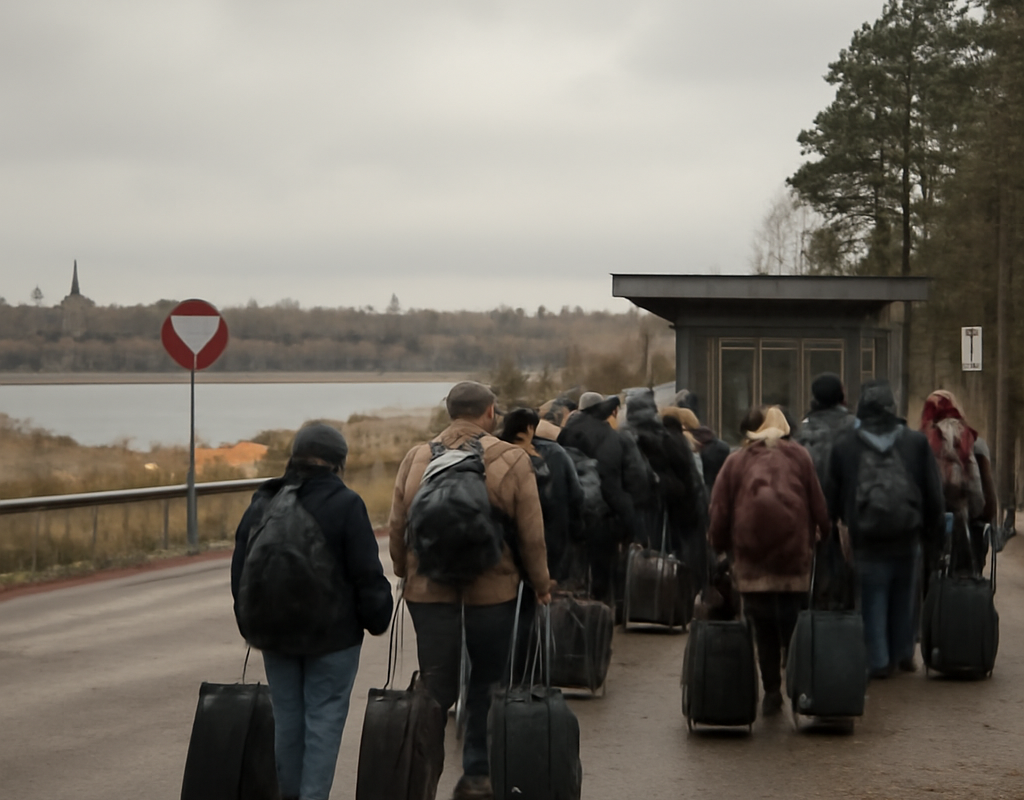
Images from Ivangorod showed people carrying suitcases, backpacks and bags while waiting to cross into Estonia before the new rules take effect. The queues underline how the Estonia-Russia border closure could affect ordinary residents, not only international travellers or security officials.
Narva Mayor Jaan Toots has urged the Estonian government to consider humanitarian exemptions. He said residents may still need to cross for urgent family reasons, including visiting elderly relatives or attending funerals.
Toots also warned that the decision could damage Narva’s economy. Hotels, restaurants and other local businesses may lose customers, while border guards and customs officers could face disruption to local employment patterns.
Which crossings will be affected?
The restrictions will cover all five road checkpoints between Estonia and Russia:
- Narva-1
- Narva-2
- Koidula
- Luhamaa
- Saatse
The closure is scheduled to last six months. After that period, the Estonian government will review the security situation and decide whether the restrictions should be extended, changed or lifted.
Rail freight will continue, subject to existing restrictions and customs checks. The decision therefore applies to road crossings rather than creating a complete halt to every form of movement between the two countries.
Travel alternatives for people crossing from Russia
Road travellers will need to use alternative routes through neighbouring countries, particularly Latvia. Those journeys are expected to take longer and cost more than direct travel through Narva or the other affected checkpoints.
For people without access to a car, air travel may become the only practical option for some journeys. The restrictions could be especially difficult for families who have traditionally relied on the Narva-Ivangorod crossing for regular visits.
Vehicle traffic through the Narva crossing was already suspended by Russia in February 2024. Pedestrians have continued to use the crossing, but that option will be removed when Estonia’s new road restrictions begin.
Border traffic has already fallen sharply
Travel between Estonia and Russia has declined significantly since Russia’s full-scale invasion of Ukraine. Figures cited by Estonian public broadcaster ERR show that annual crossings fell from more than four million before 2022 to approximately 760,000 in 2026.
About 447,000 crossings this year took place through Narva-Ivangorod, according to figures reported by AFP. Reuters reported that Russian nationals accounted for 307,000 crossings, while Estonian citizens made 175,000 and Finnish passport holders made 54,000.
These figures show that the planned closure will affect a much smaller flow of travellers than before the war, but the local impact may still be substantial. For border communities, crossings are tied to family life, work, trade and access to services.
What happens next?
Estonia’s measure is temporary on paper, with a review planned after six months. Its continuation will depend on the security situation and the government’s assessment of risks linked to alleged Russian intelligence activity, sanctions evasion and cross-border influence.
For now, residents and travellers face a clear deadline: road crossings at Narva-1, Narva-2, Koidula, Luhamaa and Saatse are due to close on 1 December. The Estonia-Russia border closure reflects the wider deterioration in relations between Moscow and European countries, while placing immediate pressure on communities whose lives have long extended across the frontier.
Key takeaway: Estonia plans to suspend all five road crossings with Russia for six months from 1 December following an alleged GRU-linked sabotage attempt. The decision is intended as a security measure, but it will also disrupt family visits, local businesses and regional travel.