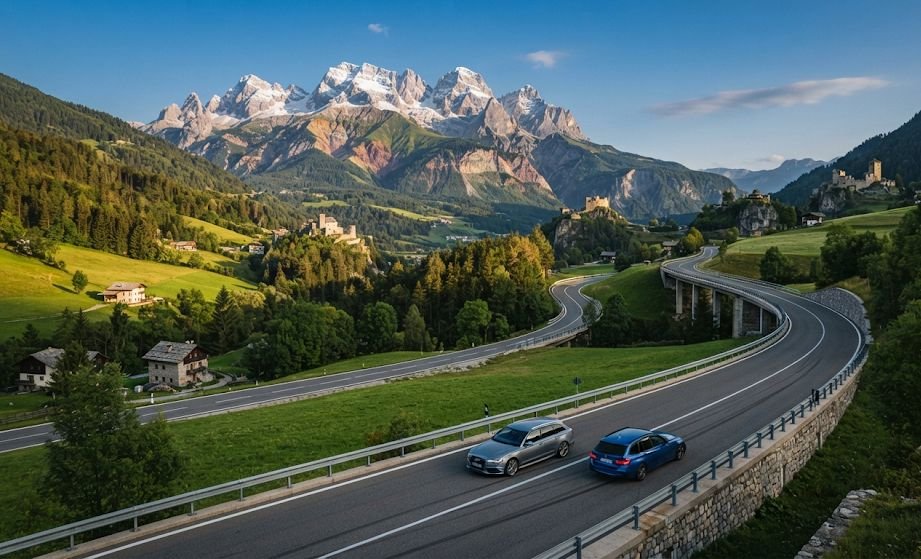
Europe’s roads are entering a new safety phase, and the EU Vehicle Safety Rules will affect travellers hiring cars or planning self-drive holidays in 2026. New vehicles registered from 7 July must meet additional requirements covering emergency braking, driver distraction, forward visibility, safety glass and tyre performance.
For Irish tourists travelling across the continent, the changes are useful to understand before collecting a rental car. They do not mean every vehicle on European roads will have identical equipment, but newer cars and vans may include more advanced assistance technology.
What the EU Vehicle Safety Rules change in 2026
The latest measures form part of the EU’s General Safety Regulation, introduced progressively since 2022. The rules apply to newly registered passenger cars and light commercial vans in EU countries.
From 7 July 2026, the additional requirements include:
- Advanced emergency braking that can detect pedestrians and cyclists
- More sophisticated warnings for driver distraction
- Improved forward visibility
- Expanded safety-glass requirements
- Additional testing of worn tyres
These measures build on earlier requirements already introduced for new vehicles. Existing cars are not generally required to be retrofitted, so rental fleets may contain vehicles with different safety systems depending on their age and specification.
Flashing brake lights and emergency stopping
Flashing brake lights are among the most visible safety features associated with the regulation. During sudden, forceful braking, an emergency stop signal can flash rapidly to warn drivers approaching from behind.
However, the timing is important. The emergency stop signal was included in earlier EU safety requirements applying to new vehicles from July 2024. It is not one of the five additional measures introduced specifically on 7 July 2026.
For tourists, this distinction matters when comparing rental vehicles. Drivers should still leave a safe distance and avoid relying on another vehicle’s warning systems to prevent a collision.
Automatic emergency braking will cover pedestrians and cyclists
Automatic Emergency Braking, or AEB, previously focused on vehicles and potential collisions. The newer phase expands required detection capabilities to pedestrians and cyclists.
If the system identifies an immediate collision risk, it may warn the driver and apply the brakes automatically. This could be particularly helpful in busy destinations such as Amsterdam, Copenhagen, Paris and Barcelona, where cars share roads with cyclists, pedestrians and public transport.
AEB is an assistance system rather than a substitute for careful driving. Visitors must continue checking blind spots, following local traffic rules and paying attention at crossings and junctions.
Driver distraction warnings for unfamiliar journeys
Driving in another country can involve unfamiliar signs, navigation instructions, roundabouts and changing road conditions. Advanced Driver Distraction Warning systems are designed to identify when a driver’s attention may be declining.
French public-service guidance describes systems that can use a camera behind the steering wheel to assess attention. Under the guidance, audible warnings may begin when inattention continues for more than six seconds at speeds between 20 and 50 kilometres per hour, with stricter warning behaviour at higher speeds.
The described technology is subject to data-protection requirements and does not retain personal or biometric information. Drivers should nevertheless take regular breaks, especially during long European road trips.
Visibility and tyre checks remain essential
Improved forward vision and expanded safety-glass areas are intended to help drivers identify hazards and improve pedestrian protection. These features may be especially useful on narrow streets, at busy crossings and when driving larger rental vehicles.
The rules also introduce additional testing for worn tyres. Tyres can lose braking and handling performance as they deteriorate, particularly in wet conditions. Before leaving a rental depot, travellers should:
- Check for visible tyre damage and warning lights
- Confirm that mirrors, cameras and sensors are working
- Ask how the vehicle’s assistance features operate
- Check roadside assistance and insurance arrangements
- Review local speed limits before starting the journey
Earlier safety systems tourists may find in rental cars
The broader General Safety Regulation also includes systems introduced during earlier stages. These can include Intelligent Speed Assistance, emergency lane-keeping, drowsiness warnings, reversing detection and event data recorders.
Intelligent Speed Assistance can use road-sign recognition, digital maps or infrastructure information to help identify speed limits. Lane-keeping and fatigue alerts may provide additional warnings, while reversing cameras and sensors can help drivers detect obstacles.
Not every vehicle will operate these systems in exactly the same way. Rental customers should ask staff for a brief demonstration before driving away.
Why the changes matter for European road trips
European Commission figures cited in the source report recorded 19,350 road fatalities in the EU in 2025, a 3% fall from 2024 and 15% below 2019. The rate was approximately 43 deaths per million inhabitants.
Fatal crashes were most common on rural roads outside urban areas. That is relevant to visitors travelling through countryside, mountains and intercity routes, where distances between services can be longer and road conditions may change quickly.
The Commission expects the wider safety regulation to help prevent more than 25,000 deaths and at least 140,000 serious injuries by 2038. Its longer-term Vision Zero ambition is to move towards eliminating road deaths by 2050.
What tourists should remember
The EU Vehicle Safety Rules offer extra protection, but technology cannot replace an alert driver. Before setting off, choose a vehicle suitable for the route, understand its controls and plan navigation in advance.
For Irish visitors travelling to Portugal, France, Italy or other European destinations, the clearest takeaway is simple: check the rental car’s safety specification rather than assuming every vehicle has the latest equipment. Careful preparation, sensible speeds and regular breaks remain just as important as the technology built into newer cars.