


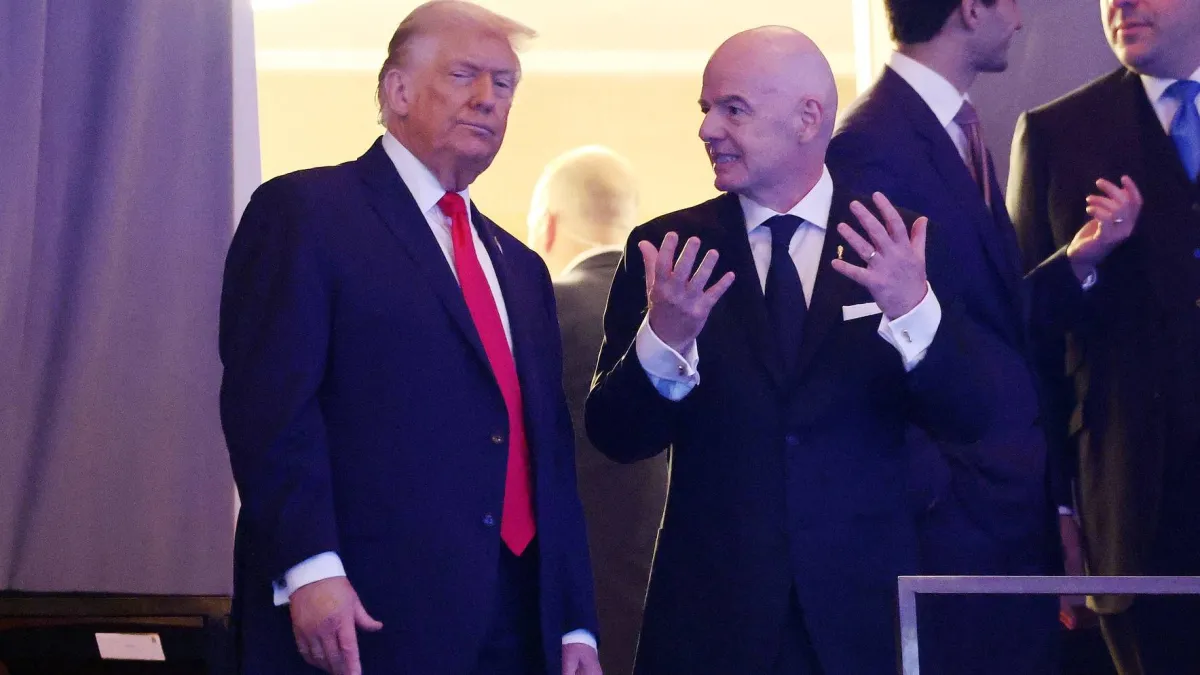
The build-up to the World Cup 2026 has already shown how quickly football stories can spill beyond the pitch, and the latest controversy involving Folarin Balogun is a clear example. In a dramatic twist, Donald Trump said he personally pushed for FIFA to review the striker’s suspension, a move that could have major implications for the USA World Cup 2026 narrative and for how disciplinary calls are viewed on the biggest stage.
Balogun had been set to miss the United States’ Round of 16 meeting with Belgium after a red card decision that sparked fierce debate. FIFA’s eventual reversal was remarkable in itself, with reports noting that such an in-tournament change had not happened for decades. Trump has now publicly claimed he requested a review, arguing that punishing a player beyond the immediate incident was unfair and damaging to the spectacle.
Trump’s Claim Adds Fresh Drama to the Tournament Conversation
Speaking to reporters, Trump said he believed the original decision was wrong and insisted he took action by asking FIFA to revisit the matter. He described Balogun as one of the team’s most important attacking players and suggested the sanction would have tilted the match unfairly.
His comments have added another layer to an already heated football debate. For supporters tracking the FIFA World Cup 2026 storylines, it is a reminder that global tournaments are shaped not only by tactics and talent, but also by disciplinary rulings, governing-body decisions and political noise around marquee matches.
The timing also matters. With attention already growing around the World Cup 2026 schedule, World Cup 2026 teams and the race toward the World Cup 2026 knockout stage, any decision involving a leading forward naturally becomes headline material.
Why the Red Card Caused So Much Backlash
Trump said the challenge looked more like an accidental collision than serious foul play. He argued that two players moving at full speed became tangled, rather than one player deliberately endangering another. That view has been echoed by many fans who felt the referee’s call was too harsh.
- The incident was seen by critics as a mistimed coming together rather than violent conduct
- Questions were raised about how VAR was interpreted during the review process
- The possible absence of Balogun threatened to weaken the U.S. attack at a crucial stage
Debates over VAR are nothing new, but they remain central to modern tournament football. As fans look ahead to the Football World Cup 2026, concerns over officiating consistency, replay interpretation and player discipline are likely to remain a major talking point.
Read more: Explore travel trends shaping the next North American tournament
What It Could Mean for the U.S. Moving Forward
If Balogun is available, the U.S. gains a major boost in both depth and finishing quality. In elite tournament football, one overturned suspension can alter a knockout tie and potentially shift a team’s path toward the later rounds.
That is why stories like this resonate far beyond a single match. They feed into wider interest around the World Cup 2026 format, the 48 team World Cup structure, and how squads may navigate pressure when margins are so tight. With fans already searching for updates on World Cup 2026 fixtures, World Cup 2026 dates and World Cup 2026 match times, every major player decision now carries added weight.
Read more: Explore how audiences in Ireland are watching major football events
A Bigger Signal Ahead of 2026
The incident also highlights just how intense scrutiny will be when the tournament returns to North America. With USA World Cup 2026, Mexico World Cup 2026 and Canada World Cup 2026 all central to fan planning, major officiating calls will be dissected in real time across every market.
Supporters are not just interested in results. They also want clarity on rules, player availability and the fairness of the process. That appetite will only grow as the World Cup 2026 host countries prepare for a tournament expected to break records for scale, travel and viewership.
Explore: A closer look at the future stadium experience for global fans
Conclusion
This Balogun episode has become more than a disciplinary footnote; it is now part of the wider conversation around fairness, influence and tournament governance. As anticipation builds for World Cup 2026, the controversy is a reminder that football’s biggest competition is often shaped as much by decisions off the field as by moments on it. For the U.S., getting Balogun back could be a competitive lift. For everyone else, it is another sign that every major call in World Cup 2026 will be examined from every angle.