

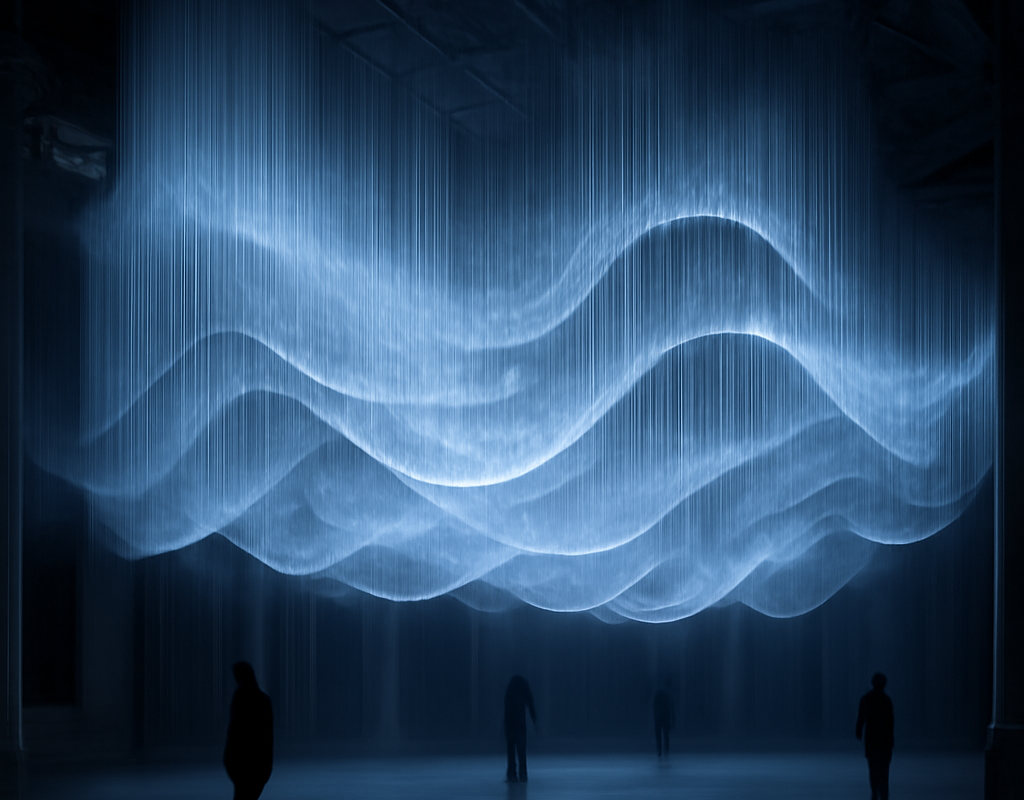
Wind is everywhere, yet it cannot be seen. In London, Amsterdam-based art duo Studio DRIFT is giving the invisible force a physical presence with Aeolus, a large-scale installation that translates air movement into light, motion and glass.
Unveiled at Ladbroke Hall, the work uses hundreds of glass rods and concealed lighting to create the impression of wind suspended in space. The installation offers visitors a visual way to experience something normally understood only through its effects on trees, water, buildings and people.
How Studio DRIFT makes wind visible
Aeolus is built around a field of glass rods arranged to capture the sensation of air in motion. Hidden lights illuminate the structure, producing a shifting visual effect that suggests a specific moment in a gust or current of wind.
Rather than presenting wind through a conventional screen or projection, Studio DRIFT uses physical materials and carefully controlled light. The result connects scientific observation with contemporary art, allowing audiences to encounter an environmental force through space, movement and reflection.
The installation is designed to make viewers more aware of the relationship between natural systems and the built environment. Its changing appearance encourages people to slow down and observe subtle movement instead of simply consuming a fixed image.
Nature and technology in the same artwork
Studio DRIFT was founded in Amsterdam by Ralph Nauta and Lonneke Gordijn. The duo’s work frequently explores the relationship between technology, nature and human experience.
In Aeolus, technology is not used to replace the natural world. Instead, lighting and engineered components provide a way to reveal a phenomenon that is normally beyond direct sight. The installation therefore turns a technological system into a tool for reconnecting visitors with the physical environment.
That idea is particularly relevant in cities, where wind is often experienced as a practical concern rather than as a natural process. Urban residents may notice strong gusts, falling temperatures or changes in weather, but rarely see the movement of air itself. The artwork makes that invisible activity the central subject.
A physical experience rather than a digital simulation
The installation also reflects a wider interest in immersive contemporary art. Instead of asking visitors to look at a static object from a fixed distance, Aeolus creates an environment that changes as people move around it.
Its glass elements and lighting produce a sense of depth and fluidity, while the scale of the work places the audience inside the visual experience. This approach gives the installation a tactile and spatial quality that differs from watching a video or viewing a photograph.
Studio DRIFT has described the work as an exploration of how art can restore a direct connection with nature through physical experience. The installation does not attempt to explain wind through data alone; it invites visitors to sense its movement emotionally and visually.
- Material: hundreds of glass rods
- Lighting: concealed lights integrated into the installation
- Location: Ladbroke Hall in London
- Theme: the relationship between nature, technology and human perception
- Artists: Ralph Nauta and Lonneke Gordijn of Studio DRIFT
Studio DRIFT plans a new Amsterdam museum
The London presentation comes as Studio DRIFT prepares for another major project in the Netherlands. The studio is developing an 8,000-square-metre museum in Amsterdam, which is expected to open in early 2027.
The planned museum will provide a permanent setting for the duo’s approach to large-scale, technologically assisted artworks. Its development also points to the growing interest in immersive installations that combine architecture, engineering, environmental themes and public participation.
For Studio DRIFT, the museum could offer space to present works at a scale that is difficult to achieve in conventional galleries. It may also allow audiences to experience several projects together, creating a broader view of the artists’ continuing investigation into natural forces and human interaction.
Why Aeolus matters beyond the gallery
Aeolus is an art installation, but its subject carries wider environmental meaning. Wind plays a central role in weather systems, climate research and renewable energy, yet it remains difficult to represent directly. By making air movement visible, the work encourages visitors to think about an element that shapes daily life while remaining largely unseen.
The installation does not present a scientific model or make a policy argument. Instead, it creates an opportunity for observation. That distinction is important: its purpose is not to measure wind but to change how people perceive it.
In an increasingly digital culture, the work also highlights the value of shared physical experiences. Visitors must occupy the same space as the sculpture and watch its changing form. The encounter depends on scale, light and movement—qualities that cannot be fully reproduced through a short online clip.
Conclusion
Studio DRIFT’s Aeolus transforms invisible wind into a luminous, three-dimensional experience at London’s Ladbroke Hall. By combining glass, light and spatial design, the installation offers a fresh way to consider nature in an urban setting and previews the artistic direction behind the duo’s planned Amsterdam museum.
The central takeaway is simple: wind may be unseen, but through art it can become something audiences can observe, explore and feel.