

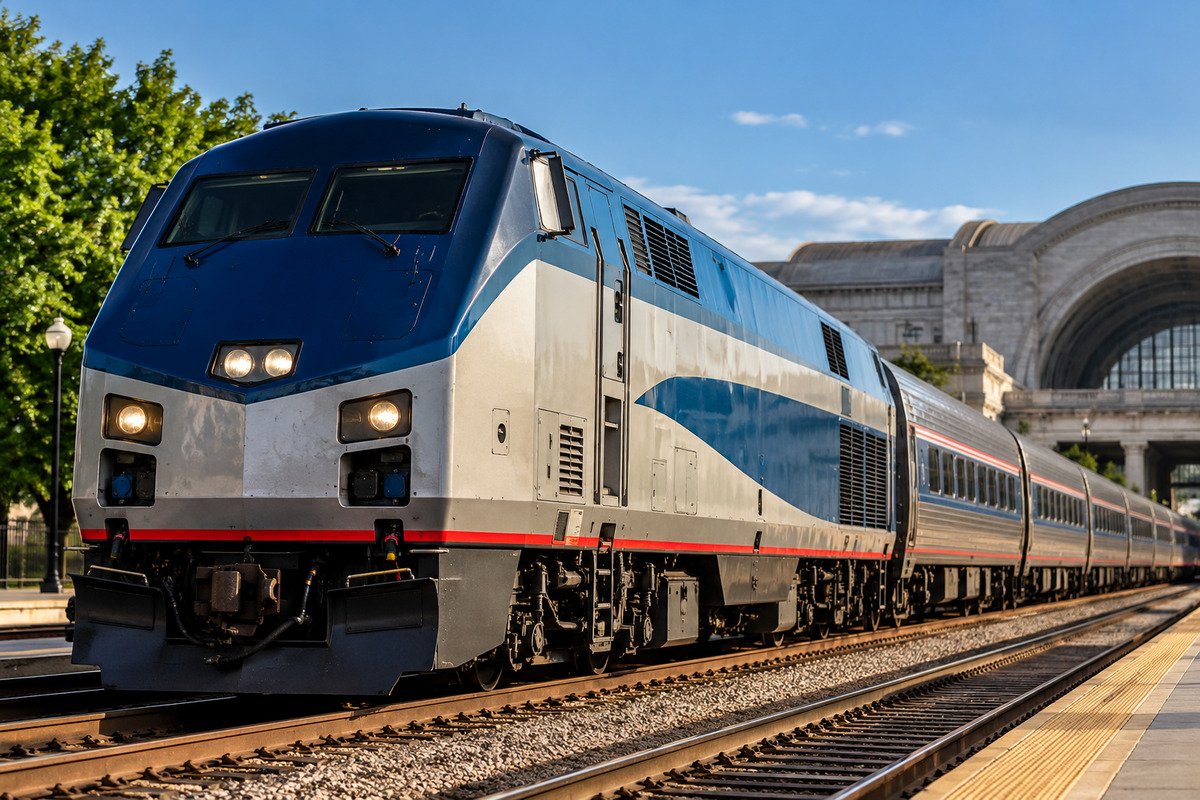
Amtrak restored direct train services between Virginia and Washington DC on 26 October 2026 after completing a nine-day upgrade inside Washington Union Station’s First Street Tunnel. The project replaced ageing switches, rail, track supports and signalling equipment at A-Interlocking, a junction that had required trains to travel at 10 mph.
The planned closure temporarily changed several Amtrak and Virginia Railway Express services. Replacement buses and revised timetables helped maintain essential connections while the work was under way, but the reopening now returns direct rail access between Washington Union Station and Virginia.
Why Amtrak closed the First Street Tunnel
A-Interlocking sits inside the First Street Tunnel immediately south of Washington Union Station. It controls movements between the station and railway routes serving Virginia, including Amtrak intercity trains and Virginia Railway Express commuter services.
Several switches and crossovers had passed their intended operational life. Their deteriorating condition meant trains were subject to a 10-mph restriction through the junction. Because the tunnel offers limited working space, Amtrak chose a concentrated nine-day closure rather than spreading the work across a series of smaller interruptions.
What was replaced during the upgrade
The construction programme combined track renewal, signalling work and rehabilitation of the tunnel’s rail infrastructure. The completed work included:
- Replacement of two double-slip switches and one crossing diamond
- Installation of eight electric switch machines
- Replacement of 215 railway ties
- Renewal of approximately 1,000 feet of rail
- Rehabilitation of 350 feet of track and tunnel base
- Placement of 550 tonnes of ballast
- Installation of about 2,500 feet of signalling and electrical cable
The work addressed the infrastructure deterioration that had constrained train movements through one of Washington’s most important passenger-rail junctions. Amtrak has not confirmed the new permitted speed through A-Interlocking, so the reopening should not be interpreted as a guaranteed reduction in journey times.
Which services were affected during the closure?
The tunnel closure affected services operating through the Washington–Virginia corridor between 16 and 26 October 2026. Amtrak Virginia reduced its timetable to one Norfolk–Alexandria round trip and one Roanoke–Alexandria round trip. Buses linked Alexandria with Washington Union Station, while additional express buses served selected Virginia locations.
The Carolinian was divided into separate rail sections, with buses covering the interrupted connection. Several long-distance trains also operated shortened routes:
- Cardinal: operated between Chicago and Indianapolis only.
- Floridian: operated on sections between Chicago and Pittsburgh, and Jacksonville and Miami.
- Silver Meteor: operated between New York and Washington, and Jacksonville and Miami.
- Palmetto: operated between New York and Washington.
- Crescent: operated on separate sections between New York and Washington, and Atlanta and New Orleans.
- Auto Train: continued between Lorton, Virginia, and Sanford, Florida, because it did not use the affected connection.
Virginia Railway Express also modified its timetable. Fredericksburg and Manassas line trains ran to and from L’Enfant rather than Washington Union Station during the construction period.
What the reopening means for passengers
The return of normal rail access removes the temporary need for replacement buses on the affected corridor and restores direct connections into Washington Union Station. It also re-establishes the route used by trains travelling between the capital and destinations including Richmond, Norfolk and Roanoke.
The junction is strategically important because Amtrak, commuter services and freight operators depend on the same corridor. A problem at this location can therefore affect journeys across several states, particularly services heading towards the southeastern United States.
Advice for passengers travelling after 26 October
Passengers with journeys scheduled after the reopening should check their booking and the latest service information before leaving for the station. The construction-related timetable changes were temporary, but individual services can still be affected by unrelated operational issues.
- Confirm the departure station, particularly if travelling on a route that was temporarily split.
- Check Amtrak’s official train-status information before travelling.
- Allow additional time at Washington Union Station if making a connection.
- Contact Amtrak directly if a booking still displays an outdated replacement-bus arrangement.
- Passengers using Virginia Railway Express should check the current timetable rather than relying on the temporary L’Enfant arrangement.
A longer-term improvement for the Washington–Virginia corridor
The completed project was coordinated with Virginia Railway Express, the Virginia Passenger Rail Authority and the North Carolina Department of Transportation. CSX, Norfolk Southern and the Washington Metropolitan Area Transit Authority also supported the operational arrangements.
Replacing worn switches, rail and signalling equipment should improve the resilience of the corridor and reduce the risk of infrastructure-related restrictions at A-Interlocking. However, Amtrak has not announced a specific journey-time saving or confirmed a new maximum speed through the junction.
Conclusion
Amtrak’s First Street Tunnel upgrade has restored direct train services between Virginia and Washington DC from 26 October 2026. The most important practical step for passengers is to verify their train status and routing through official Amtrak or Virginia Railway Express channels, especially if they travelled during the temporary closure. The project replaces ageing infrastructure at a critical junction, strengthening a rail connection used by commuters and long-distance passengers across the southeastern United States.