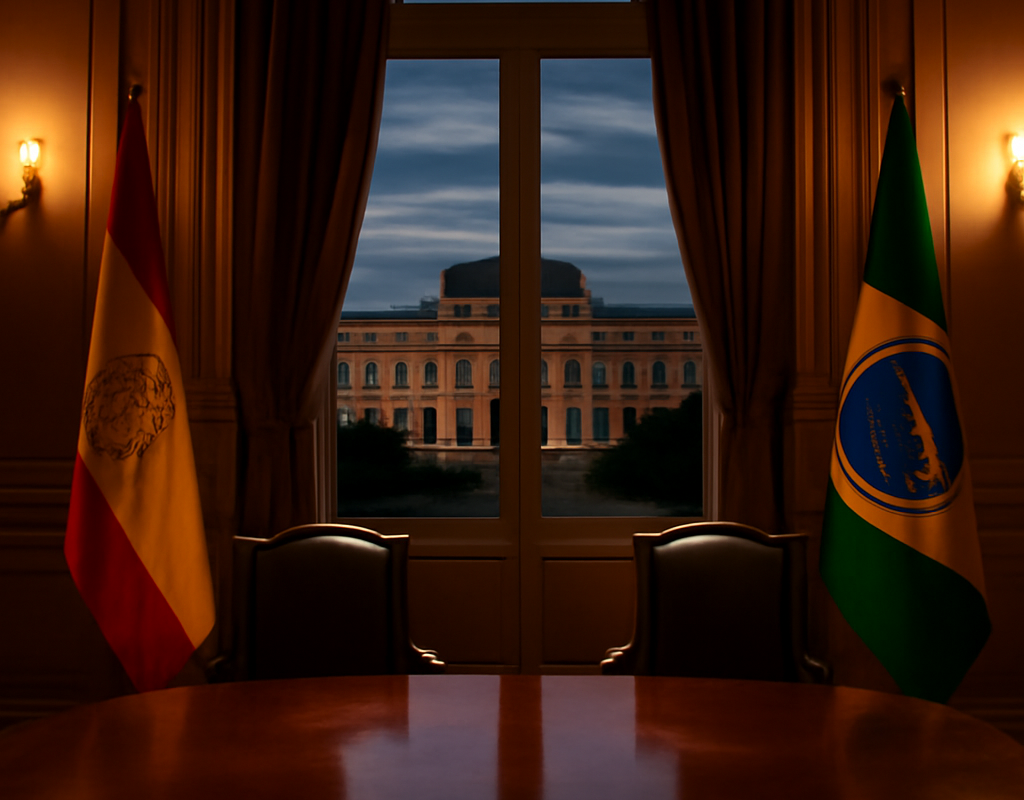
Spain’s Prime Minister Pedro Sánchez and Brazil’s President Luiz Inácio Lula da Silva have reaffirmed their commitment to closer cooperation during talks in Madrid. The meeting focused on international law, multilateralism, democratic institutions and the shared challenge posed by far-right politics.
Spain and Brazil discuss democracy and multilateralism
Sánchez welcomed Lula to the Moncloa Palace on Monday, where the leaders reviewed their bilateral agenda and discussed ways to strengthen relations between Spain and Brazil. According to the Spanish government, their talks also covered the future of the United Nations and the importance of defending social cohesion.
The meeting comes as international institutions face pressure from armed conflicts and political polarisation. Both leaders presented multilateral cooperation and respect for international law as central to addressing global challenges.
Lula later said the discussions had been productive. In a post on X, he said the two leaders had stressed the need to counter hate speech and disinformation while supporting social inclusion and democratic governance.
Lula calls for reform of the UN Security Council
The Brazilian president also renewed his call for reform of the United Nations Security Council. He argued that the need for change had become more apparent because of what he described as the body’s limited effectiveness during escalating conflicts in Ukraine and the Middle East.
Reform of the Security Council has been a long-standing issue in Brazil’s foreign policy. Brasília has sought a greater role for emerging powers in the UN’s central decision-making body, while supporters of reform say its current structure does not fully reflect the modern international system.
Sánchez and Lula highlight a progressive political agenda
Following their formal meeting, Sánchez and Lula held a second conversation about the future of the political left and the progressive agenda they share. They highlighted improved working conditions and fair taxation as measures that could support economic prosperity and reduce social divisions.
The leaders’ comments also placed the meeting within a wider debate over the direction of European and Latin American politics. Both have positioned themselves as defenders of democratic institutions and have criticised far-right movements for spreading polarisation, hate speech and misinformation.
- Democratic institutions: The leaders underlined the need to protect democracy and social cohesion.
- International cooperation: They reaffirmed the importance of multilateralism and international law.
- Economic policy: They pointed to workers’ rights and fair taxation as part of their shared political vision.
- UN reform: Lula again raised the case for changes to the Security Council.
Meeting follows divisions at Madrid summit
Lula’s visit took place shortly after he missed the 30th Ibero-American summit, which was held in Madrid earlier in November. The gathering exposed ideological differences among leaders from Europe and Latin America.
The absence of Lula and Mexican President Claudia Sheinbaum left Sánchez as the most prominent left-wing leader attending the summit. Political divisions were also visible in relations between Sánchez and Argentina’s President Javier Milei.
The two leaders exchanged a notably cold greeting at the Royal Collections Gallery. Their strained relationship followed Milei’s earlier criticism of Sánchez, whom the Argentine president had described as a “disgraceful dictator” in October.
Lula has also clashed repeatedly with Milei. Their disagreements intensified during Brazil’s recent election campaign, when Lula defeated Flávio Bolsonaro, described in the source report as one of the Argentine president’s closest regional allies.
Spain’s political uncertainty adds context to the talks
The meeting comes at a difficult moment for Sánchez domestically. The Spanish prime minister is seeking to remain in office after calling an early election when government partners refused to support a package of measures aimed at tackling the country’s housing crisis.
That political uncertainty gives Sánchez an additional reason to emphasise issues shared with Lula, including social inclusion, labour conditions and opposition to far-right politics. However, the meeting’s immediate formal purpose was to strengthen bilateral relations and discuss international affairs.
What the Madrid meeting means for Spain-Brazil relations
The talks did not announce a new agreement, but they demonstrated a shared political outlook between the Spanish and Brazilian governments. Both leaders used the meeting to defend multilateral institutions, democratic values and closer cooperation.
For Spain, Brazil remains an important partner in Latin America. For Brazil, engagement with Spain offers a route to deeper links with Europe and a platform for advancing its views on global governance. The next test will be whether the political commitments discussed in Madrid lead to concrete cooperation on bilateral and international issues.
The key takeaway is that Sánchez and Lula used their Madrid meeting to present Spain-Brazil relations as part of a broader defence of democracy, multilateralism and social inclusion at a time of growing political tension.