

Standfirst: Revised EU passenger-rights legislation is scheduled to apply from 23 October 2027, requiring clearer baggage pricing and protecting qualifying small personal items on eligible flights. Travellers should not assume the change means every overhead cabin suitcase will be free, particularly on UK–EU journeys.
What the new EU baggage rules will change
New EU baggage rules are set to reshape how airlines present cabin-bag charges when Regulation (EU) 2026/2202 applies on 23 October 2027. The reform is intended to make the total cost of a flight easier to understand before passengers complete a booking.
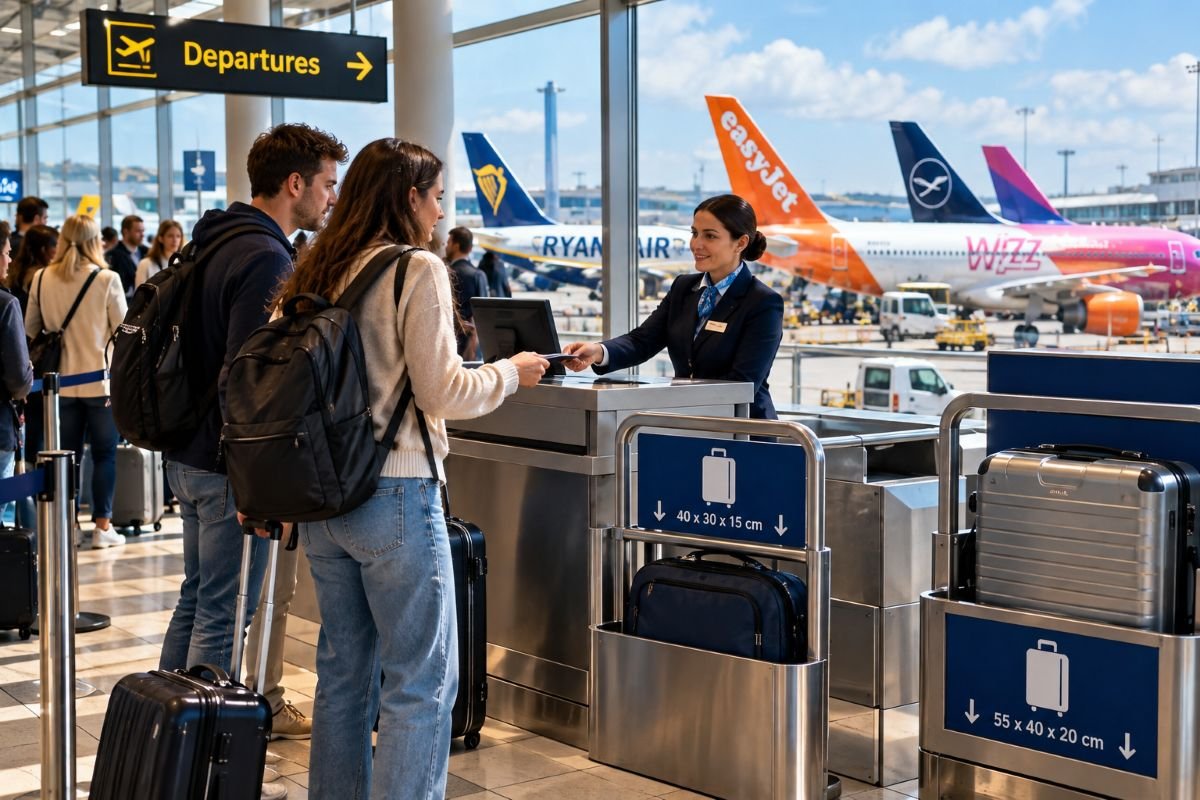
Under the framework described in the supplied legislation, a qualifying personal item, such as a small backpack, handbag or laptop bag, must be carried without an additional fee. The item is expected to fit beneath the seat, with a cited benchmark of 40 × 30 × 15 centimetres.
That protection is separate from a larger cabin suitcase designed for the overhead locker. Airlines may still sell cheaper fares that exclude larger cabin baggage, provided the baggage-inclusive options and associated costs are displayed more clearly during the booking process.
Personal item and cabin suitcase are not the same
The most important practical distinction is between an under-seat personal item and an overhead trolley bag. The new EU baggage rules do not create one identical free-bag allowance for every airline.
- Small personal item: must be carried without an additional charge when the rules apply and the item meets the applicable conditions.
- Larger cabin baggage: may require a baggage-inclusive fare or a separately purchased option.
- Airline dimensions: can continue to differ, so passengers must check the operating carrier’s policy.
Which airlines and routes may be affected?
The changes are relevant to airlines operating flights covered by EU passenger-rights legislation, including Ryanair, easyJet, Wizz Air, Vueling, Eurowings, Transavia, Lufthansa, KLM, Air France, Iberia and TAP Air Portugal. The precise application depends on the route, departure point and operating airline.
Current published personal-item dimensions cited in the supplied material vary. Ryanair and Wizz Air list 40 × 30 × 20 centimetres, Vueling lists the same dimensions, while easyJet lists 45 × 36 × 20 centimetres. Lufthansa and KLM list 40 × 30 × 15 centimetres. These allowances are airline policies rather than a single standard that applies across Europe.
Passengers should therefore continue checking their booking confirmation and the airline’s official baggage page. A ticket marketed by one company may also be operated by another carrier, making the operating airline especially important on connecting or codeshare itineraries.
Why UK–EU flights need extra checking
The territorial scope creates an important complication for travellers between the United Kingdom and the European Union. Flights departing from EU airports generally fall within the relevant passenger-rights framework, regardless of whether the airline itself is based inside or outside the EU.
Some flights arriving in the EU from outside the bloc may also qualify when they are operated by an EU carrier. However, a flight departing from the UK and operated by a non-EU airline may not automatically receive the same protection.
That means a passenger travelling from Spain to the UK, or between EU destinations, may face a different legal position from someone flying from the UK to France on a UK-based airline. Travellers should check the route and operating carrier rather than relying only on the airline’s brand or the destination.
Will larger cabin bags still cost extra?
Yes. The revised system does not guarantee free overhead luggage. The supplied examples show that easyJet has advertised larger cabin bags from £5.99, while Eurowings has listed overhead baggage from €18 on certain BASIC fares. Wizz Air generally links larger trolley-bag access to an eligible service such as WIZZ Priority.
Charges can vary according to route, fare, booking date and whether the bag is added online or presented at the airport. Gate charges may be substantially higher if a bag does not meet the permitted dimensions, so measuring luggage before departure remains important.
The central benefit is transparency rather than a guaranteed reduction in the final ticket price. A family may still pay more for overhead bags, but the cost should be easier to compare before purchase.
What travellers should do before October 2027
The revised provisions are not scheduled to apply until 23 October 2027. Until then, passengers must follow the current policy of the airline operating their flight.
- Check the personal-item and cabin-bag dimensions shown for the exact fare.
- Compare the complete price, including baggage, seats and other optional services.
- Measure and weigh luggage before leaving for the airport.
- Review each airline separately on multi-carrier or connecting journeys.
- For UK–EU travel, confirm whether the departure airport and operating carrier fall within the relevant legal coverage.
- Keep the baggage allowance attached to the booking in case the fare conditions change.
Does this affect travellers from Ireland?
Travellers departing from Ireland on eligible EU routes should pay close attention to the final implementation guidance and the operating airline’s fare conditions. Irish passengers using connecting flights through the UK or travelling on itineraries involving non-EU carriers should check each sector separately, because protections and baggage terms may not be identical.
The new EU baggage rules do not remove the need to read the fare conditions. They are designed to make those conditions clearer, not to guarantee that every flight includes a free overhead suitcase.
Will the rules make European flights cheaper?
Not necessarily. Airlines may continue to offer low headline fares that exclude larger cabin baggage. The likely change is that travellers will be better able to compare a basic fare with a baggage-inclusive option before paying.
That could be useful for families, groups and passengers who know they need locker space. It may also reduce surprises at checkout, provided customers distinguish carefully between a free under-seat item and paid overhead luggage.
Conclusion
The new EU baggage rules are scheduled to apply from 23 October 2027 and should strengthen protection for qualifying personal items while improving the way airlines display baggage-inclusive fares. They do not promise free overhead suitcases or identical allowances across Ryanair, easyJet, Wizz Air, Lufthansa, KLM and other carriers. The safest approach is to compare the full fare, check the operating airline and measure cabin luggage before departure.