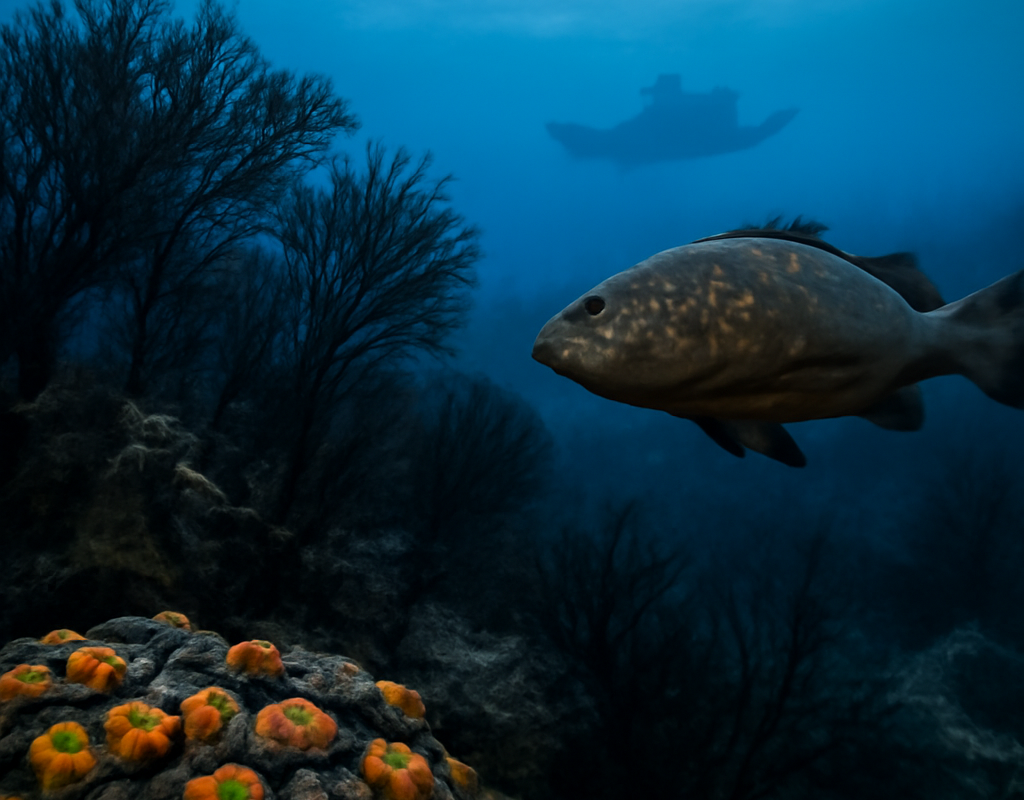
New EU news from Portugal’s Atlantic region shows that marine protection can deliver measurable results. A major survey around Madeira found larger and more abundant limpets and bigger groupers inside protected areas, while also highlighting serious concerns about shark numbers.
The Madeira Ocean Expedition brought together more than 200 specialists during October to examine waters around Madeira, Porto Santo and the Desertas Islands. Its findings will help guide decisions on managing and expanding the archipelago’s marine protected areas.
Madeira ocean survey examines largely unexplored waters
Madeira sits at an important ecological crossroads in the North-East Atlantic. Whales, seabirds and turtles pass through its waters, while the islands support cold-water corals and the Mediterranean monk seal, one of the world’s rarest seal species.
Despite that importance, large areas of Madeira’s surrounding ocean have not been studied in detail. The expedition aimed to address those gaps and create a clearer picture of marine health.
Research teams worked from the historic tall ship Santa Maria Manuela and several smaller boats. The programme included:
- Nearly 500 scientific dives
- More than 300 baited underwater camera deployments
- Environmental DNA sampling from seawater
- Drone mapping of the coastline
- Microplastic sampling
- Deep-sea observations using drifting cameras
The expedition was organised by Madeira’s regional government alongside the Oceano Azul Foundation, National Geographic Pristine Seas, ARDITI and Oceanário de Lisboa. Researchers from MARE-Madeira also used a fishing boat because the regional research centre does not yet have its own research vessel.
Marine protected areas show positive results
One of the clearest findings concerns limpets, a type of grazing sea snail traditionally collected as a local delicacy. Scientists found that limpets inside protected areas were both larger and more numerous than those in less protected waters.
The result suggests that restrictions on harvesting are helping the species recover. Researchers also recorded the largest groupers inside protected zones, providing further evidence that limits on fishing and collection can benefit marine ecosystems.
The findings are relevant to Madeira’s plan to protect 30 per cent of its sea by 2030, including at least 10 per cent under full protection. They offer a practical example of how EU environmental policy and regional conservation measures can work together, although the expedition itself was a Portuguese regional initiative rather than a European Commission programme.
Monk seal recovery offers hope
The Mediterranean monk seal provides another example of the value of long-term protection. The species had almost disappeared from Madeira by the late 1980s, when only six to eight animals were thought to remain.
The Desertas Islands were designated a nature reserve in 1990, partly to safeguard the seals. The population is now increasing, although recovery remains slow because monk seals reproduce slowly.
The expedition also carried out the first satellite tagging of a Blainville’s beaked whale in the North-East Atlantic. Initial tracking indicated that the whale favoured waters south of the Desertas, close to a fully protected area. More tracking will be needed to establish how consistently the species uses those waters.
Low shark numbers raise concern
Not every result was positive. Fewer than 10 sharks were recorded during the entire expedition. Organisers described the scarcity as concerning and said it reflects broader concerns about shark populations in the Atlantic.
A single survey cannot explain the causes of low shark numbers, and the expedition’s results are described as early findings. However, the observation underlines why comprehensive monitoring is important when authorities decide where marine protection should be strengthened.
Deep-sea discoveries reveal hidden habitats
Madeira’s waters are predominantly deep ocean, making them difficult and costly to investigate. Drift cameras reached depths of 1,060 metres and recorded sponge fields and large black corals that may be several hundred years old.
The equipment also captured evidence of human impact, including lost fishing lines and a discarded glass bottle. These observations show that even remote deep-sea habitats are exposed to pollution and marine debris.
Closer to the surface, researchers identified a dense black coral garden off Porto Santo. The site has been nicknamed Ariel’s Garden after the team’s pink underwater robot, which was used during habitat mapping.
What happens next for Madeira’s marine protection?
A second expedition planned for 2027 will focus on deeper waters. Its results could help identify additional areas suitable for protection and improve understanding of habitats that remain poorly documented.
For Madeira, the survey provides both encouragement and a warning. Protected areas appear to be helping some commercially and ecologically important species, but shark scarcity, plastic waste and lost fishing gear show that protection must be supported by enforcement and continued research.
The wider lesson for Europe news is straightforward: marine reserves are most effective when they are based on evidence, properly managed and monitored over time. Madeira’s experience offers a useful model for European ocean policy while showing that reaching conservation targets will require action in deep and nearshore waters alike.
Key takeaway
The Madeira ocean survey found convincing signs that marine reserves are working, particularly for limpets, groupers and the recovering monk seal. But low shark numbers and deep-sea pollution demonstrate that protection is not the end of the process. Reliable data and sustained conservation measures will be essential if Madeira is to meet its 2030 marine protection goals.