

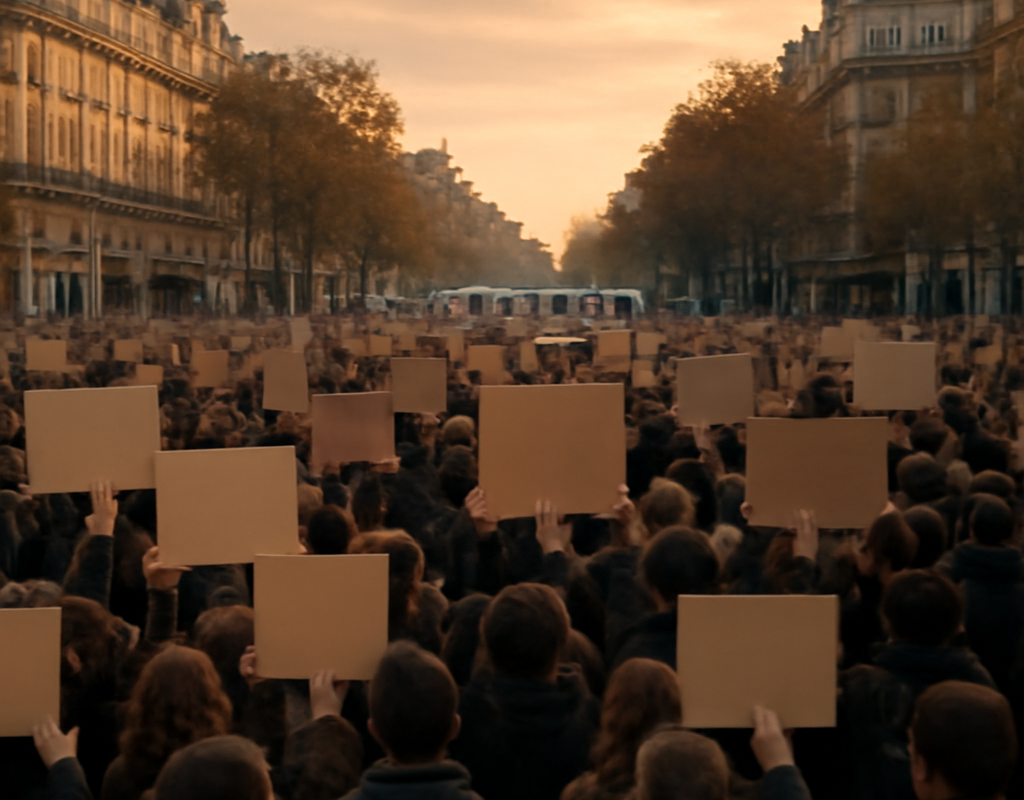
Hundreds of thousands of people joined demonstrations in Paris on 24 October 2026, protesting the cost-of-living crisis, higher fuel prices and issues linked to a wider student movement. The protests followed violence at demonstrations the previous week, prompting French authorities to introduce a stricter security operation across the capital.
Police and military personnel were deployed near several strategic locations, while security forces worked to prevent a repeat of the earlier unrest. Despite the measures, clashes were reported and more than 1,000 people were arrested, according to the source report.
Paris protests draw a major turnout
The demonstrations brought together students and other protesters concerned about household finances, transport costs and the broader direction of French policy. The scale of the gatherings made the protests one of the most significant recent expressions of public dissatisfaction in France.
Students speaking during the demonstrations said they remained determined to continue campaigning, despite the violence that overshadowed protests the previous week. Their participation has helped give the movement a broader national profile, with demonstrations also linked to wider concerns about living standards.
The protests are part of Europe news today because they combine economic pressure, youth mobilisation and public-order concerns in one of the European Union’s largest member states. However, the demonstrations are a national French political and social development rather than an EU decision.
French authorities impose tighter security measures
Following the violence at earlier demonstrations, the French government introduced a strict security protocol for the latest protests. Military personnel were visible outside some strategic sites in Paris, alongside a substantial police presence.
The security response was intended to protect public buildings and businesses while allowing demonstrations to proceed. Authorities faced the difficult task of balancing the right to protest with measures designed to limit disorder and protect residents, visitors and emergency services.
Even with the heightened deployment, confrontations occurred in parts of the capital. More than 1,000 arrests were reported, although an arrest does not by itself establish that an individual committed an offence. Further legal proceedings would be required before any allegation could be determined in court.
Why the protests matter
The events have several wider implications for French politics and public life:
- Household pressure: Rising fuel prices and living costs are affecting public confidence and driving demands for government action.
- Student mobilisation: Young people remain a visible part of the demonstrations and say last week’s violence has not ended their campaign.
- Public-order concerns: The scale of the security operation shows the authorities’ concern about further clashes.
- Political responsibility: The government and opposition figures are disputing who is responsible for escalating tensions.
Government blames France Unbowed over violence
The French government has blamed the hard-left France Unbowed party, known in French as La France Insoumise, and its leader Jean-Luc Mélenchon for what it says is encouraging violence around the protests.
The accusation has been rejected by Guillaume Lescaut, an LFI deputy mayor of Aubervilliers, who spoke during the demonstration. The disagreement reflects a wider political dispute over how opposition parties should respond when protests become confrontational.
The claims remain politically contested. The available report does not establish that the party or Mr Mélenchon directed specific acts of violence, and no such conclusion should be inferred from the government’s criticism.
What happens next in France?
The immediate focus will be on whether further demonstrations are announced and whether tensions decline after the latest events. Authorities are likely to assess arrests, injuries, damage and the effectiveness of the security arrangements before deciding how to manage any subsequent protests.
For protesters, the central demands concern living costs, fuel prices and the issues raised by the student movement. For the government, the challenge is to respond to economic grievances while maintaining public safety and protecting the right to peaceful assembly.
The demonstrations may also influence the wider debate in French politics, particularly if student participation continues or if further unrest spreads to other cities. Any future developments should be assessed separately, with a clear distinction between peaceful protest, disorder and confirmed criminal findings.
What does this mean for Ireland?
The Paris demonstrations do not create a direct legal or policy change for Ireland. Their relevance to Irish readers is regional: France’s economic pressures, fuel costs and public-order debates can affect political discussion across the European Union, especially when similar concerns arise in other member states.
There is also a practical consideration for people travelling to or doing business in France. Demonstrations and security restrictions can disrupt public transport, access to central areas and commercial activity. Travellers should consult current advice from French authorities and transport operators before visiting affected locations.
Key takeaway
The latest EU news context is national rather than institutional: hundreds of thousands protested in Paris over living costs, fuel prices and student concerns, while French authorities responded with extensive security measures. More than 1,000 arrests were reported after clashes, but the political dispute over responsibility remains unresolved. The next major question is whether the movement continues and whether future demonstrations remain peaceful.