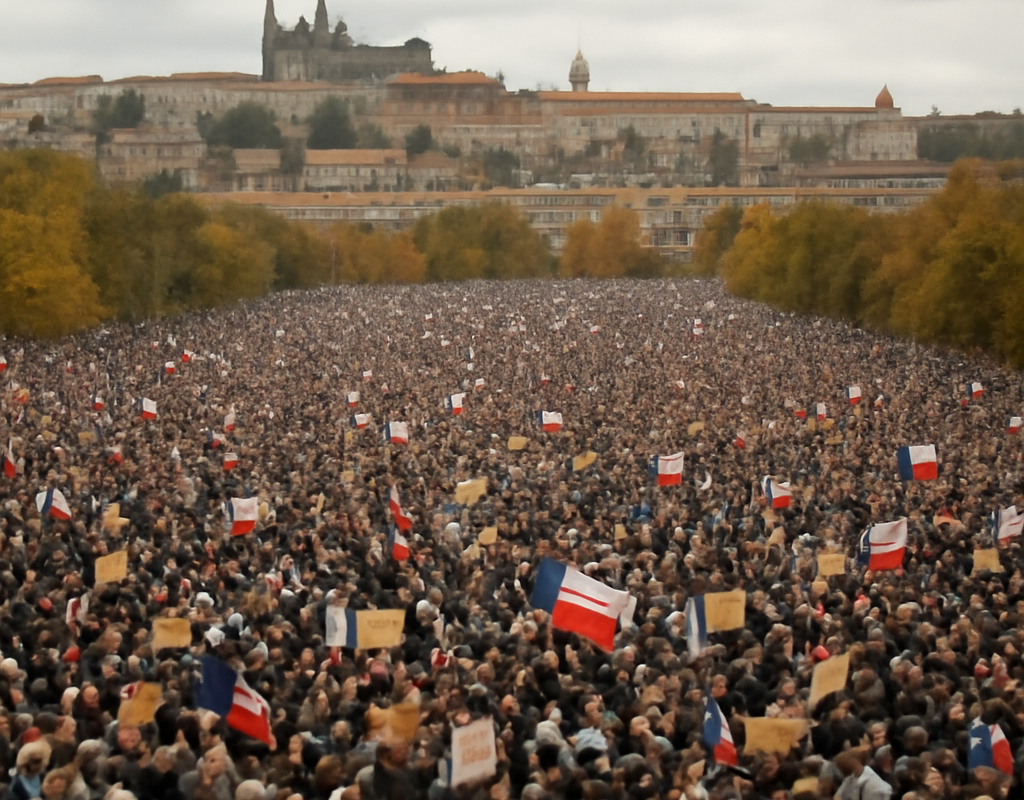
Hundreds of thousands of people gathered in Prague on Sunday to oppose the Czech government’s plan to replace household licence fees for public television and radio with funding from the state budget. The rally was the largest protest so far against the three-party government led by Prime Minister Andrej Babiš.
Czech public media funding plan draws huge Prague protest
Organised by civic group Million Moments for Democracy, the demonstration took place at Letná, one of Prague’s largest public spaces. Media reports estimated the crowd at between 350,000 and 400,000 people.
Protesters travelled from across the Czech Republic to defend the independence of Czech Television and Czech Radio. Many also criticised the government’s wider policies and called on the Freedom and Direct Democracy party, known as SPD and led by Chamber of Deputies Speaker Tomio Okamura, to leave the governing coalition.
The protest’s slogan, “Never again 4:36”, referred to the time at which the government majority advanced a disputed amendment during an early-morning sitting in October. Opposition lawmakers said the debate had been cut short, preventing more than 60 opposition MPs from speaking.
Why the proposed change is controversial
Czech households that own a television or radio currently pay separate monthly charges: 150 koruna for television and 55 koruna for radio. The government wants to abolish those payments and replace them with direct allocations from the state budget.
Critics argue that the proposed system could make the broadcasters more vulnerable to political pressure. Public service media depend on editorial independence to report on the government, opposition parties and public institutions without direction from those in power.
Opposition parties, media organisations and other critics also say the planned state subsidy would be significantly lower than current licence-fee income. Publicly available figures cited in connection with the debate put this year’s revenue from household fees at 6.73 billion koruna for Czech Television and 2.47 billion koruna for Czech Radio.
Support for independent broadcasters crosses Czech society
The rally attracted backing from a wide range of organisations and professions. Student groups, theatres, writers, athletes, churches, healthcare workers and international journalists’ organisations were among those expressing support for public television and radio.
Speakers said public broadcasters should not be controlled by politicians, the government or the state. Instead, they argued, the services should belong to the public and reflect the views of significant sections of society.
The issue has become a major flashpoint in Czech politics because the funding model affects more than the broadcasters’ finances. It also raises questions about how public media can scrutinise government decisions while remaining institutionally independent.
Government defends its approach
Representatives of the governing parties have defended the proposed funding change. Radek Vondráček, from the largest governing party, ANO, criticised the protest organisers and Million Moments for Democracy during a televised debate, describing the group as “an association of professional agitators”.
The government’s plan would end the existing household-fee system, but the proposed replacement has not won broad acceptance among opponents. Critics fear that annual decisions over state-budget support could give future governments additional leverage over editorial priorities.
Protest ends without reported disturbances
The demonstration was broadcast live by Czech public news television, the Czech news agency and several independent media outlets. Police said the event proceeded without incident until early evening, with no disturbances reported.
The size of the turnout gives the dispute considerable political weight. It shows that the future of public broadcasting has become a central concern for many voters, alongside opposition to the government’s broader direction.
What happens next for Czech public media?
The proposed funding amendment remains at the centre of a political and public dispute. Its progress through parliament will be closely watched by broadcasters, journalists, opposition parties and civil society groups.
For Czech viewers and listeners, the key question is whether a state-budget model can provide stable funding without weakening editorial independence. For the government, the challenge will be to explain how the new arrangement would protect public media from political influence while addressing concerns about the current fee system.
The Prague rally has made clear that the funding debate is no longer a technical question about household charges. It has become a wider argument about press freedom, democratic accountability and the role of independent public broadcasting in Czech society.