

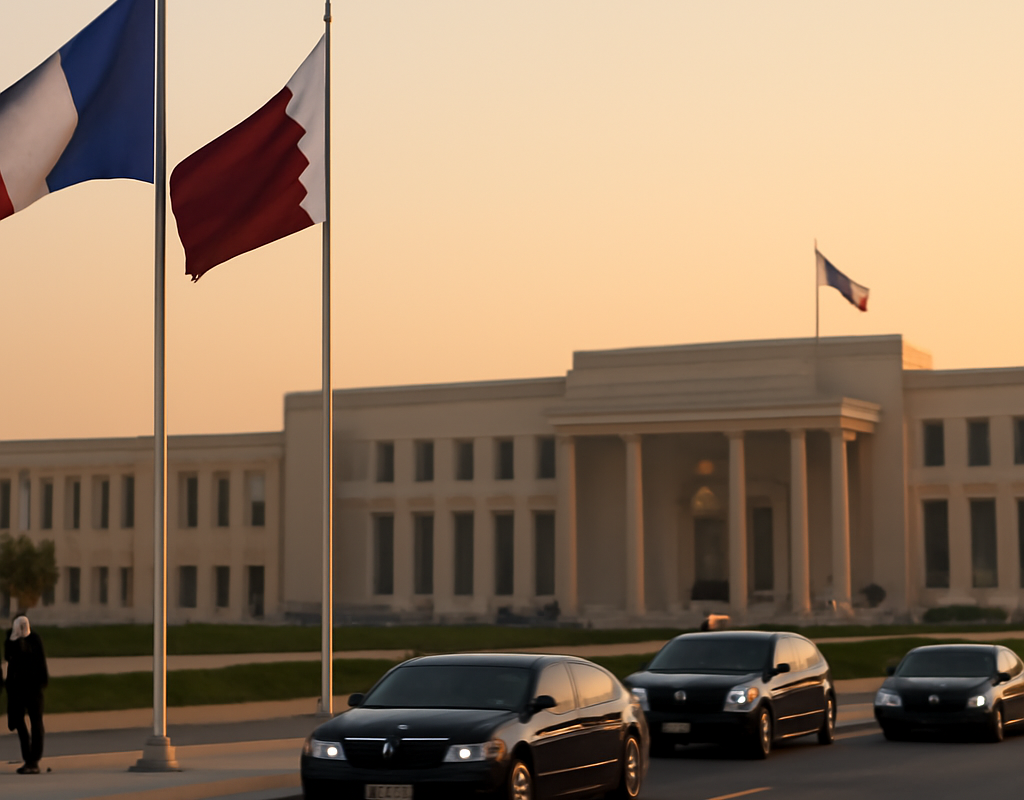
French President Emmanuel Macron has concluded a state visit to Qatar with a renewed strategic partnership and a significant gas agreement, as France seeks closer Gulf cooperation on energy, security and regional diplomacy.
The visit took place amid heightened tensions in the Gulf and political pressure in France over living costs. Macron said the objectives of his wider Gulf tour had been achieved, while discussions with Qatar focused on energy supplies, defence and efforts to reduce regional tensions.
What happened during Macron’s Qatar visit?
Macron’s visit to Doha formed part of a broader Gulf tour aimed at strengthening France’s relationships with key regional partners. Qatar welcomed the French president with full state honours, underlining the importance both governments attach to their bilateral relationship.
The most concrete outcome was a gas agreement intended to support France’s energy security. The source material does not provide the agreement’s value, duration or delivery schedule, but the deal comes as European countries continue to pay close attention to reliable energy supplies and price stability.
The discussions also covered regional security. Qatar has sought to maintain channels with Tehran while developing its own defensive capabilities, making Doha an important diplomatic partner for countries attempting to manage tensions in the Gulf.
Why the gas agreement matters to France
Energy prices remain politically sensitive in France, particularly for households facing pressure on living costs. A stronger relationship with Qatar could give Paris another source of gas supply and deepen cooperation with a major energy producer.
However, an agreement with Qatar does not automatically mean lower household bills. Consumer prices depend on international markets, contracts, infrastructure, taxes, currency movements and the policies of energy suppliers. The practical effect will depend on the terms of the deal and how it is implemented.
For France, the agreement is therefore both an economic and diplomatic development. It can support supply diversification while giving Paris a stronger platform for dialogue on wider regional issues.
Potential areas of cooperation
- Energy: expanded cooperation on gas supplies and energy security.
- Defence: closer strategic coordination as regional security concerns increase.
- Diplomacy: continued engagement with Qatar on Gulf tensions and regional stability.
- Economic relations: stronger links between France and Qatar at a time of uncertainty over energy costs.
Qatar’s wider security role
Qatar has been balancing several priorities as tensions in the Gulf have intensified. It has warned of a possible energy disruption peak in the coming days and months, while also arguing that dialogue and economic ties offer a route towards lasting peace.
Qatari officials have described changes to the country’s defence posture, including the rapid redeployment of defensive assets. Those developments help explain why security featured prominently in Macron’s visit alongside the gas agreement.
Qatar’s position gives it relevance beyond its energy resources. The country maintains relationships with different regional and international actors, allowing it to act as a diplomatic channel even when political tensions are high.
What does this mean for Europe?
The agreement is primarily a bilateral France-Qatar arrangement, not an EU decision. It should not be described as a new European Union energy rule or a measure that automatically applies across all member states.
Nevertheless, it has wider European significance. EU countries have sought to strengthen energy security and reduce exposure to supply disruptions. New commercial agreements by individual member states can contribute to that broader objective, although their benefits and legal terms vary from country to country.
The visit also reflects the importance European governments place on Gulf diplomacy. Energy, maritime security and regional conflicts can have consequences for European economies, transport routes and foreign policy.
Relevance for Ireland
Ireland is not directly covered by the France-Qatar agreement based on the information available. Any indirect effect would depend on European gas markets and broader changes in regional energy supply. Ireland’s energy system and import profile are distinct from France’s, so the agreement should not be presented as an immediate change to Irish household bills or national energy policy.
What happens next?
The next stage will be implementation of the agreement and clarification of its commercial details. Governments and energy companies will need to establish how supplies are scheduled, transported and priced.
France and Qatar are also expected to continue security and diplomatic discussions. The value of the partnership will be measured not only by the gas arrangement but also by whether it helps sustain communication during a period of regional tension.
For readers following European current affairs, the development shows how energy policy and foreign policy are increasingly connected. A state visit can produce commercial commitments while also serving wider strategic and diplomatic goals.
Conclusion
Macron’s Qatar visit produced a strengthened bilateral partnership and a gas agreement aimed at supporting France’s energy security. It is not an EU-wide decision, but it reflects broader European concerns about energy resilience, regional stability and Gulf diplomacy. The key issue now is how the agreement will be implemented and whether it delivers practical benefits without being overstated as an immediate solution to living-cost pressures.