

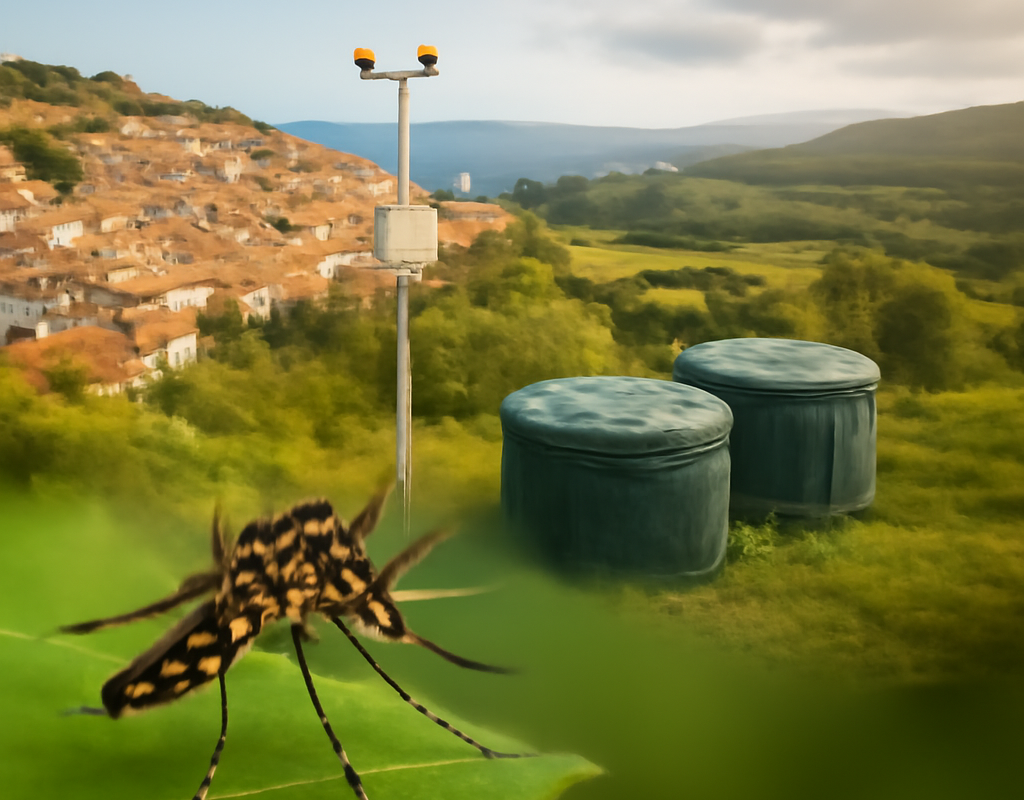
Europe is facing a growing public-health challenge as tiger mosquitoes become established farther north and create new opportunities for dengue, chikungunya and Zika viruses to spread. Health authorities are combining mosquito control, disease surveillance, medical research and public participation to prevent occasional infections from becoming endemic transmission.
The issue is no longer limited to tropical regions. By late October 2026, Italy had recorded 76 locally acquired dengue cases and France eight—roughly twice the number reported in those countries in 2025, according to the source report. Although outbreaks remain limited in most of Europe, specialists warn that preparation is essential because the insects cannot realistically be eliminated once established.
Why tiger mosquitoes are moving north
The Asian tiger mosquito, Aedes albopictus, was introduced to Italy in the 1990s, reportedly through shipments of used tyres. It has since expanded into countries including France, Spain, Germany and Switzerland.
The mosquito can carry several viruses, but local transmission requires more than the presence of the insect. An infected traveller may return from a region where dengue, chikungunya or Zika is circulating. If a local mosquito bites that person, it can acquire the virus and later transmit it to another person.
This creates a pathway from imported infection to a local outbreak. The risk is heightened by increased international travel, warmer conditions and the mosquito’s ability to spread through transport networks, including cars.
According to figures cited in the report, tiger mosquitoes are moving about 60 kilometres farther north each year, while disease outbreaks are spreading at an estimated rate of around 120 kilometres annually.
Portugal tests sterile-male mosquito release
Portugal is testing one population-control method by releasing male mosquitoes sterilised through irradiation. In September, authorities released 30,000 sterile males during a second effort to reduce the tiger mosquito population.
Male mosquitoes do not bite. The purpose of releasing sterilised males is to allow them to mate with females without producing viable offspring. The approach is intended to reduce reproduction rather than eliminate mosquitoes immediately.
Other methods are also being examined internationally. Brazil has used mosquitoes carrying the bacterium Wolbachia, which can interfere with the ability of viruses to infect the insects. These approaches are part of a wider public-health response rather than a single solution.
Experts emphasise that eradication is not a realistic goal where the mosquito has already become established. The focus is therefore shifting towards reducing numbers, detecting infections early and preventing transmission.
Surveillance becomes central to Europe’s response
Monitoring mosquito populations and identifying imported infections quickly can help authorities intervene before a wider outbreak develops.
Citizen reporting and digital tools
Members of the public are being encouraged to help identify the mosquito’s expansion. The Mosquito Alert app is being used in parts of Europe to collect reports and support surveillance. Citizen observations can provide health authorities with information about where tiger mosquitoes may be appearing.
Residents can also reduce breeding sites around their homes by:
- Removing standing water from containers, plant pots and outdoor items
- Keeping water-storage containers covered
- Using insecticide-treated screens where appropriate
- Following local guidance on indoor spraying and mosquito control
- Reporting suspected mosquito sightings through recognised monitoring programmes
Wastewater and airport monitoring
The EU’s Health Emergency Preparedness and Response Authority, known as HERA, is supporting wastewater surveillance to detect signs of dengue circulation before infected people necessarily seek medical care.
Monitoring is taking place at major European airports and international hubs in Singapore, Africa and Latin America. The objective is to create an early-warning network capable of identifying changes in virus circulation and supporting faster public-health action.
Early diagnosis matters because a person carrying a virus should be treated promptly and protected from further mosquito bites. This reduces the chance that local mosquitoes will acquire the virus and pass it to others.
Healthcare systems need better tools
Surveillance cannot prevent every infection. Doctors must also be able to recognise mosquito-borne diseases in patients who have not recently travelled abroad, particularly as local transmission becomes more plausible.
HERA is providing €10 million for the development of new diagnostic tools. The agency is also supporting research into antivirals and vaccines.
Vaccines for dengue and chikungunya exist, but their protection and suitability vary. Health authorities may eventually consider targeted vaccination in areas where mosquitoes are established and sustained transmission is detected. Any such decisions would depend on evidence, local risk assessments and public-health guidance.
What the mosquito threat means for Europe
The expanding range of tiger mosquitoes illustrates how climate, travel, trade and urban environments can interact to create new health risks. It does not mean that dengue, chikungunya or Zika are circulating widely across Europe. However, imported infections can lead to local transmission when the right mosquito species is present.
For European countries, the response will require coordination between national health services, local authorities, laboratories, researchers and communities. EU-level bodies can support surveillance, preparedness and research, while national and regional authorities remain responsible for many practical control measures.
For Ireland, the immediate risk is different because the tiger mosquito’s established presence described in the report is concentrated in parts of continental Europe. Nevertheless, Irish residents travelling to affected areas should follow public-health advice, and health professionals may need to remain alert to relevant symptoms and travel histories. Ireland’s position within European disease-surveillance networks also makes early information-sharing important.
What happens next?
Authorities are expected to continue combining several measures rather than relying on one intervention:
- Tracking the movement and density of tiger mosquitoes
- Using wastewater and airport surveillance to identify viruses earlier
- Testing methods such as sterile-male releases
- Improving diagnostic capacity for clinicians
- Researching antiviral treatments and improved vaccines
- Reducing standing water and other breeding sites
- Communicating clearly with residents and travellers
The central challenge is prevention. Once an invasive mosquito becomes established, removing it entirely is unlikely. Europe’s most effective strategy is therefore to detect infections early, limit mosquito populations and ensure communities know how to reduce breeding sites.
The key takeaway is clear: Europe’s mosquito-borne disease risk is already present, but coordinated surveillance, public participation and better medical tools can help prevent isolated cases from becoming endemic transmission.