

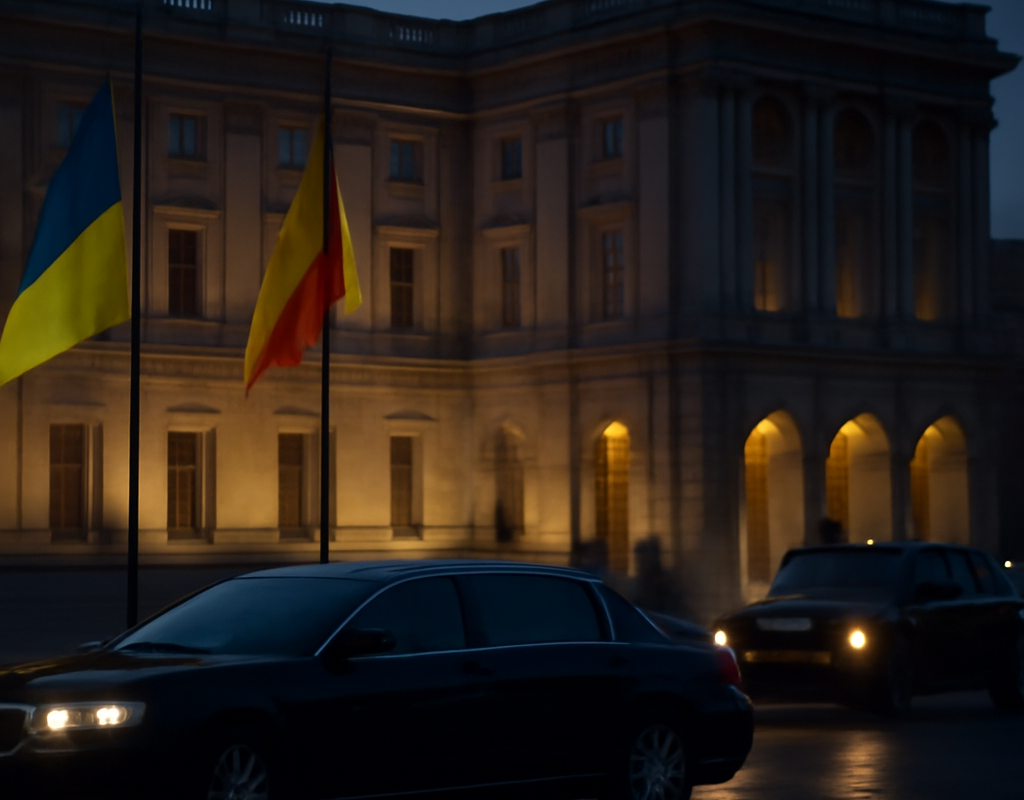
Ukrainian President Volodymyr Zelenskyy arrived in Madrid on 4 November for high-level talks with Spanish Prime Minister Pedro Sánchez, King Felipe VI and representatives attending the Ibero-American Summit. The unannounced visit is focused on strengthening Ukraine’s air defence, defence cooperation and international support while opening new diplomatic contacts with Latin American countries.
Zelenskyy’s arrival was kept confidential for security reasons and confirmed only after his aircraft landed. His programme coincides with the two-day summit, which brings together representatives from 22 Ibero-American countries and international organisations.
Zelenskyy’s Madrid agenda includes Sánchez and Felipe VI
The Ukrainian president is expected to hold bilateral meetings with Sánchez and Felipe VI, as well as discussions with several Latin American delegations. He is also due to join a wider meeting involving international leaders, including United Nations Secretary-General António Guterres and European Council President António Costa.
In a social media message confirming his arrival, Zelenskyy said Ukraine’s immediate priorities were stronger air defences, protection for civilians and expanded cooperation on defence production. He indicated that further support measures were being prepared but did not provide details about specific agreements or participating governments.
The visit gives Spain an opportunity to demonstrate support for Ukraine while using the summit’s diplomatic setting to deepen relations between Kyiv and Latin American countries. Governments across the region have taken differing positions on Russia’s invasion, making direct engagement important for Ukraine’s international diplomacy.
Why Latin America matters to Ukraine’s diplomacy
Several Latin American presidents are in Madrid, including Argentina’s Javier Milei, Chile’s José Antonio Kast and Bolivia’s Rodrigo Paz. Their presence creates an unusually broad opportunity for Zelenskyy to discuss Ukraine’s position with governments that have varying foreign-policy priorities.
The meetings are taking place against a politically divided backdrop. Mexican President Claudia Sheinbaum and Brazil’s Luiz Inácio Lula da Silva are absent, despite their countries’ importance in Latin America and their previous engagement with international discussions about the war.
For Kyiv, contact with Latin American governments can help maintain international attention on Ukraine, build support for diplomatic initiatives and strengthen cooperation in areas such as defence production and economic recovery. However, the source material does not indicate that any new commitments have yet been formally announced.
The Ibero-American Summit faces questions about its influence
The Madrid summit is also intended to reinforce the Ibero-American format, which has faced criticism over declining presidential attendance and difficulty reaching common declarations. At the 2024 meeting in Ecuador, only a small number of heads of state attended and participants did not adopt a final declaration.
Spanish Foreign Minister José Manuel Albares rejected the suggestion that the forum is losing relevance. He argued that all 22 countries were represented in Madrid, even where presidents were absent, and said the gathering’s value lay in maintaining dialogue across different political positions.
The summit’s attendance reflects the region’s changing political balance. Several governments represented in Madrid are led by conservative or right-wing presidents, while some of Sánchez’s closer political partners in Latin America are not attending at presidential level.
Felipe VI calls for open trade and stronger EU-Latin America ties
Economic cooperation is another major theme in Madrid. Addressing Ibero-American business leaders, Felipe VI argued that protectionism and higher trade barriers were not the best response to economic uncertainty. He instead called for an open economy based on common rules, legal certainty and transparent institutions.
The Spanish monarch highlighted Latin America’s energy resources, critical minerals and rare earths as potential sources of new economic opportunities. He said stable institutions and investor confidence would be necessary if countries were to attract investment and develop those resources sustainably.
Felipe VI also stressed the importance of closer ties between the European Union and Latin America and the Caribbean. For Spain, strengthening that relationship is a central part of its wider European and international policy, particularly as governments seek more resilient supply chains and diversified economic partnerships.
What happens next?
Zelenskyy’s meetings in Madrid are expected to continue through the summit. The immediate focus will be whether discussions produce concrete announcements on air defence, military-industrial cooperation or wider diplomatic support.
Any formal defence assistance or agreements would need to be assessed according to the decisions of the governments involved. At this stage, the confirmed development is Zelenskyy’s visit and planned meetings, not a published package of new commitments.
The summit will also test whether the Ibero-American framework can maintain relevance despite uneven participation. Its ability to produce practical cooperation, rather than only political declarations, will be important for its future influence.
Conclusion
Zelenskyy’s Madrid visit combines Ukraine’s search for wider international support with Spain’s effort to strengthen its links to Latin America. The talks with Sánchez, Felipe VI and summit participants may broaden diplomatic and defence cooperation, but the most significant question is whether the meetings lead to confirmed measures. For now, the visit represents a high-level diplomatic push rather than a formally announced new agreement.