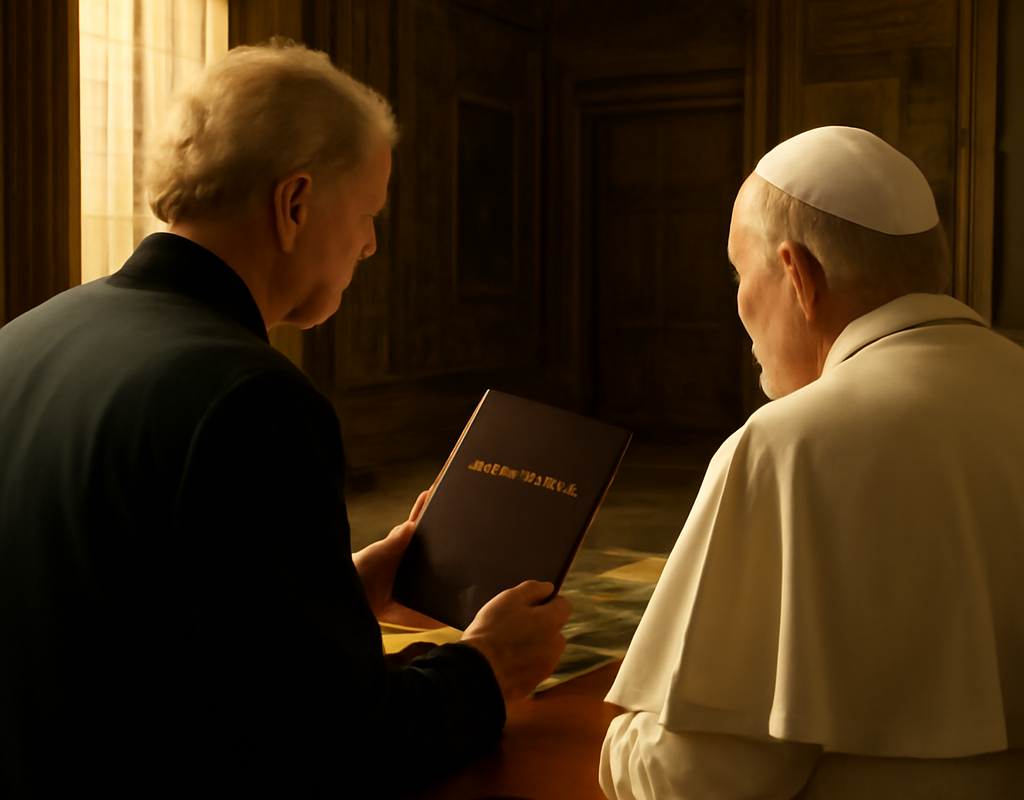
Bob Dylan met Pope Leo XIV at the Apostolic Palace on Wednesday, bringing together two internationally recognised figures whose public work has often engaged with faith, music and peace. The brief Vatican audience took place a day before the Nobel laureate is due to perform in Rome.
The 85-year-old American singer-songwriter gave the Pope a copy of his autobiography, Chronicles – Volume 1. In return, Leo XIV presented Dylan with a rosary. The meeting was accompanied by photographs shared by Father Antonio Spadaro, who attended with Andrea Monda, editor of L’Osservatore Romano.
A brief Vatican meeting before Dylan’s Rome performance
Dylan was in the Italian capital as part of his tour and is scheduled to appear at the Palazzo dello Sport on Thursday evening. Wearing a black sweatshirt with the hood pulled over his head, he met the Pope for greetings and a short exchange inside the Apostolic Palace.
The audience was not announced as a formal policy or diplomatic meeting. Instead, it was a cultural and personal encounter linking the singer’s long career with the Vatican’s continuing interest in music as a way to communicate spiritual and social themes.
- Location: Apostolic Palace, Vatican City
- Participants: Bob Dylan and Pope Leo XIV
- Gift from the Pope: A rosary
- Gift from Dylan: Chronicles – Volume 1
- Next public appearance: Dylan’s concert at Rome’s Palazzo dello Sport
Why Bob Dylan’s music has a connection with the Vatican
The meeting reflects a relationship between Dylan’s music and Catholic public life that goes back decades. In 1997, he performed before Pope John Paul II and a large gathering of young people at the National Eucharistic Congress in Bologna.
Dylan sang three songs, including Knockin’ on Heaven’s Door, before greeting John Paul II. The Polish Pope also referred to the lyrics of Blowin’ in the Wind during his address, using the song’s questions about human life as the starting point for a reflection on Christian faith.
That earlier appearance established Dylan as an unusual bridge between popular music and religious audiences. His songs have been associated with civil-rights campaigns, anti-war movements and questions about moral responsibility, although his own views have not always fitted neatly into a single political or ideological position.
Leo XIV previously cited an unpublished Dylan protest song
The Vatican meeting followed an earlier connection between the Pope and Dylan’s writing. In July, Leo XIV cited lines from Go Away You Bomb, a protest lyric written by Dylan in 1963 during the Cold War.
The song addresses the destructive power of nuclear weapons and was never officially recorded or released on one of Dylan’s albums. Its original manuscript was discovered in 2013. Leo XIV used the lyric in the preface to Disarmata e disarmante. La pace è un dono, a Vatican publishing project edited by journalist Alessandro Banfi.
The reference formed part of a wider warning about rearmament and the danger of renewed nuclear escalation. It also showed how Dylan’s early writing continues to be used in discussions about peace and international security.
Dylan’s best-known political songs include Masters of War and Blowin’ in the Wind. However, his public position has been more complex than a straightforward pacifist label. In 2001, he said he did not regard himself as a pacifist and defended the principle of self-defence.
Faith has remained part of Dylan’s artistic identity
Religious themes have been a recurring part of Dylan’s career. Raised in a Jewish family, he experienced a significant spiritual shift in the late 1970s and moved closer to Christianity.
That period produced a series of albums in which Christian language and gospel influences were prominent:
- Slow Train Coming, released in 1979
- Saved
- Shot of Love
Although his later work returned to a broader musical and lyrical range, spiritual references did not disappear. Dylan has also described himself as religious and spoken about reading Scripture, meditation and prayer.
Music’s role in Pope Leo XIV’s public message
Music has also featured prominently in Leo XIV’s public appearances during the first year of his pontificate. The Pope has been heard singing parts of the Regina Caeli and the Pater Noster in Latin, while showing interest in the music performed by communities during his travels.
At a Jubilee gathering for choirs and choral groups in November 2025, Leo described music as a gift of civilisations and a means of expressing feelings that can be difficult to communicate in ordinary speech. He cited the words attributed to Saint Augustine, “Cantare amantis est” — “singing is characteristic of one who loves”.
That emphasis helps explain the significance of the Dylan meeting. It was not simply a celebrity visit: it reflected the Vatican’s view of music as a cultural language capable of connecting personal belief, public ethics and shared ideas about peace.
A meeting shaped by music, faith and peace
Bob Dylan’s Vatican visit brought together several strands of his public life: songwriting, religious exploration and engagement with questions of war and peace. For Leo XIV, the meeting also continued his efforts to use cultural references to frame conversations about human dignity and the risks of conflict.
The encounter remains a brief audience rather than a formal agreement or institutional decision. Its wider importance lies in the connection between an artist whose work has influenced generations and a Pope who has repeatedly presented music as a language of spiritual and human solidarity.
Bob Dylan’s meeting with Pope Leo XIV therefore offered a distinctly cultural moment in Vatican life, with the rosary and autobiography symbolising an exchange between two different traditions of reflection. Dylan’s Rome concert the following evening provides the immediate next chapter in that connection.