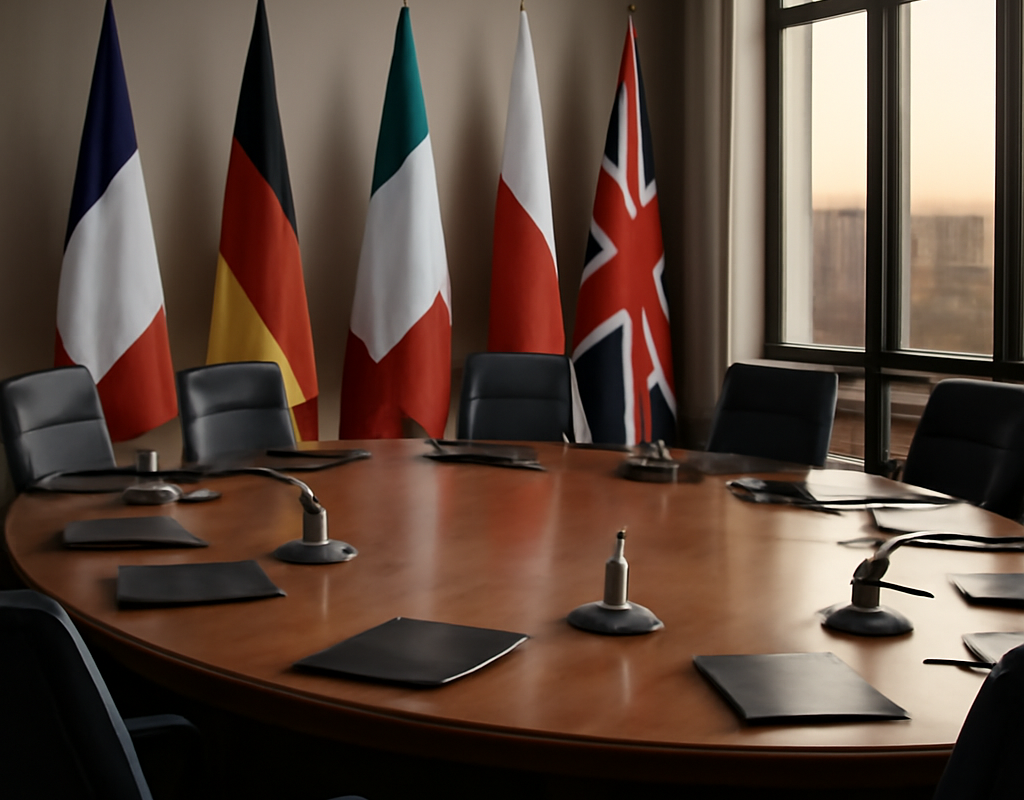
EU leaders have agreed that Europe will be represented in Ukraine peace negotiations by a joint team rather than a single special envoy. The format includes France, Germany, Italy, Poland and the United Kingdom, alongside the European Union institutions and NATO.
The decision was reached at an informal European Council meeting in Dublin on Friday, 13 November 2026. It gives Italy and Poland a formal place in the negotiating group while leaving EU foreign policy chief Kaja Kallas without the envoy role she had sought.
Joint team chosen instead of a single envoy
The negotiating team will bring together the E5 countries—France, Germany, Italy, Poland and the UK—with the European Council, European Commission and NATO. The UK is not an EU member, but participates through the E3 format alongside France and Germany.
European Council President António Costa said leaders had agreed that the European team would consist of the EU institutions and the E5 of the Coalition of the Willing. The arrangement expands a format already used in recent discussions involving the United States, which is helping broker contacts on ending Russia’s war against Ukraine.
Italy participated in the latest meeting in Abu Dhabi, while Poland is expected to join the next round. Previous rounds have also involved representatives in Miami, Oslo and Brussels.
Why the Dublin decision matters
The choice reflects an effort to give eastern and western European countries a place at the negotiating table. Poland had warned against decisions being made by western European governments on behalf of countries closer to Russia and Ukraine. Italy’s Prime Minister Giorgia Meloni had argued before the summit that Europe needed a clearer and more unified voice.
However, leaders stopped short of creating a new single representative. The outcome therefore preserves a multi-country structure rather than transferring responsibility to one EU envoy.
The agreement is a political decision about representation in an ongoing diplomatic process. It does not itself establish a peace agreement, determine the terms of a settlement or guarantee that direct negotiations with Russia will begin.
Kallas’s bid for the envoy role rejected
Kaja Kallas had made a public case for representing the EU in the talks. She said that security and foreign policy representation formed part of her mandate, while acknowledging that Russian officials opposed her because of her strongly stated views.
She also said EU leaders could change the existing arrangement if they wished, but argued that attention should remain focused on the substance of the negotiations.
Costa responded by pointing to the division of responsibilities under the EU treaties. He said the president of the European Council represents the European Council and the European Union in common foreign and security policy at the level of national leaders. He also said the Commission president represents the Commission in areas falling within its responsibilities.
European Commission President Ursula von der Leyen likewise declined to endorse a separate envoy. She said EU leaders had decided how the 27 member states and the EU institutions would be represented.
What happens next in the Ukraine talks?
The immediate test will be whether Russia accepts direct contact with European representatives. Moscow has repeatedly refused to sit at the same table as European officials, although US special envoys Steve Witkoff and Jared Kushner said after travelling to Moscow that Russia had indicated a willingness to hold face-to-face discussions with Europeans.
The Kremlin subsequently played down that message, leaving uncertainty about whether a meeting will take place.
The next phase will therefore depend not only on the European format agreed in Dublin, but also on decisions by the United States, Ukraine and Russia. The European team may provide broader political representation, but its effectiveness will depend on whether the parties engage with it and whether the talks produce substantive progress.
Key points from the decision
- Europe will use a joint negotiating team rather than one special envoy.
- The group includes France, Germany, Italy, Poland and the United Kingdom.
- The European Council, European Commission and NATO will also be represented.
- Italy has already taken part in a recent round; Poland is expected to join the next.
- Kaja Kallas was not appointed as a dedicated representative.
- Russia’s willingness to meet European representatives remains unconfirmed.
What it means for Ireland
Ireland hosted the informal meeting in Dublin, but the decision is European rather than an Irish national policy announcement. Ireland is represented in EU discussions through its membership of the European Union, while the European Council’s agreed negotiating format involves the EU institutions and the named national participants.
The outcome also illustrates the distinction between the European Council, which brings together EU heads of state or government and sets political direction, and the European Commission, which manages responsibilities assigned to it under EU law. The peace talks themselves remain a diplomatic process rather than a newly adopted EU law or regulation.
Conclusion
The latest EU decision on Ukraine peace talks creates a broader European negotiating team, adding Italy and Poland while retaining France, Germany, the UK, the EU institutions and NATO. It gives Europe a collective structure, but leaves unresolved whether Russia will engage directly and whether the arrangement can produce meaningful progress toward peace.