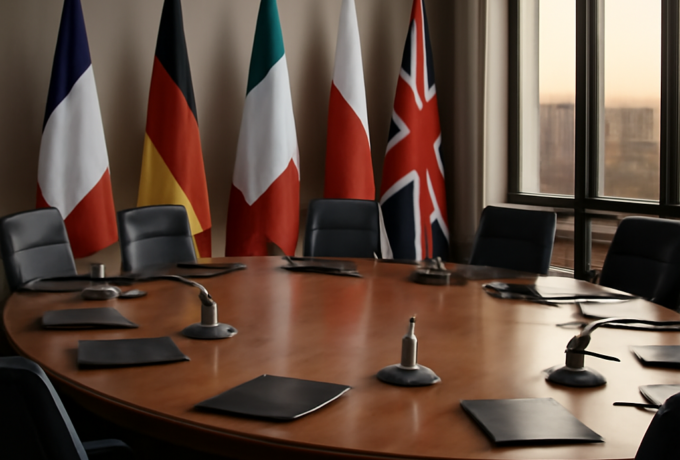
EU news: European leaders have agreed on a joint team for talks aimed at ending the war in Ukraine, bringing Italy and Poland into a format involving France, Germany, the United Kingdom, the European Union and NATO. Leaders have not appointed a single European envoy, despite pressure for one figure to coordinate the bloc’s role.
The arrangement reflects the difficulty of creating a common diplomatic structure while ensuring that eastern and western European security concerns are represented. It also leaves open questions about who will speak for Europe, how the talks will be coordinated and what role EU institutions will play alongside national governments and NATO.
What was agreed on the peace talks?
The proposed negotiating team will include representatives from France, Germany, the UK, Italy and Poland, alongside the EU institutions and NATO. The format is intended to give the discussions a broad European and transatlantic base rather than place responsibility on one country or one appointed envoy.
The decision does not amount to a peace agreement, nor does it settle the terms of any future settlement. It establishes a political framework for European participation in talks concerning Ukraine’s war and the continent’s wider security order.
According to the source report, leaders declined to appoint a single envoy. That means coordination will remain distributed among participating governments and institutions, at least for now.
Why Italy and Poland matter
Italy and Poland bring different regional perspectives to the process. Italy is one of the EU’s largest member states and has been seeking a meaningful role in diplomatic discussions about the war. Poland, meanwhile, has consistently stressed the security concerns of countries in eastern Europe and the risks of decisions being made without their involvement.
Including both countries may be intended to strengthen the legitimacy of the negotiating format. It also acknowledges that European governments do not view the conflict solely through the same strategic lens.
- Italy adds the perspective of a major southern European country and EU member state.
- Poland represents a frontline regional security perspective and has strongly emphasised eastern Europe’s role.
- France and Germany remain central European diplomatic actors.
- The UK and NATO provide a wider transatlantic security dimension.
- EU institutions connect the talks to common European foreign-policy and security discussions.
Why leaders rejected a single envoy
A single envoy could provide a clear public point of contact and make the European position easier to communicate. However, appointing one person could also create political tensions over their mandate, authority and relationship with national governments.
The decision to use a joint team suggests that leaders preferred political representation by several major actors rather than transferring responsibility to one official. The arrangement may help accommodate different national priorities, but it could also make decision-making more complicated.
The lack of a single envoy is particularly significant because peace talks require clarity over who can make commitments, relay proposals and report back to governments. Unless a more detailed structure is announced, the practical division of responsibilities remains uncertain.
What does this mean for EU foreign policy?
The development is part of the wider debate over Europe’s role in negotiations involving Ukraine and Russia. European governments have repeatedly argued that the continent’s security cannot be decided without European participation. The inclusion of EU institutions and NATO indicates that the issue is being treated as both a diplomatic and security matter.
At the same time, the format shows the limits of EU foreign policy coordination. National governments retain important diplomatic and security powers, while the European Union must work through its institutions and member-state consensus. NATO is a separate alliance, meaning its inclusion does not turn the talks into an EU process.
For the European Union, the central challenge will be maintaining a coherent position across countries with different geographic priorities, historical experiences and assessments of future security risks.
Possible implications for Ireland
Ireland is not identified as a member of the negotiating team in the source material. However, decisions about Ukraine and European security can have wider implications for all EU member states, including Ireland.
Any future EU position could affect common foreign-policy discussions, humanitarian support, sanctions policy and debates about Europe’s security responsibilities. Ireland’s traditionally military-neutral position also means that developments involving NATO and European defence may be followed closely in Dublin, even where Ireland is not directly represented in the negotiating format.
What happens next?
The next step will be to clarify how the joint team will operate. Key questions include who will chair or coordinate meetings, how information will be shared with other EU member states and whether the format will change as negotiations develop.
The structure may also face pressure if the participating governments disagree over the objectives or sequencing of talks. A joint team can widen representation, but it will need a clear mandate if it is to present a consistent European position.
For now, the confirmed development is the creation of a broad negotiating format and the decision not to appoint a single envoy. It should not be interpreted as a final settlement or as evidence that peace terms have been agreed.
Conclusion
The new peace-talks format brings Italy and Poland into a wider team involving major European governments, the EU institutions and NATO. Its strength is broader representation; its weakness is the absence of one clearly designated European coordinator. The immediate priority will be defining the team’s mandate and ensuring that Europe’s participation remains coherent as discussions on Ukraine’s future security continue.