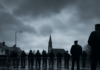
A tense standoff unfolded on Portadown’s Garvaghy Road on Sunday as protesters blocked a planned Orange Order parade, reviving memories of one of Northern Ireland’s most divisive disputes. The confrontation, watched closely across Ireland, continued into the evening and raised fresh concerns about political stability, public safety and the future of power-sharing at Stormont.
What happened on Garvaghy Road?
Thousands of protesters gathered before dawn along the predominantly nationalist Garvaghy Road, where an Orange Order march from Drumcree church was scheduled to pass. Crowds linked arms in heavy rain, while Police Service of Northern Ireland officers formed lines at both ends of the road.
The parade had been authorised under a ruling by the Northern Ireland Parades Commission. The approved event involved 35 members of the Portadown district lodge walking silently without bands. However, police later stopped the march within roughly 100 yards of its starting point, citing public safety concerns.
Portadown district master Nigel Dawson said the Orange Order would probably make another attempt later in the evening. As night fell, both the protest crowd and loyalist supporters remained in the area, with a police helicopter circling overhead.
- The standoff centred on a planned Orange Order march along Garvaghy Road.
- Police prevented the authorised parade from proceeding beyond its initial point.
- Large crowds gathered on both sides of the dispute.
- A local primary school announced it would close on Monday for safety reasons.
- Political leaders called for restraint and de-escalation.
Why the dispute has reopened old wounds
The confrontation carries particular weight because of the history of the Drumcree dispute. During the 1990s, attempts by Orange Order members to march along the nationalist road triggered serious disorder and contributed to wider sectarian tension across Northern Ireland.
Sunday’s events were the first time in 28 years that the Orange Order was due to walk this stretch of the road. For residents, the proposed march was not simply a question of parade routes or tradition. Many saw it as a return to an era associated with intimidation, violence and deep community division.
Marie-Therese Murray joined the protest carrying an image of her son Darren, who was killed at the age of 12 after being chased by Protestant youths during the tensions that followed the 1996 Drumcree standoff. She appealed for an end to the confrontation, warning that another generation could be traumatised by the dispute.
Residents said the community had mobilised peacefully but intended to remain in place. A petition opposing the parade reportedly attracted almost 4,000 signatures, while supporters travelled from locations including Belfast, Derry, Dublin, Kerry and Cavan.
Follow further Ireland News and Northern Ireland developments through DailyDigest’s latest coverage.
Political reaction across Northern Ireland and Ireland
Stormont First Minister Michelle O’Neill visited the Garvaghy Road protest and told reporters that the events raised questions about how the peace process and political institutions were functioning. Some protesters called for Stormont to be brought down, reflecting the depth of anger among residents.
Democratic Unionist Party leader Gavin Robinson criticised O’Neill’s presence at the protest. He accused her of undermining the rule of law and argued that respect for the police, courts and legal decisions must apply consistently.
In Dublin, Minister for Foreign Affairs Helen McEntee said she was closely monitoring the situation and urged political leaders to reduce tensions. She pointed to progress made in the decades since the worst violence of the Troubles and said her priority was preventing a return to past divisions.
Northern Secretary Chris Bryant also travelled for meetings with political representatives. He called on both communities to compromise as efforts continued to prevent the confrontation from escalating.
Impact on residents, schools and public services
The dispute was already affecting daily life in the area. St John the Baptist Primary School, also known as Bunscoil Eoin Baiste, announced that it would close on Monday because of safety concerns.
Residents said workers across the community, including healthcare staff, professionals and youth workers, were making arrangements to stay away from work. The statements reflected fears that the standoff could continue beyond a single day and disrupt local services, education and businesses.
Police warnings described the protest as unlawful and said participants could face arrest. Chants directed at officers highlighted the hostility surrounding the operation, although community representatives repeatedly said their objective was to maintain a peaceful blockade.
What happens next?
The immediate focus is whether the Orange Order will attempt to proceed again and how police will respond. Any further movement could increase pressure on the Parades Commission, local political leaders and the PSNI to maintain public safety while upholding legal decisions.
The political consequences may extend beyond Portadown. The dispute has placed additional strain on Northern Ireland’s already fragile power-sharing arrangements, with competing claims about legality, consent and the rights of residents and marchers.
Questions being closely watched
- Will another attempt be made to march along Garvaghy Road?
- Can local representatives agree a route or process acceptable to both communities?
- How long will schools, workplaces and local services remain affected?
- Will the confrontation create further pressure on Stormont’s institutions?
Frequently asked questions
What is the Garvaghy Road dispute?
It is a long-running disagreement over Orange Order parades along a predominantly nationalist road in Portadown. Earlier confrontations in the 1990s became major flashpoints during the Troubles.
Who authorised the 2026 parade?
The Northern Ireland Parades Commission authorised a limited silent parade involving 35 Orange Order members from the Portadown district lodge.
Why did police stop the march?
Police stopped the march shortly after it began, saying they could not allow it to continue on public safety grounds.
Could the standoff affect Stormont?
Political leaders have warned that the dispute could deepen existing tensions within Northern Ireland’s power-sharing institutions, although its longer-term impact remains developing.
Conclusion
The Garvaghy Road standoff has brought Northern Ireland’s unresolved parade disputes back into sharp focus. For residents who remember the violence of the 1990s, the confrontation represents far more than a single march. For political leaders, the priority now is preventing escalation, protecting communities and preserving the progress achieved since the peace process.
As this Breaking News Ireland story develops, the next steps taken by the Orange Order, police and Stormont politicians will determine whether the crisis remains contained or becomes a wider test of Northern Ireland’s fragile political settlement.