

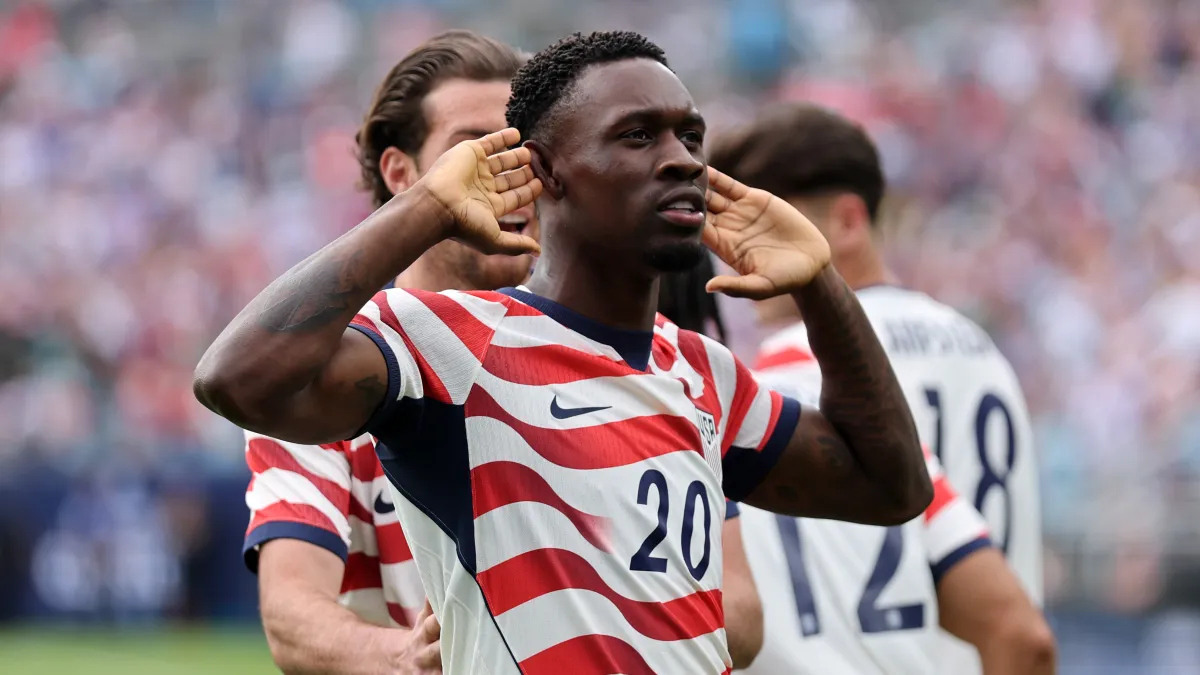
The United States received a major lift ahead of its knockout meeting with Belgium after Folarin Balogun was cleared to play, ending days of uncertainty around one of the team’s most important attackers. The decision will matter well beyond this tie, because player availability and discipline can shape the wider conversation around the World Cup 2026 and how top nations manage pressure on the biggest stage.
Balogun had been expected to miss the match after the red card he received against Belgium appeared set to trigger a one-game ban. Instead, FIFA suspended the implementation of that sanction, effectively restoring his eligibility for the Round of 16 fixture. For the USA, it is a significant sporting reprieve. For Belgium, it has become a source of frustration and debate over process, fairness and tournament governance.
Why Balogun is available again
The key issue was not a traditional appeal of the sending-off itself. Under FIFA rules, there is no standard appeals route for a red card in this kind of situation. However, disciplinary provisions do allow FIFA’s judicial bodies to suspend a punishment and place the player under a probationary period. That is the mechanism used here.
As a result, Balogun’s ban was effectively paused for a year, which means he can feature immediately. For a USA side trying to build momentum before future major tournaments such as the FIFA World Cup 2026, the ruling offers an important reminder that administrative decisions can be just as decisive as tactics.
Belgium’s objection and FIFA’s response
Belgium’s football federation sought clarification after the reversal and was initially given an avenue to challenge the move. But FIFA later ruled that the Belgian federation did not have legal standing in the matter, declaring the appeal inadmissible.
That response has only intensified criticism from the Belgian camp, which argued it was acting to protect sporting integrity. From their perspective, the process created confusion less than a day before kickoff. From FIFA’s perspective, the procedural line was clear: Belgium was not formally a party to the disciplinary proceedings.
- Balogun’s red card sanction was suspended
- He was placed under a probationary period
- Belgium’s challenge was rejected as inadmissible
- The USA can now field one of its top attacking threats
What it means for the USA moving forward
Balogun’s return changes the complexion of the match. The USA now enters the knockout tie with greater pace, sharper movement in transition and a more natural focal point in attack. In modern tournament football, that kind of boost can alter an entire bracket path.
It also feeds into broader interest around the Football World Cup 2026, especially among fans tracking the development of the American squad. With the 48 team World Cup approaching, every major knockout performance becomes part of the bigger story around squad depth, tournament maturity and expectations for USA World Cup 2026 hopes.
Read more: Football transfer market latest deals and rumours
Explore: Global sporting events shaping fan travel in 2026
USA schedule snapshot
The Americans have already navigated a testing run of fixtures and now face their biggest assignment yet in the knockout stage. A victory would send them into a quarterfinal against either Spain or Portugal, raising the stakes even further for a squad eager to prove it belongs among the elite.
Read more: How major tournaments change broadcast strategy
Explore: Fan guide to travelling for big football matches
The bigger takeaway
Balogun’s availability is the headline, but the deeper story is how quickly off-field rulings can reshape a tournament narrative. For the United States, this is an immediate boost before a defining test. For supporters already looking ahead to the World Cup 2026, it is another sign that elite football is decided not only by moments on the pitch, but also by the legal and disciplinary frameworks surrounding the game.