

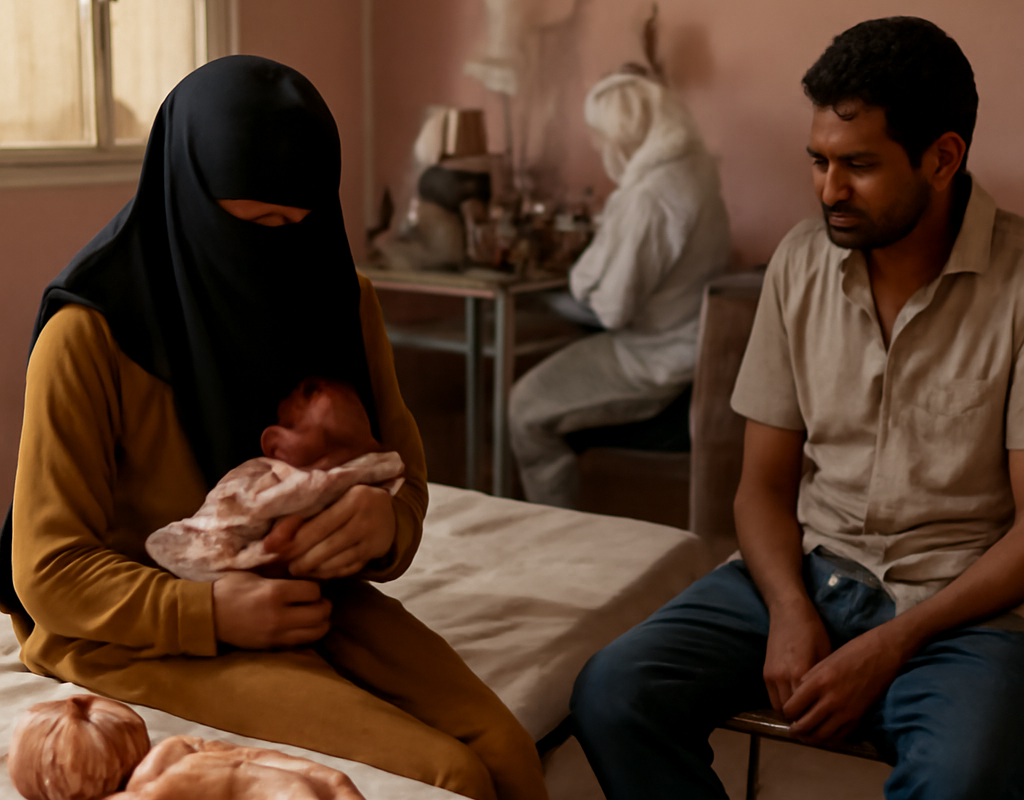
Yemen crisis is pushing children and families deeper into hunger, displacement and homelessness as renewed fighting disrupts access to food, healthcare and humanitarian assistance. In Aden, premature twins who fled their village with their family have become a stark example of how war and poverty are endangering civilians.
The seven-week-old twins, Raghad and Raad Hassan, were born as fighting intensified in south-west Yemen. Their family fled the Kahboub mountains after attacks involving bombs, missiles and drones reached their village. With no reliable transport available, the family walked for three days towards the port city of Aden, carrying the newborns under blankets.
Yemen crisis leaves newborn twins fighting for survival
According to their mother, Lina, the twins became increasingly weak during the journey. Cold, dust, vomiting and diarrhoea made their condition worse, while the family struggled to find food and transportation. By the time they reached al-Sadaqah hospital in Aden, both babies had been diagnosed with severe acute malnutrition.
Raad was in the most critical condition. His ribs were visible, his breathing was rapid and shallow, and he struggled to keep down fortified milk. His father, Bajash Ali Sagir Hassan, said the twins were fed twice daily, but the family could sometimes provide only water because the price of baby milk had risen beyond their means.
The case illustrates the connection between conflict, displacement and food insecurity. Families forced from their homes often lose their income, possessions and access to healthcare at the same time. For Bajash, fleeing meant abandoning 10 sheep—the family’s only livelihood.
War and displacement deepen Yemen’s humanitarian emergency
The United Nations says hundreds of thousands of people have been displaced during the latest escalation, while many others have lost access to lifesaving aid. The collapse of an informal ceasefire has contributed to renewed fighting, including advances along the Red Sea coast and the isolation of Taiz, Yemen’s third-largest city.
Civilians in affected areas face soaring food prices and limited access to essential supplies. Humanitarian agencies have warned that people in cut-off communities are at serious risk as aid deliveries become more difficult. The internationally recognised government is fighting Houthi forces with support from Saudi air strikes, leaving families caught between competing forces.
For children, the consequences are especially severe. Even before the latest escalation, the United Nations estimated that around half a million Yemeni children could experience severe acute malnutrition during the year. Malnutrition weakens the immune system and can become fatal when combined with infection, dehydration or inadequate medical treatment.
Hospital resources stretched beyond capacity
At al-Sadaqah hospital, medical staff are working with limited beds, equipment and funding. The malnutrition unit has 22 beds, but staff said only 13 patients could be admitted at one time, prioritising the most critical cases.
Doctors reported shortages of oxygen, ventilation machines and laboratory facilities. These gaps make it harder to treat children whose conditions require urgent monitoring and specialist care. Some children also return shortly after discharge because their families cannot afford nutritious food, vitamins or antibiotics.
A supervising nurse, Aisha Ragab, helped secure a place for the twins by arranging for them to share one bed. Her own experience of fleeing the war shaped her determination to help the family.
- Families are arriving without money, insurance or stable accommodation.
- Rising food prices are making infant nutrition unaffordable.
- Hospitals lack essential equipment and sufficient staffing.
- Children discharged from treatment may quickly become ill again.
Children forced to sleep outside after fleeing violence
While doctors cared for the twins, Bajash looked after his three other children, all under five. The family had no bedding, luggage or toys. With no space for them inside the hospital, the children spent the night outside on the street.
Their situation reflects a wider pattern across Yemen, where displacement often means living in unsafe and overcrowded conditions. Families fleeing violence may lose homes, employment and community support in a matter of hours. For children, repeated displacement can cause lasting physical and psychological harm.
The emergency in Yemen is therefore not only a military crisis. It is also a public health and humanitarian crisis, with hunger spreading through communities already exhausted by years of conflict.
Read more: Ireland and global current affairs
- Ireland breaking news and the latest Irish news
- Dublin news today, Irish politics news and national updates
Explore more international coverage
- World news, international affairs and humanitarian crisis coverage
- Live updates Ireland and major global developments
What happens next in the Yemen crisis?
The immediate needs are clear: safe shelter, food, medical supplies and uninterrupted humanitarian access. Hospitals require funding, equipment and staff, while displaced families need assistance to rebuild their livelihoods and protect their children.
The twins’ survival will depend on continued medical care, but their story also highlights the wider challenge facing Yemen. Without sustained aid and a reduction in fighting, children who leave hospital may return to the same conditions that made them ill.
The Yemen crisis shows how quickly conflict can turn poverty into a life-threatening emergency. Protecting civilians requires more than emergency treatment; it requires safe access to food, healthcare and shelter for every family forced from home.