

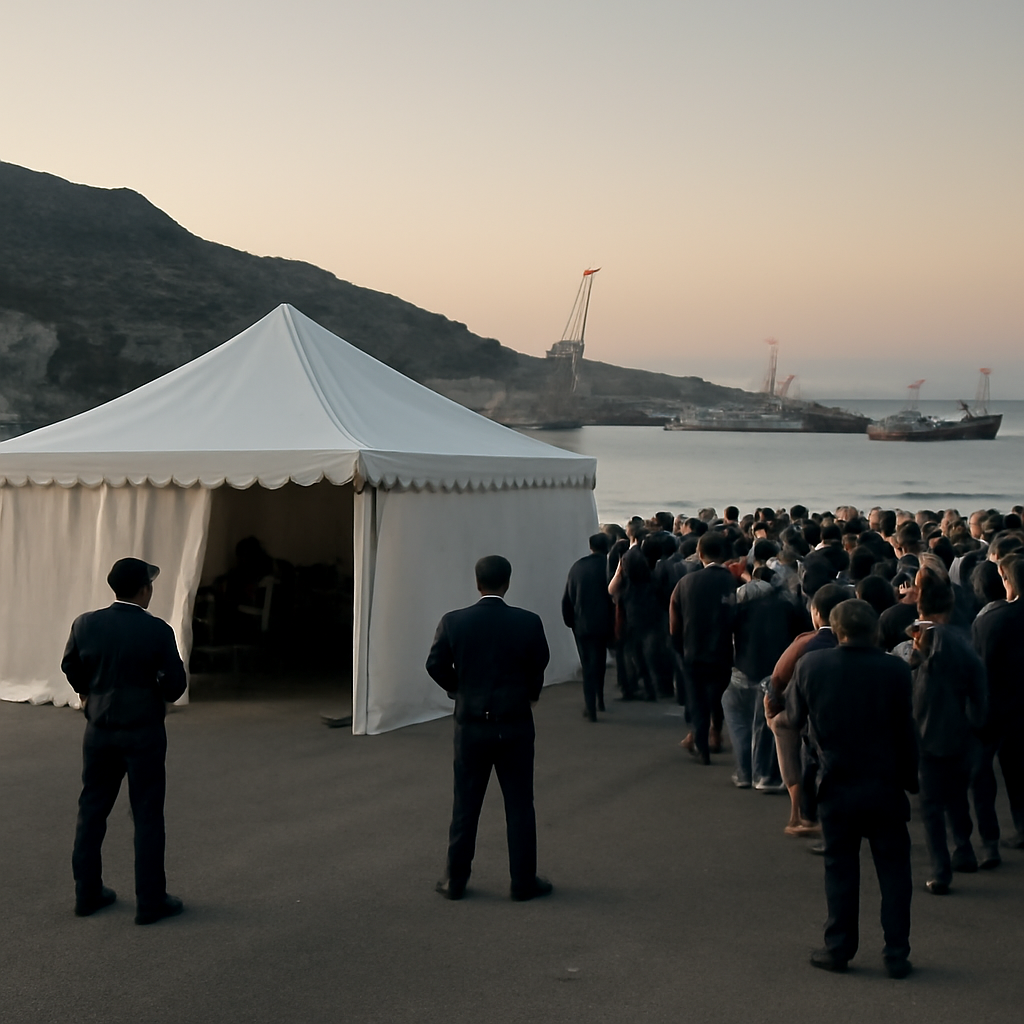
Thousands of migrants were moved to a new temporary reception facility in Ceuta on Friday after Spanish officers fired warning shots into the air as crowds surged during the operation. The transfer comes amid a continuing migration crisis in the Spanish autonomous city and renewed debate over security, reception capacity and Ceuta’s relationship with the European Union.
Spanish authorities began moving people from the Trampolín and Benítez beaches to a port facility shortly after 6:30 a.m. Several Civil Guard patrols escorted groups on foot along the roughly two-kilometre route.
The operation became difficult to control when groups from the two beaches joined together. Some migrants began running as officers attempted to manage the crowd, prompting warning shots into the air, according to the source report.
New facility has capacity for about 1,800 people
The temporary camp at the port can accommodate approximately 1,800 people. Authorities estimated that more than 4,000 migrants were being transferred from the two beach locations, although the precise number was expected to become clearer after registration was completed.
The site is the fifth temporary reception space established by the Spanish government in response to the crisis. The situation began in late July, when more than 70,000 people crossed into Ceuta from Morocco, according to the report.
Many people had spent around six weeks living in precarious conditions on the streets while waiting for accommodation in reception facilities. The latest move is intended to provide a more organised location, but the operation has also highlighted the gap between available capacity and the number of people needing shelter.
Why the port site is controversial
The decision to establish tents at the port has faced opposition from the Unified Police Union, known by its Spanish initials SUP. The organisation argued that the port is critical infrastructure and raised concerns about safety and policing conditions.
Spain’s National Court rejected the union’s request for an interim injunction on Thursday. That decision allowed the installation of the temporary tents to continue, although it did not resolve the broader dispute over the site’s suitability.
A SUP spokesperson said the port was not a safe location and warned that responsibility would be demanded if a serious incident occurred. Ceuta’s vice-president, Alejandro Ramírez, also criticised the government’s approach, saying the arrangements had been made under pressure and without sufficient preparation.
Ramírez pointed to a reported increase in incidents in the port area, saying the number had risen from 80 to more than 1,000 over a 50-day period. The source report did not provide further detail on how those incidents were recorded or categorised.
Ceuta’s wider importance for EU migration policy
Ceuta is a Spanish autonomous city on the North African coast and one of the EU’s external border areas. Developments there have implications beyond local reception policy because the city is situated at a sensitive point between the European Union and Morocco.
The latest events are therefore relevant to wider European migration policy, including:
- the management of EU external borders;
- reception conditions for migrants and asylum seekers;
- the role of Spanish authorities and Frontex;
- cooperation between Spain, Morocco and EU institutions; and
- the distribution of funding for border and reception infrastructure.
The operation is a Spanish national response rather than a new EU decision. However, Ceuta’s location means that border management, migration and asylum policy remain matters of wider European concern.
Spain seeks closer EU integration for Ceuta and Melilla
The transfer took place as Spanish Foreign Minister José Manuel Albares presented measures aimed at moving Ceuta and Melilla towards fuller integration within the European Union’s structures.
According to Spain’s Foreign Ministry, the proposed measures include:
- a permanent seat for Ceuta on the European Committee of the Regions;
- a permanent seat for Melilla on the same committee;
- a stronger Frontex presence in both territories;
- specific treatment for Ceuta and Melilla in negotiations over the EU’s next Multiannual Financial Framework; and
- work on possible arrangements for integrating both cities into the EU Customs Union.
The plans recognise the cities’ particular geographical and socio-economic circumstances. They do not, based on the information available, amount to a completed change in their legal status or an adopted EU measure.
What happens next?
In the immediate term, authorities must complete the transfer and registration of people arriving at the port facility. They also face the challenge of managing accommodation for a population that appears to exceed the camp’s stated capacity.
Further discussions will determine whether the port site remains a temporary solution and whether additional reception spaces are needed. Legal and political scrutiny is also likely to continue, particularly over safety, infrastructure and the responsibilities of local and national authorities.
At EU level, Spain’s proposals concerning Ceuta and Melilla would require further institutional and political work. Any change involving the Customs Union, EU funding or the role of Frontex would need to follow the relevant EU procedures rather than taking effect solely through a Spanish announcement.
Conclusion
The warning shots during the transfer underline the pressure facing Ceuta as Spanish authorities try to move thousands of migrants into limited reception space. The episode is part of a national emergency, but it also connects to broader EU debates about external borders, migration management and support for frontline territories. For now, the key issues are the completion of the transfers, the safety of the port facility and the next steps in Spain’s plans to strengthen Ceuta and Melilla’s links with the EU.