

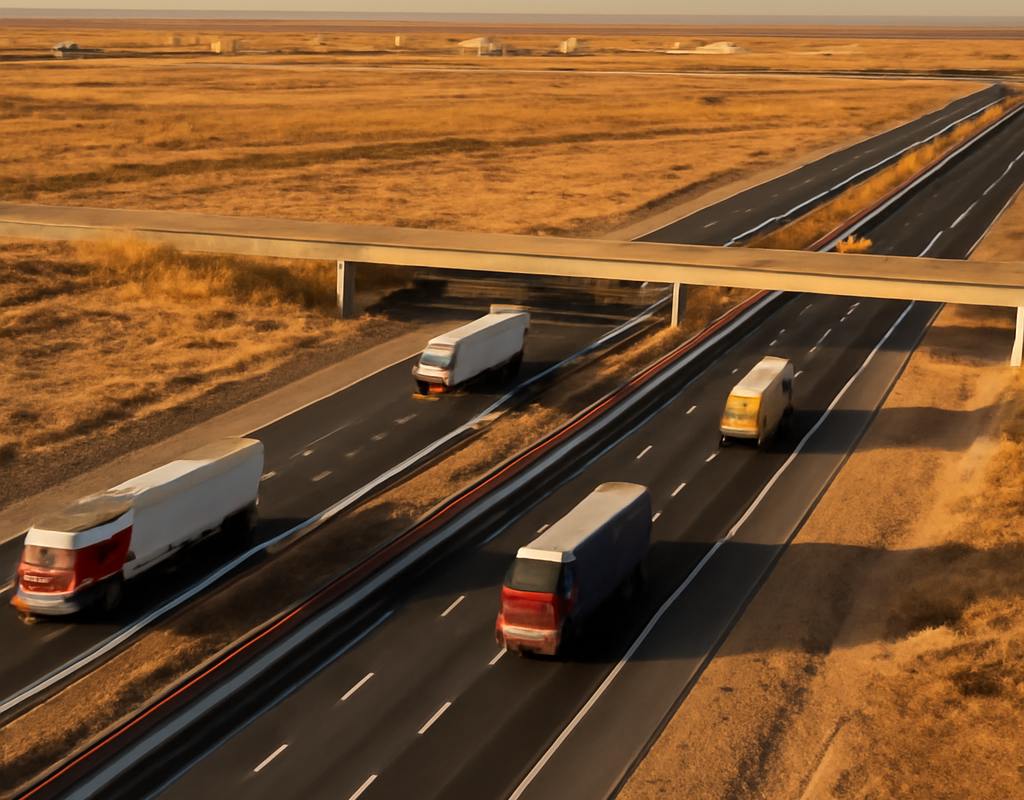
A major highway upgrade in Uzbekistan is moving closer to completion, with the project designed to improve freight connections between China, Central Asia and markets further west, including Europe. The expansion is intended to shorten journey times, reduce vehicle operating costs and increase capacity along one of the region’s important overland trade routes.
The work is taking place on the A380 highway in Karakalpakstan, an autonomous republic in northwestern Uzbekistan. A 25-kilometre section between Nukus and Urgench is being widened from two lanes to four, with construction around 90% complete and scheduled for completion by the end of 2026.
What the A380 highway project involves
The reconstruction is valued at $48.7 million (€43.6 million) and forms part of a broader transport programme supported by the Asian Development Bank. Around three kilometres of concrete surfacing and work on an overpass remained outstanding when the project was assessed.
The improved section will also include dedicated U-turn overpasses. These structures are intended to allow vehicles to change direction without crossing into opposing traffic lanes, improving both road capacity and safety.
Officials expect the expanded road to handle between 14,000 and 15,000 vehicles each day once the work is complete. That would represent a substantial increase from the estimated 6,000 to 7,000 vehicles currently using the route daily.
Faster freight journeys along the regional corridor
The A380 is part of Corridor 2 of the Central Asia Regional Economic Cooperation programme, known as CAREC. The initiative brings together 11 countries to improve transport infrastructure, support trade and deepen regional economic links.
A separate 240-kilometre section running from Kungrad towards the Kazakhstan border was completed in 2024. Freight operators say the improvement has already changed the economics of moving goods through the area.
Damir Mamutov, general manager of the international transport company Promizvest Servis, said trucks previously needed at least 10 to 12 hours to travel the 240 to 250 kilometres between Kungrad and Beyneu. Following the reconstruction, he said the same journey can now take between three and four hours.
Operators have also reported fewer maintenance problems. Poor road conditions previously meant that trucks could require tyre and suspension repairs after only one or two journeys. Better surfaces have reduced the frequency of those repairs and lowered costs for companies transporting goods to Türkiye, Kazakhstan, Tajikistan and other destinations.
A wider $383 million investment programme
The highway works are part of a wider regional transport programme with a total budget of $383.4 million (€343 million). The financing includes:
- $274.2 million (€245 million) in loans from the Asian Development Bank
- $109.2 million (€97.7 million) from the Uzbek government
- Road improvements intended to increase freight capacity and support cross-border commerce
Transport infrastructure is only one part of the development strategy. Asian Development Bank officials have also linked economic corridors with opportunities in agriculture, tourism and services. Better connections can help businesses reach export markets, attract investment and connect communities with wider regional supply chains.
Border procedures remain a major obstacle
Improved roads do not automatically eliminate delays for international freight. Trucks can still lose significant time at border crossings because of customs processing, inspections and queues.
Regional officials say the next phase of the work will focus on modernising border procedures alongside physical infrastructure. Proposed improvements include digital customs systems and electronic queuing arrangements for trucks, allowing freight movements to be managed more efficiently.
In August 2026, the Asian Development Bank approved a separate $400 million regional financing facility called Border Upgrades for Integration, Logistics, and Development, or BUILD. The facility is intended to support improvements at road and rail border crossings throughout the CAREC region, including digital systems, inspection equipment and border-management capacity.
Why the route matters for Europe
The A380 upgrade is not an EU decision or a European Union infrastructure project. Its importance for Europe lies in the wider trade corridor connecting Chinese production centres with Central Asian transport networks and destinations farther west.
Reliable roads through Uzbekistan can support routes towards Kazakhstan, the Caspian region, Türkiye and European markets. The improvements may also strengthen the broader Trans-Caspian and Central Asian logistics network, although the efficiency of the full route depends on conditions at several borders and on connections across different transport modes.
For European importers and exporters, the project illustrates how investment outside the European Union can influence supply-chain options. Faster inland transport may provide businesses with additional routes, but the overall benefits will depend on customs coordination, rail and road capacity, border management and demand from freight operators.
What happens next
The immediate priority is to finish the remaining construction on the 25-kilometre section between Nukus and Urgench. Once completed, authorities will need to ensure that the new road capacity is matched by efficient traffic management and functioning border procedures.
The wider BUILD facility could support further upgrades across the CAREC region, but individual projects and implementation schedules will depend on the relevant authorities and financing arrangements. The A380 expansion is therefore one part of a longer effort to make Central Asian trade corridors more reliable.
Conclusion
The A380 highway expansion strengthens a key overland link between China, Central Asia and markets connected to Europe. Its expected benefits include shorter freight journeys, lower vehicle maintenance costs and higher road capacity. However, the success of this trade route will depend not only on completing the highway, but also on reducing delays at international borders through digital customs and more modern crossing facilities.