

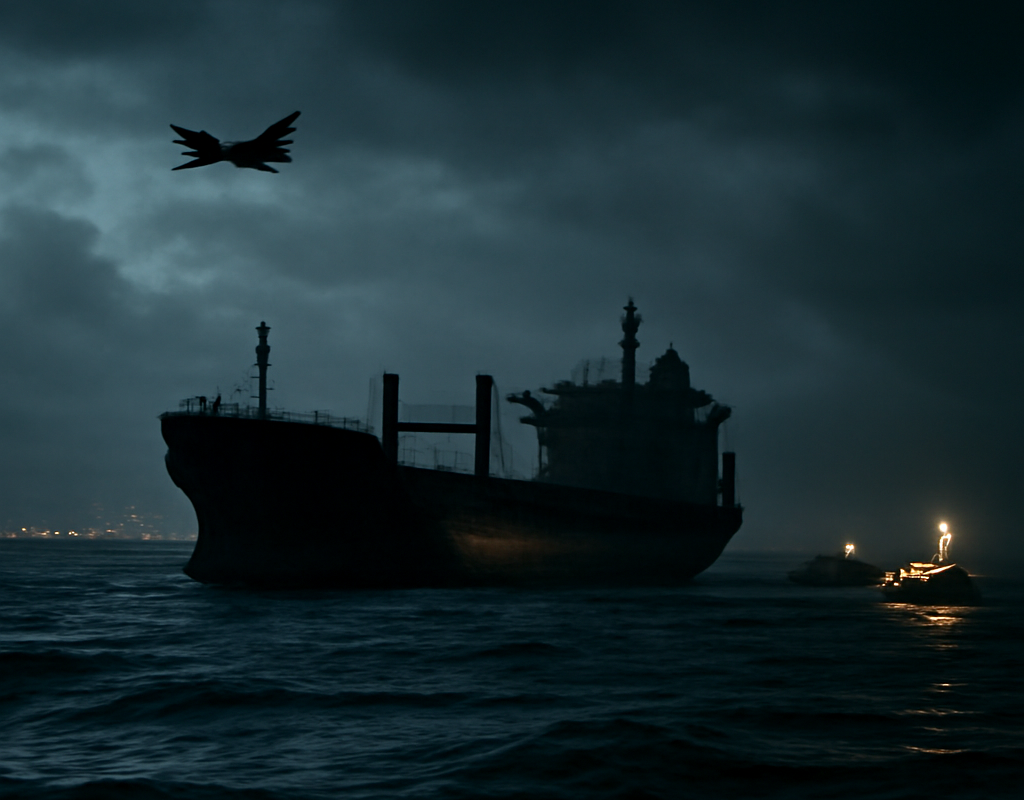
The United States says it disabled a commercial vessel in the Gulf of Oman after its crew allegedly ignored repeated warnings linked to a naval blockade of Iran. The incident, reported on 8 November 2026, has added to growing tensions around the Strait of Hormuz, one of the world’s most important shipping routes.
US Central Command said an aircraft fired precision munitions at the stern of the St Kitts-flagged M/V Huda after the vessel allegedly attempted to leave regional waters following a visit to an Iranian port. The account has not been independently verified, while Iranian authorities have issued a separate claim involving two tankers and sea mines.
What happened to the commercial vessel?
According to CENTCOM, the ship’s civilian crew was instructed to abandon targeted areas before the strike took place. The US military described the action as disabling the vessel rather than sinking it and said the crew had made several attempts to breach the blockade.
The United Kingdom Maritime Trade Operations agency said it had received a report of an incident involving a bulk carrier and military forces in the Gulf of Oman. The reported location was approximately 18 nautical miles east of Khor Fakkan on the eastern coast of the United Arab Emirates.
The UAE National Guard later said that 22 people had been rescued from a cargo ship in the Gulf. The available reports did not establish whether all details in the US military account and the maritime incident report referred to precisely the same sequence of events.
US military account of the blockade
CENTCOM said US forces had redirected 147 commercial vessels since July after those ships complied with the blockade. It also claimed that five merchant ships had been disabled after refusing to comply.
The command further said that US forces had previously destroyed 10 Iranian commercial oil tankers alleged to be connected to an Islamic Revolutionary Guard Corps shadow network. Those claims concern military operations and allegations by the US side; the source material did not provide an independent assessment of the vessels’ legal status or the basis for each action.
The incident raises important questions under maritime and international law, including the legal basis for a blockade, the status of commercial vessels, and the obligations of military forces when confronting civilian crews. No broader legal ruling or international institutional response was included in the available report.
Iran reports tanker fires near the Strait of Hormuz
Iran’s Revolutionary Guards navy offered a different account of events. It said two oil tankers had caught fire after striking mines: one east of the Strait of Hormuz and another inside the strategic waterway.
The IRGC said the ships had allegedly switched off navigation and positioning systems and attempted to use an “unauthorised” route. It warned that vessels cooperating with the US military or entering areas designated by Iran as unauthorised could face danger.
These claims had not been independently verified in the available information. The report also did not identify the tankers, confirm the number of casualties or establish who had placed the alleged mines.
Why the Strait of Hormuz matters
The Strait of Hormuz connects the Persian Gulf with the Gulf of Oman and the wider Arabian Sea. It is a critical passage for energy shipments and commercial trade. Any military incident in or near the waterway can affect shipping insurers, vessel operators, energy markets and regional security calculations.
For European countries, the consequences could extend beyond the immediate military confrontation. Disruption to shipping may increase transport costs, complicate energy imports and place pressure on supply chains. The scale of any effect on Europe would depend on how long the confrontation lasts, whether commercial traffic is interrupted and how markets respond.
The incident is therefore relevant to wider European affairs even though it occurred outside Europe. European governments and companies with maritime, energy or trading interests in the region may need to monitor security advisories and changes to shipping routes.
Wider escalation around Iran
The latest maritime incident follows several reports of explosions in and around Iranian territory. Reports on Friday described explosions on Qeshm Island, while Iran’s Tasnim news agency said missiles had struck the area.
US President Donald Trump later confirmed that US forces had targeted an Iranian air-defence system. Iranian news agencies subsequently reported further explosions in Qeshm, Sirik, Jask and Bandar Abbas.
The source material did not provide enough independently verified information to establish the full scale of the military activity, the damage caused or the number of casualties. The separate accounts from Washington and Tehran underline the difficulty of confirming events during a rapidly developing confrontation.
What happens next?
The immediate priority for maritime authorities will be determining the condition of the vessel and its crew, clarifying the circumstances of the reported rescue and assessing whether other ships face a heightened risk in the Gulf of Oman or Strait of Hormuz.
Further developments may include:
- Additional statements from CENTCOM, Iran and regional maritime agencies;
- Investigations into the reported vessel damage and tanker fires;
- New navigation or security warnings for commercial shipping;
- Diplomatic reactions from countries whose vessels or nationals are affected; and
- Changes to shipping routes, insurance costs or commercial operations in the region.
At present, the competing accounts mean that several key facts remain unresolved. The confirmed position is that a serious incident involving military forces and commercial shipping was reported in the Gulf of Oman, while the wider confrontation around the Strait of Hormuz is continuing to develop.
Conclusion
The reported disabling of the M/V Huda marks a significant escalation in the maritime standoff between the United States and Iran. With both sides issuing sharply different explanations and further incidents reported near the Strait of Hormuz, the main risks are to civilian crews, commercial navigation and the stability of a vital international shipping route. Governments and maritime operators will be watching for verified investigations and any steps that reduce the danger of further confrontation.