

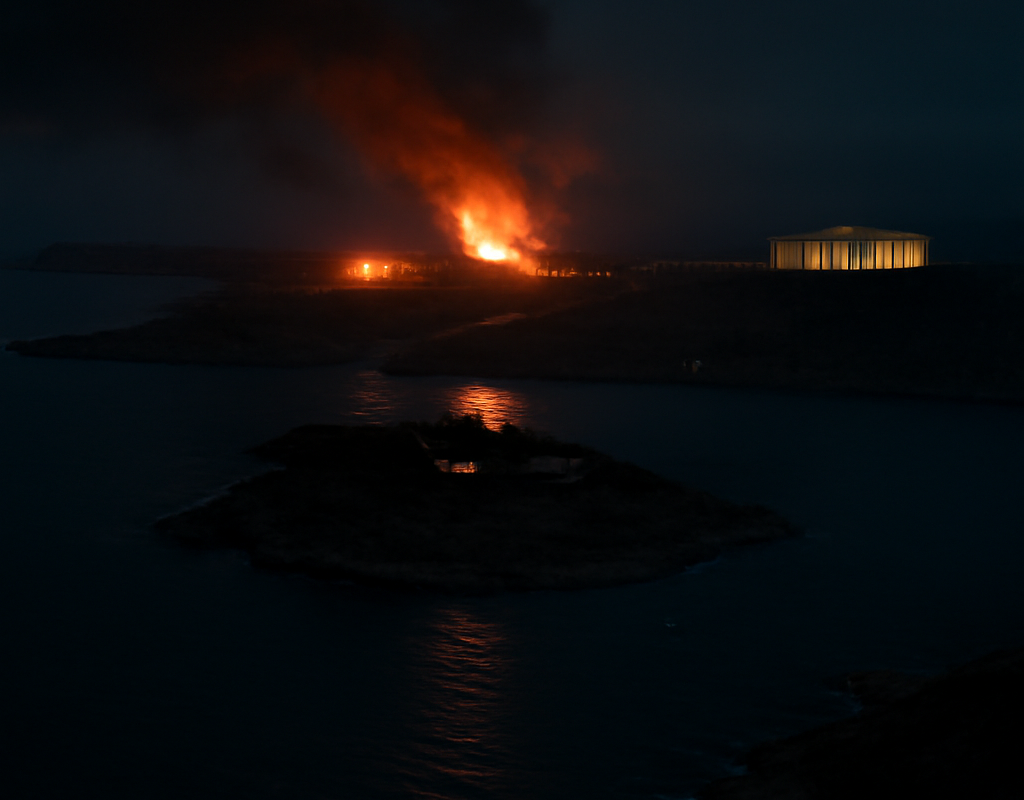
The United States carried out new airstrikes against Iranian air-defence systems on Friday, while diplomatic efforts led by Qatar continued to prevent a wider regional conflict. The developments are significant for Europe because any escalation could affect energy supplies, maritime navigation, regional security and diplomatic efforts involving European governments.
US President Donald Trump described the action as a minor strike against an air-defence installation on Qeshm Island. Iranian state media reported that two missiles hit the Suza area, but did not identify the targets or provide a confirmed assessment of damage.
What happened in the latest US-Iran strikes?
According to the source report, the US military conducted limited strikes in southern Iran on Friday night. Trump said the operation targeted a recently built anti-aircraft system and lasted only a short time.
The action followed earlier US strikes described by the military as defensive. Explosions were reported on Qeshm and Hengam islands, near the Strait of Hormuz, as well as in the mainland area around Bandar Abbas.
Iran’s Islamic Revolutionary Guard Corps also claimed that it had shot down a US military drone over southern Iran. The United States had not confirmed that claim at the time of publication.
The competing accounts underline the uncertainty surrounding the military situation. There was no independently verified information in the source material confirming the full extent of the damage, the number of casualties or whether the strikes would lead to further attacks.
Qatar says negotiations with Tehran are continuing
Despite the military action, Qatar rejected reports that diplomatic negotiations had collapsed. Its government said Qatari mediators remained in contact with both Washington and Tehran in an effort to support talks.
Qatar has been acting as the main mediator in proposals aimed at addressing disagreements between the United States and Iran, particularly over Iran’s nuclear programme. Two Middle East officials cited by the Associated Press said Iran was reviewing proposals presented by Qatar.
However, the talks face substantial obstacles. Iranian officials have reportedly linked any ceasefire or return to nuclear negotiations to several conditions, including:
- An end to the US military blockade affecting Iranian ports;
- The lifting of sanctions;
- The unfreezing of Iranian assets;
- Compensation for war-related damage; and
- An end to wider hostilities in the region, including Israeli military operations in Lebanon.
Trump has previously insisted that Iran’s nuclear activities must be addressed as part of any agreement intended to end the conflict. The gap between the two positions remains one of the central barriers to a durable settlement.
Why the Strait of Hormuz matters
The latest strikes took place close to the Strait of Hormuz, a vital maritime route for global energy shipments. Qatar’s leadership said discussions with Trump focused on reducing tensions, protecting freedom of navigation and safeguarding energy supplies.
Any prolonged military confrontation in or around the waterway could have consequences well beyond the Middle East. Disruption to shipping, higher insurance costs and uncertainty over energy markets could affect businesses and consumers internationally, including in European countries.
For the European Union, the situation also raises questions about diplomatic coordination, sanctions policy, maritime security and the potential effects of a wider conflict on migration and humanitarian conditions. The source report did not indicate that the European Union had announced a new measure in response to the strikes.
Regional leaders intensify diplomatic contacts
Trump spoke with Qatar’s Emir Sheikh Tamim bin Hamad Al-Thani about efforts to reduce tensions and seek a comprehensive agreement. US Defence Secretary Pete Hegseth also spoke with Qatar’s defence counterpart, Sheikh Saoud bin Abdulrahman Al Thani.
Qatar’s Prime Minister and Foreign Minister Sheikh Mohammed bin Abdulrahman Al Thani said that diplomatic engagement was intended to prevent the crisis from escalating further. He acknowledged that a perfect agreement might not be achievable, but argued that a workable settlement would be preferable to allowing the conflict to continue unchecked.
Iranian Foreign Minister Abbas Araghchi said he had spoken with 12 foreign ministers over two days to explain Iran’s position. In a social media post, he called for regional security arrangements without what he described as interference from powers outside the region.
What happens next?
The immediate outlook remains uncertain. The continuation of negotiations alongside fresh military action suggests that diplomacy and pressure are proceeding simultaneously rather than sequentially.
The main issues to watch are:
- Whether the United States conducts further strikes;
- Whether Iran responds against US or allied targets;
- Whether Qatar can keep the negotiation channel open;
- Whether the parties agree on the conditions for a ceasefire; and
- Whether maritime traffic and energy supplies around the Gulf remain secure.
European governments may also face pressure to clarify their diplomatic positions and assess potential consequences for citizens, businesses, energy markets and regional security. Any confirmed EU response would need to come through the relevant European institutions or member-state governments.
Conclusion
The latest US-Iran strikes have increased the risk of a broader confrontation, but they have not ended the diplomatic channel being led by Qatar. The key question is whether negotiations can produce a ceasefire framework before further military action pushes the region into a wider war. For Europe, the consequences could extend to energy security, shipping, foreign policy and humanitarian stability.