

Ireland breaking news coverage often brings global crises closer to home, and the latest reports from Ukraine underline the devastating human cost of war. Hundreds of civilians have escaped the Russian-occupied city of Oleshky after years of shelling, shortages and fear, arriving in northern Ukraine to reunite with relatives.
The evacuees crossed into Ukraine through Belarus during a rare humanitarian ceasefire in the Kherson region. Many had remained trapped since Russia seized Oleshky during the opening days of the full-scale invasion in February 2022.
Ukraine evacuation brings families together
Oleshky is geographically isolated, bordered by the Dnipro River on one side and Russian military positions on the other. Residents described a city where food and essential supplies became increasingly difficult to obtain, while roads were exposed to mines, drones and shelling.
Among those who escaped were Olha and Viacheslav, who travelled with their children and dog. They said the family had stayed because leaving appeared to be even more dangerous than remaining in the city. As conditions deteriorated, however, they decided that evacuation was their only chance.
According to accounts from residents, some people ventured through mined areas in search of food. Others who were too frightened to leave their homes reportedly cooked garden weeds to survive. The testimony illustrates the extreme deprivation facing civilians in areas cut off by the conflict.
A narrow window to leave
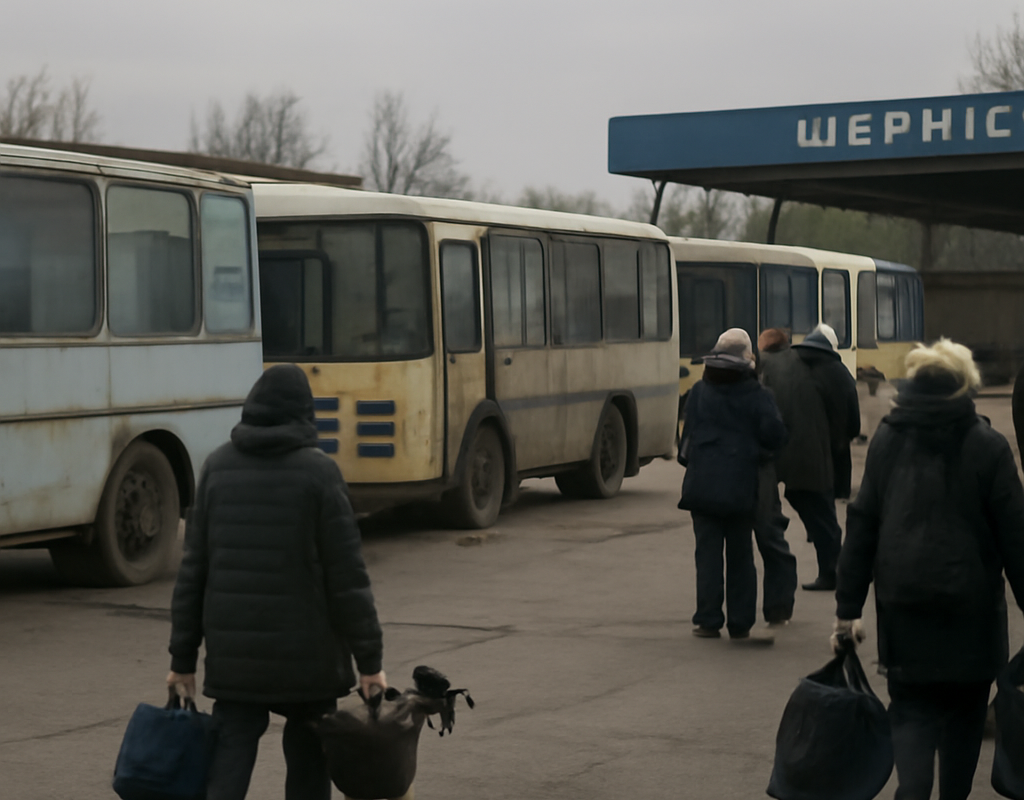
Residents were given a four-hour opportunity to depart. A convoy of 25 buses transported as many as 750 evacuees, while ambulances assisted people with limited mobility. After travelling through Russian-occupied territory and southern Russia, the group flew to Belarus before continuing by bus to a military facility in Chernihiv.
Up to 6,000 people were believed to remain in Oleshky and nearby areas, including around 200 children. An estimated 1,700 people were still living in the city itself before the evacuation operation.
The arrival in Chernihiv produced emotional scenes. Elderly passengers, some of whom were too weak to walk, were carried from the buses on stretchers. Other evacuees were met by relatives who had feared they would never see them again.
Residents describe life under occupation
Mykhailo Palii was reunited with his daughters, Dasha and Anya, after arriving at the Ukrainian facility. He described damage to his home caused by drone attacks and missile strikes, saying he had withheld some details from his family to spare them further worry.
Another couple, Tetiana and Volodymyr, arrived carrying their cat. They said their home had burned down three years earlier and that they had since lived in an abandoned neighbouring property. With no close relatives remaining in Oleshky, they said leaving was the clearest decision they could make once a safe route became available.
The ceasefire created a rare pause in fighting and enabled the civilian convoy to move. However, those who escaped remain deeply concerned about neighbours and friends who were unable to leave.
Rebuilding after escape
Evacuation is only the first step for families who have lost homes, income and personal security. Many now face temporary accommodation, employment uncertainty and the difficult process of replacing documents and reconnecting with public services.
Palii said he was prepared to take any work necessary to support his family, including construction, farming and demolition. Olha said her family would initially stay with acquaintances because they had no relatives elsewhere in Ukraine.
Their determination reflects the resilience of displaced Ukrainians, but it also highlights the long-term humanitarian needs created by the war. Safe housing, medical care, psychological support and employment will be essential as evacuees attempt to rebuild their lives.
Read more: Ireland and international news
- Latest Irish news and Ireland breaking news
- Dublin news today, Irish politics news and live updates Ireland
Explore more: major stories and analysis
What happens next for Oleshky evacuees?
The immediate priority is to provide evacuees with safe accommodation and practical assistance. Families must also decide whether they can return to their home region or begin again elsewhere in Ukraine. For those whose properties were destroyed or occupied, returning may not be possible for years.
The evacuation also raises questions about civilians still living in Russian-controlled areas. A temporary ceasefire can open a route to safety, but residents need reliable humanitarian corridors and guarantees that they can travel without facing renewed attacks.
Key facts about the evacuation
- Oleshky was seized by Russian forces in the early phase of the full-scale invasion.
- The city is isolated by the Dnipro River and nearby Russian positions.
- A convoy of 25 buses carried up to 750 evacuees.
- Residents travelled through occupied territory, Russia and Belarus before reaching Chernihiv.
- Thousands of people were believed to remain in Oleshky and surrounding areas.
Conclusion
The escape from Oleshky is both a rescue operation and a reminder of the war’s continuing impact on civilians. For the families who reached safety, the journey marks the end of years of isolation—but not the end of their struggle. As Ireland breaking news audiences follow developments, the central message from the evacuees is clear: survival may be possible, but lasting peace and a safe future remain urgently needed.