

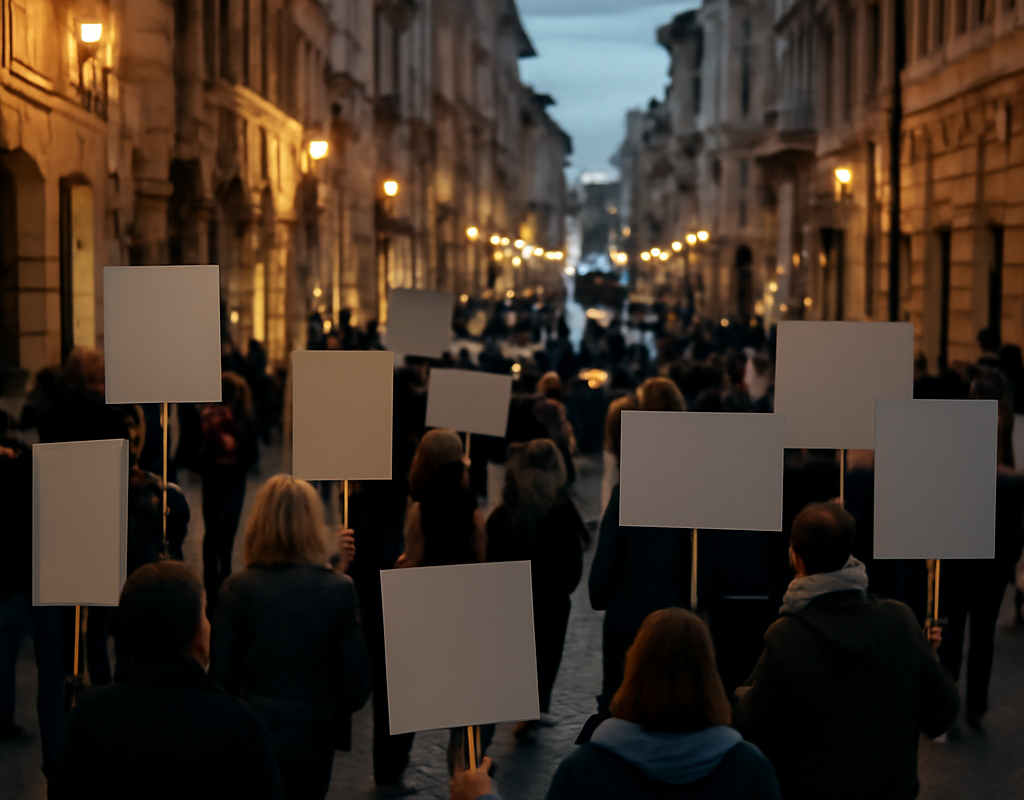
Standfirst: Demonstrations over the cost of living, Italy’s government and conflicts in the Middle East took place across several major cities on Saturday. The protests were largely peaceful, but isolated confrontations with police led to arrests, injuries and hundreds of identity checks.
Thousands of people joined demonstrations across Italy on Saturday, with marches and smaller gatherings reported in Rome, Milan, Florence, Turin and Bologna. The protests focused on rising living costs, opposition to Prime Minister Giorgia Meloni’s government and the wars in the Middle East.
Italy’s Department of Public Security said nine people had been arrested nationwide by the end of the day. Authorities also reported 87 people to prosecutors and brought 371 people to police stations for checks, including 110 minors and 69 foreign nationals.
Protests were mostly peaceful but tensions rose in several cities
Most demonstrations proceeded without serious disorder, although tensions increased later in the day in a number of locations. The authorities had mounted a large security operation following violence during protests the previous weekend.
Police officers and soldiers patrolled city centres, while 500 soldiers were deployed in Milan after attacks on shops reported during the earlier disturbances. The expanded security presence was intended to protect public spaces while allowing peaceful demonstrations to continue.
Rather than following one single route, protesters in several cities gathered in smaller groups before joining together. Security forces blocked attempts to move towards some central areas, leading to confrontations at police cordons.
Incidents reported in Rome, Florence and Bologna
Rome
In Rome, a group separated from the main demonstration on Via Cavour and moved towards the Colosseum. The protesters entered the historic Flavian Amphitheatre while chanting slogans and displaying placards. Authorities later escorted them from the site as the wider march continued through the capital.
A separate confrontation involved a demonstrator standing in front of a police water-cannon vehicle. Video circulated on social media appeared to show officers removing the person from the vehicle’s path.
Florence
In Florence, demonstrators attempted to cross the Santa Trìnita bridge but were held back by police. Officers used batons as some protesters pushed against the security cordon.
Bologna
Police prevented a march in Bologna from proceeding towards Via Marconi and Via Reno. Bottles and other objects were thrown at security forces, who responded with a water cannon and tear gas.
One person was taken to hospital after being struck by police officers, according to the report. The circumstances surrounding the injury were not independently detailed.
Milan and Turin
The situation in Milan was calmer than in some other cities. At least three marches converged near the city centre, where verbal confrontations were reported between protesters and far-right activists.
Turin also experienced moments of tension as demonstrators attempted to move through areas restricted by security forces.
Authorities make arrests and conduct hundreds of checks
The figures released by the Department of Public Security distinguish between arrests, reports to the authorities and temporary checks at police stations. Being taken to a police station for identification does not, by itself, mean that a person has been arrested or charged.
- Nine people were arrested nationwide.
- 87 people were reported to the authorities.
- 371 people were taken to police stations for checks.
- The checks included 110 minors and 69 foreign nationals.
In Milan, 30-year-old Youssef Siher was detained and placed under investigation on suspicion of aggravated incitement to commit a crime. He was alleged to have been linked to the “17 October Movement”, which reportedly shared information about participation in the previous weekend’s protests. An investigation is not a final finding of wrongdoing.
Meloni says protest rights and public safety must both be protected
Prime Minister Giorgia Meloni praised the police, soldiers and other personnel involved in managing the demonstrations. She said the right to protest should be guaranteed alongside the right of residents to feel safe in their cities.
Meloni’s comments reflected the central challenge facing the authorities: permitting lawful demonstrations while preventing violence, damage to property and disruption in busy urban areas. The government’s strengthened security operation has drawn attention because it combines police deployments with military patrols in city centres.
What happens next?
The arrests and reports will now proceed through Italy’s legal system, while investigators assess incidents recorded during the demonstrations. The government is also likely to face continued political debate over the balance between public order measures and freedom of assembly.
For residents and visitors, the immediate impact is likely to be localised road closures, altered public transport routes and increased security around central areas. The demonstrations were a national Italian development rather than an EU decision, but they form part of wider European current affairs involving the cost of living, political dissatisfaction and public-order policy.
Conclusion
The latest EU news cycle includes many institutional decisions, but this story concerns a national protest movement in Italy. Saturday’s demonstrations were largely peaceful, yet isolated clashes produced nine arrests and hundreds of police checks. The key issue now is whether Italy can safeguard the right to protest while responding proportionately to violence and protecting public spaces.