

Polish President Karol Nawrocki cut short his journey to Senegal on 30 October after police entered the Constitutional Tribunal and its president, Bogdan Święczkowski, was suspended from his duties. The confrontation has intensified a long-running dispute over judicial appointments, the rule of law and the relationship between Polish law and European Union law.
The development is a major focus of Europe news because it involves Poland’s highest constitutional court, the national government and an unresolved conflict that has previously drawn scrutiny from EU institutions. The immediate legal position remains contested, with the Tribunal describing the action as a “coup d’état” while Justice Minister and Prosecutor General Waldemar Żurek said he had sought the lifting of immunity for Święczkowski and his deputy, Bartłomiej Sochański.
What happened at Poland’s Constitutional Tribunal?
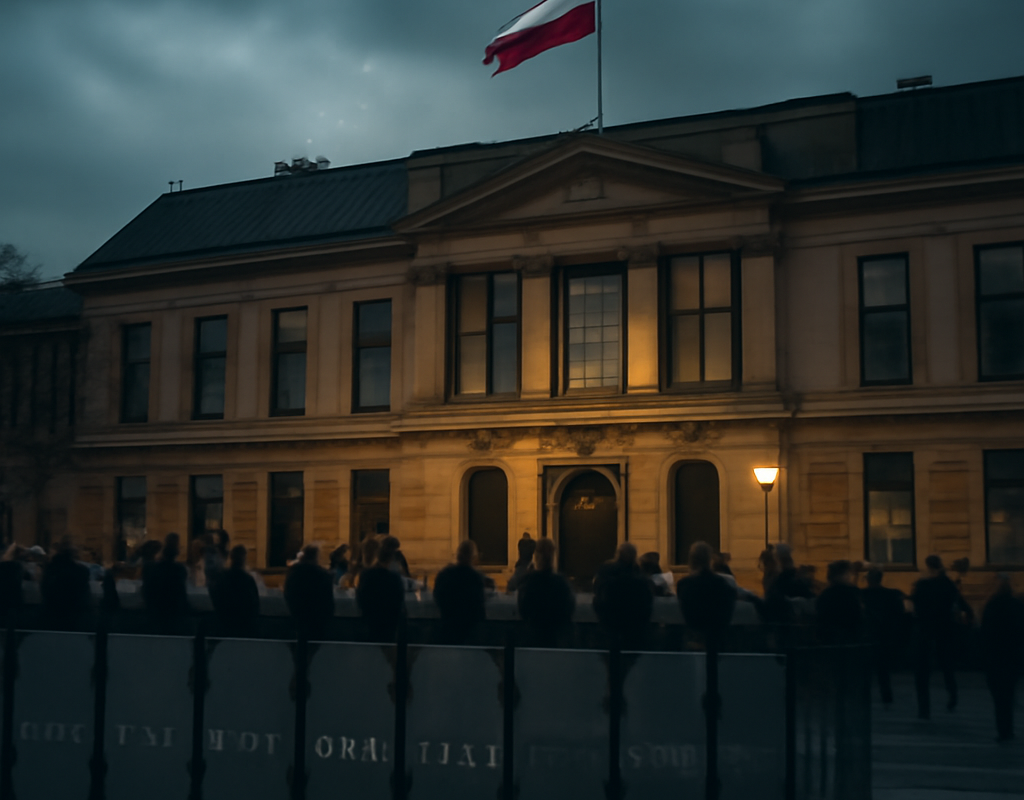
Dozens of police officers were deployed outside the Tribunal’s building in Warsaw after security warnings. The measures followed the entry of police into the institution and the announcement that Święczkowski had been suspended.
The suspension was announced by Constitutional Tribunal judge Anna Korwin-Piotrowska. The Tribunal subsequently published a statement on X rejecting the action and claiming that Korwin-Piotrowska was not a valid member of the court. It said that those involved were committing the crime of a coup d’état.
That allegation is a statement by the Tribunal and has not been established as a judicial finding. The competing claims underline the depth of the institutional confrontation and the absence of a shared interpretation of the court’s lawful authority.
Why did President Nawrocki return to Poland?
President Nawrocki was travelling to Senegal when he decided to turn his aircraft around. In a statement posted on X, he said that the president needed to be in Poland at such a moment and confirmed that he was returning.
His decision brought the constitutional dispute directly into the centre of Polish politics. Supporters of the opposition Law and Justice party, known as PiS, gathered outside the Tribunal. Reports from the scene said protesters chanted criticism of Prime Minister Donald Tusk, while some people prayed and held Catholic rosaries and religious images.
The president’s return does not itself resolve the legal dispute. It signals the political importance attached to the confrontation and places the head of state at the centre of a conflict involving the government, prosecutors, judges and the Tribunal’s leadership.
The wider dispute over judicial appointments
The immediate confrontation is linked to changes made to Poland’s judiciary during the period when PiS governed from 2015 to 2023. The European Union repeatedly criticised the Constitutional Tribunal, arguing that the court had become too closely aligned with the previous administration.
During that period, the Tribunal issued rulings stating on several occasions that Polish law took precedence over EU legislation. Such decisions contributed to a broader rule-of-law dispute between Warsaw and Brussels, including questions about judicial independence and the primacy of EU law.
After winning the 2023 election, Prime Minister Donald Tusk pledged to address the disagreement with EU institutions. His government has sought to remove or replace judges appointed under the previous PiS-led administration. President Nawrocki, however, has blocked appointments to the court, keeping the institutional conflict unresolved.
Key issues in the crisis
- Judicial appointments: The government wants to address appointments made during the previous administration, while opponents argue that the process is being used to take control of the Tribunal.
- Constitutional authority: The parties disagree over who has the power to suspend officials and determine the lawful composition of the court.
- EU law: Earlier Tribunal rulings challenged the principle that EU law takes precedence in areas covered by the Union’s legal order.
- Presidential powers: Nawrocki’s opposition to government appointments has helped prolong the dispute.
What does the crisis mean for Poland and the EU?
The confrontation could further complicate Poland’s efforts to restore confidence in its judicial institutions. It also risks reviving concerns in Brussels about whether constitutional checks and balances are functioning independently.
This is not an EU decision or an action taken by the European Commission. It is a national constitutional and political confrontation in Poland. However, it has clear European significance because Poland is an EU member state and because the dispute concerns the relationship between national constitutional law and EU law.
Any formal response from EU institutions would depend on further verified developments, including the legal basis for the suspension, any immunity proceedings and the decisions of Polish courts or public authorities. The information available does not establish that the latest events have produced a new EU legal measure or a final determination on the status of the Tribunal’s president.
What happens next?
The next steps are likely to focus on the competing institutional claims and the immunity requests involving Święczkowski and Sochański. Further legal action could clarify whether the suspension was valid and which body has authority over the Tribunal’s leadership.
The government, the presidency and PiS are also expected to remain divided over judicial reform. For observers of European politics, the key question will be whether Poland can settle the dispute through recognised constitutional and judicial procedures rather than allowing the confrontation to deepen.
Conclusion
Poland’s Constitutional Tribunal crisis has escalated after President Karol Nawrocki returned from his Senegal trip and police were deployed outside the court. The suspension of Bogdan Święczkowski remains fiercely contested, and the Tribunal’s “coup d’état” allegation is part of an unresolved political and legal dispute rather than an established court finding. The outcome will matter beyond Poland because it touches on judicial independence, constitutional authority and the application of EU law.