

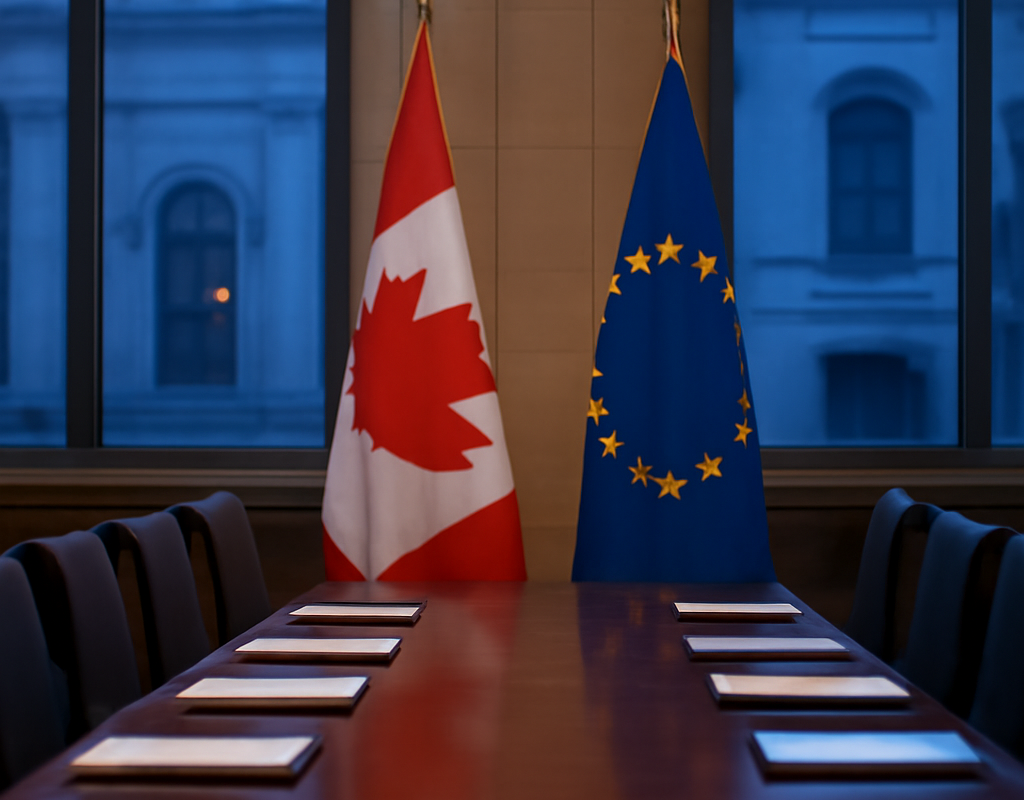
Canada and the European Union have set June 2027 as the target for concluding negotiations on a proposed new form of partnership that could make Canada the bloc’s first associate member. The arrangement is not provided for in the EU treaties, and its legal structure, powers and ratification process have yet to be agreed.
The announcement followed a Canada-EU summit in Montréal on 30 October 2026. Canadian Prime Minister Mark Carney said both sides were working towards the “deepest possible partnership short of accession”, while European Commission President Ursula von der Leyen described the initiative as an uncharted but potentially transformative relationship.
What Canada’s proposed associate membership would mean
The proposed status would sit below full EU membership but seek to establish a closer relationship than a conventional association agreement. The negotiations are expected to cover three broad areas:
- Policy: closer cooperation across areas of shared strategic interest.
- Programmes: wider Canadian participation in EU initiatives, including Horizon and Erasmus.
- Governance: new arrangements for consultation, coordination and joint decision-making.
The practical meaning of “associate membership” remains unsettled. The EU treaties provide for membership by European states, meaning Canada cannot follow the normal accession route. Any new framework would therefore need to be designed outside the established full-membership model.
Von der Leyen highlighted Canada’s potential participation in Horizon and Erasmus, as well as cooperation connected to the €90 billion support loan for Ukraine. The summit also widened discussions on digital trade, energy, critical raw materials, supercomputing, artificial intelligence and satellite technology.
Germany objects to the associate member label
The proposal has already exposed differences among EU member states. Germany opposed using the phrase “associate member” during negotiations over the summit’s joint declaration. The final text instead referred to an “ever closer association”.
European Council President António Costa also avoided the disputed term, describing the future relationship as an association that would be “the closest, deepest and most unique of its kind”. His wording reflects the European Council’s role in representing the collective position of EU countries and the need to secure member-state support.
Von der Leyen said there was broad backing for bringing Canada closer to the European Union, but did not directly address Berlin’s objections. The disagreement is significant because the initiative cannot become operational through a Commission announcement alone. Member states will need to determine whether they support the legal and institutional framework that emerges from the talks.
Why the Canada-EU partnership matters
Canada and the EU are already close partners in trade, research, security and diplomacy. A deeper arrangement could provide a structured way to coordinate on issues that affect both sides of the Atlantic, particularly at a time of pressure on supply chains, energy systems and strategic technologies.
Potential areas of importance include:
- access to research and education programmes;
- cooperation on artificial intelligence and advanced computing;
- secure supplies of critical raw materials;
- energy cooperation and digital trade;
- satellite and space-related technologies;
- support for Ukraine and wider European security.
However, the initiative is political as well as economic. Associate membership would create a new category in the EU’s external relationships. It could eventually offer a model for other close partners, although no such precedent currently exists.
What happens next?
The European Commission and the Canadian government plan to hold a college-to-cabinet meeting in spring 2027. That meeting is expected to develop the substance of the proposal and clarify the division of responsibilities between the two sides.
Carney is then expected to attend an EU leaders’ summit in June 2027, where he hopes negotiations can be concluded. That deadline is a political objective rather than a confirmed legal implementation date.
Several important questions remain open:
- What institutions would oversee the relationship?
- Would Canada have any formal role in EU decision-making?
- Which programmes and policies would be covered?
- How would the agreement be approved across the EU?
- Would national parliaments need to ratify it?
- What approval would be required in Canada?
Carney has previously indicated that the proposal would be put to a vote in the Canadian Parliament. The European approval process is not yet clear and will depend on the final legal design.
Implications for Ireland and the wider EU
Ireland is not being asked to implement a new rule at this stage. The proposal remains under negotiation, and no new EU law or treaty arrangement has been adopted. If the partnership eventually covers research, education, trade, energy or technology, Irish universities, companies and public bodies could benefit from stronger Canada-EU cooperation under the final terms.
For the EU as a whole, the immediate issue is whether member states can agree on a new form of institutional partnership without creating uncertainty about membership rights and obligations. The June 2027 target gives negotiators a timetable, but it does not settle the legal or political questions surrounding the concept.
Conclusion
The Canada-EU associate membership proposal has moved from an unexpected idea to a formal negotiating objective, with June 2027 set as the target for a possible agreement. Canada and the European Commission support an unusually close partnership, while Germany and the European Council leadership have avoided endorsing the associate-member label. The decisive next step will be the development of a clear framework and the agreement of EU member states on how it should be approved.