

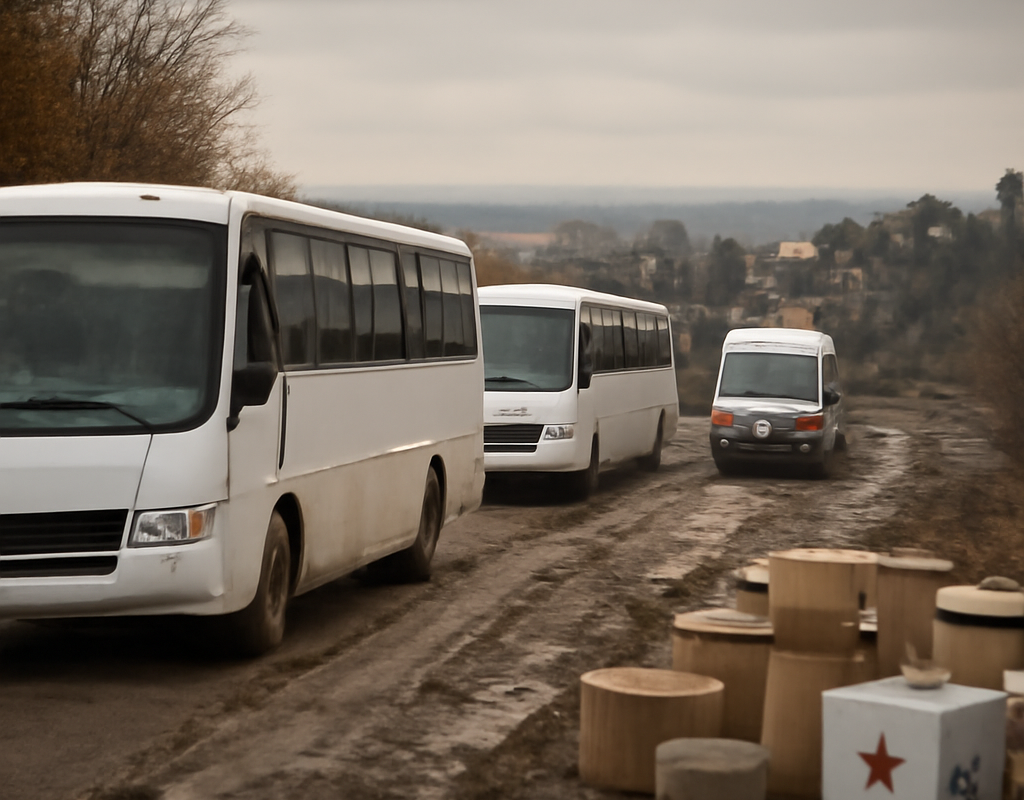
Residents are leaving the Russian-occupied Ukrainian city of Oleshky under a temporary local ceasefire, in a rare humanitarian operation involving officials from both sides of the war. The evacuation comes as fighting continues elsewhere in Ukraine and residents face a long route through Russian and Belarusian territory before reaching Ukrainian-controlled areas.
The operation began on Friday, 30 October 2026, after a convoy carrying food, medicine and medical support entered the southern Kherson region. Ukrainian officials said people who wanted to leave were being transported away from Oleshky, while those remaining would receive humanitarian assistance.
Humanitarian evacuation begins in Oleshky
Ukrainian negotiator David Arakhamia said the evacuated residents and members of the Ukrainian delegation had set off for Anapa in Russia. From there, they are expected to travel by air to Belarus before continuing by bus towards northern Ukraine.
The precise route has not been made public. Although Ukrainian-controlled territory lies only a few kilometres away across the Dnipro River, the evacuees cannot cross directly because of the military situation. Instead, they face a journey of hundreds of kilometres through territory controlled or administered by Russia and Belarus.
A convoy of 25 buses and several ambulances arrived in Oleshky earlier in the day. The vehicles delivered essential supplies and assisted residents who had decided to leave the city.
- Food and medicine were delivered to residents.
- Buses transported people who wanted to evacuate.
- Ambulances were included in the humanitarian convoy.
- People who remain in Oleshky are expected to receive further assistance.
What is known about the local ceasefire?
The ceasefire applies locally in Oleshky and the surrounding area of Ukraine’s southern Kherson region. According to the statements issued by Russia and Ukraine, it is due to remain in place until Sunday evening.
The two sides said residents could leave safely if they wished, while those who stayed would continue to receive humanitarian support. The arrangement represents a limited area of cooperation between officials from the two countries, despite the continuation of the wider war.
Reports from Ukrainian and Russian officials described the humanitarian mission as being carried out jointly. Ukraine’s presidential office said the operation was under way, while Russia’s human rights ombudsman said a convoy carrying people towards Russian territory was leaving the city.
How many people remain?
Local authorities and volunteers estimate that about 2,000 people remain in Oleshky. The city is located in the Kherson region, an area that has been heavily affected by the war and divided by the Dnipro River.
The evacuation is intended for residents who want to leave, rather than a compulsory removal of the entire population. The available statements did not indicate how many people would ultimately be transported or how long the wider humanitarian operation would continue beyond the ceasefire period.
Fighting continues outside the evacuation area
The local truce has not stopped military activity elsewhere. Russia’s Defence Ministry claimed that more than 1,000 Ukrainian drones had been intercepted overnight. Ukraine, meanwhile, reported Russian attacks involving ballistic missiles, other missiles and dozens of drones.
The competing claims could not be independently verified from the information available. They underline the limited nature of the arrangement in Oleshky: it is a local humanitarian pause, not a wider ceasefire covering the war in Ukraine.
The operation also highlights the practical difficulties facing civilians in occupied or contested areas. Safe movement may depend on coordination between opposing authorities, temporary suspension of attacks and access to transport, medical care and basic supplies.
Why the evacuation matters
The Oleshky operation is significant because it creates a temporary channel for civilian movement during an active conflict. Cooperation between Ukrainian and Russian officials remains highly unusual, particularly while attacks continue across other parts of the country.
For residents, the immediate priority is safe passage and access to assistance. The indirect route through Anapa and Belarus reflects the military and territorial realities around the Dnipro. It also means that people leaving Oleshky must undertake a complicated journey before reaching Ukrainian-controlled territory.
The mission may also provide a limited example of how local humanitarian arrangements can operate without resolving the wider political or military dispute. It does not represent a peace agreement, a national ceasefire or an end to hostilities.
What happens next?
The local ceasefire is expected to remain active until Sunday evening, giving residents a short window in which to leave. Officials will need to coordinate transport, medical support and the onward journey through Russia and Belarus.
Key questions include:
- How many residents will ultimately be evacuated?
- Will the humanitarian corridor remain open after Sunday?
- Will the route to Ukrainian-controlled territory be completed without incident?
- What assistance will be available to people who remain in Oleshky?
For Ireland and other European countries, the operation is another reminder of the continuing humanitarian consequences of Russia’s war against Ukraine. Any broader impact will depend on developments in the conflict and on future diplomatic efforts, rather than on this limited local arrangement alone.
Conclusion
The evacuation from Oleshky is a narrowly focused humanitarian operation taking place during a temporary local ceasefire. Residents are being offered a route out of the Russian-occupied city, but the journey is lengthy and the wider fighting continues. The central takeaway is that the arrangement offers short-term civilian relief without changing the broader military and political situation in Ukraine.