

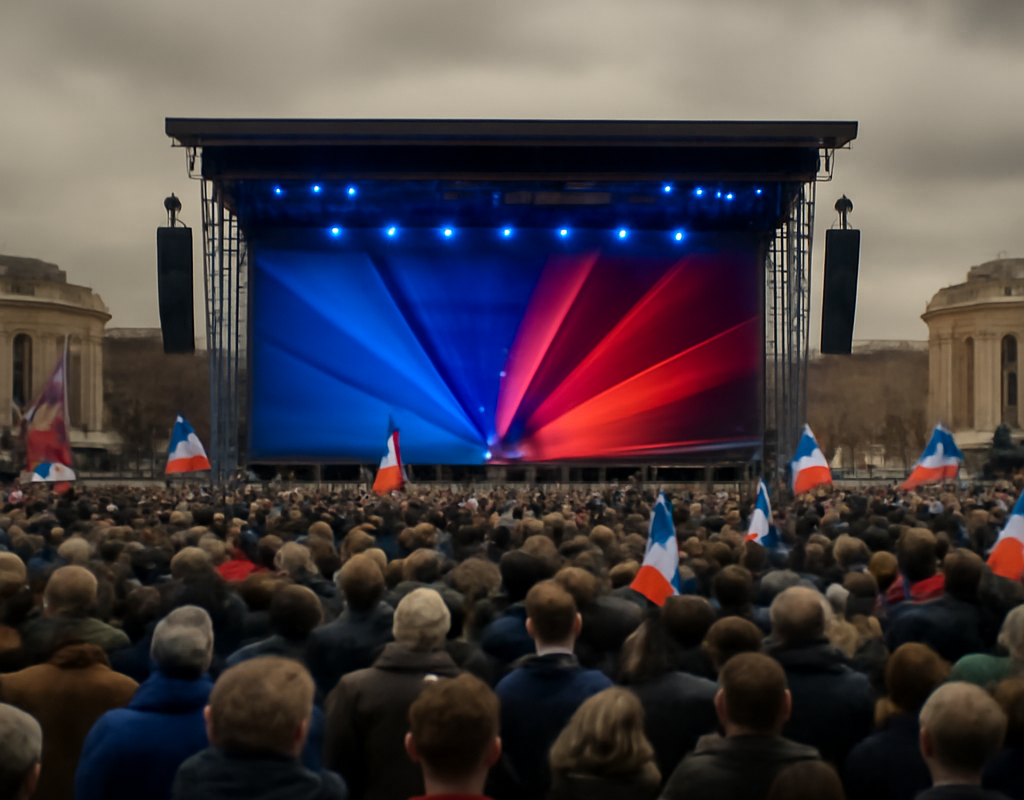
Jean-Luc Mélenchon has presented a new manifesto for France’s 2027 presidential election as nationwide demonstrations continue over wages, public services and economic insecurity. The France Unbowed leader is seeking to consolidate support on the left while positioning his campaign as a fundamental break with the country’s current political direction.
The manifesto, titled L’Avenir en commun — “The Future in Common” — was launched at a rally in Le Bourget, north of Paris, a venue with strong associations with French presidential politics. Mélenchon’s campaign comes amid a tense political climate, with Marine Le Pen leading polling and several left-wing groups considering closer cooperation.
Mélenchon sets out his platform
The manifesto places ecological transformation among France Unbowed’s central priorities. Earlier versions of the programme had placed the creation of a Sixth Republic at the forefront, but the latest document gives greater prominence to environmental reform and the restructuring of public administration.
Among the proposals are plans to:
- Replace France’s current administrative regions with “eco-regions” focused on managing water resources.
- Strengthen environmental protections in the French Constitution.
- Continue a gradual phase-out of nuclear power.
- Target 100% renewable energy by 2060, later than the previous 2050 objective.
- Raise the monthly minimum wage, known as the SMIC, to €1,700.
- Lower the legal retirement age to 60 for people who have paid into the pension system for 40 years.
The document has been released as a political foundation rather than a fully costed governing programme. Party officials say it will be followed by around 100 detailed documents setting out how individual measures would operate.
Economic proposals and budget plans
Mélenchon’s economic programme retains several long-standing France Unbowed commitments, including higher wages and earlier retirement for qualifying workers. The campaign has also presented a revised budget for 2027, outlining approximately €100 billion in additional revenue from tax measures and around €80 billion in new spending.
The figures indicate the scale of the proposed intervention but do not, on their own, establish how a future government would implement the entire manifesto. Further details on taxation, public spending and the financing of reforms are expected as the campaign develops.
Foreign policy and Europe
The manifesto gives particular attention to the war in Gaza and Israeli settlement activity in the West Bank. It proposes suspending the association agreement between Israel and the European Union, a move that would have significant implications for EU external relations and would require action beyond the authority of a French president alone.
On Ukraine, the document calls for a ceasefire but provides fewer details on military support for Kyiv. It also proposes a new European security framework that would include Russia. These positions place Mélenchon’s platform within wider debates about European foreign policy, NATO and the future of the continent’s security architecture.
France’s relationship with the European Union is likely to remain a major issue during the campaign. Former prime minister Édouard Philippe criticised what he described as Mélenchon’s opposition to European integration and NATO. Such claims are part of the political contest, rather than a formal assessment by an EU institution.
Support on the left, but a wide polling gap
Mélenchon is polling at about 18%, according to the figures cited in the source report, placing him in second position but well behind Marine Le Pen, who is polling between 35% and 37%.
His campaign has received important endorsements. Most Communist and overseas-territory members of the French National Assembly have formally backed his candidacy, despite Communist Party leader Fabien Roussel also standing. The Greens are expected to consider a possible alliance with France Unbowed in mid-December.
The question of cooperation could prove decisive on the left. Support from other parties may broaden Mélenchon’s electoral base, but negotiations would also involve disagreements over economic policy, Europe, international affairs and the future of France’s institutions.
Manifesto launch takes place during national protests
The rally took place as demonstrations continued across France. Nearly 200 marches were held on Thursday, with protesters calling for higher wages, action against economic insecurity, stronger public services and additional resources for schools and universities.
Turnout estimates differed sharply. Organisers put participation at around 1.6 million people, while France’s interior ministry estimated that approximately 575,000 demonstrators took part. The competing figures reflect different counting methods and remain politically contested.
The protests provide an important backdrop to Mélenchon’s message. His campaign is attempting to connect demands over living standards and public services with a wider programme of constitutional, environmental and economic change.
What happens next in French politics?
The manifesto is not a government programme and does not change French law. It is a campaign document that will be developed through further policy papers and tested during the presidential race.
The next stages will include decisions by potential coalition partners, further clarification of the programme’s financing and debate over its foreign-policy proposals. The campaign will also face sustained scrutiny over whether its plans could be implemented within France’s constitutional system and alongside the country’s commitments as an EU and NATO member.
For European observers, the election matters because France is one of the EU’s largest member states and a central actor in debates over defence, energy, climate policy, fiscal rules and relations with neighbouring countries.
Conclusion
Jean-Luc Mélenchon’s new manifesto sets out an ambitious programme focused on ecological reform, higher wages, pension changes and a reworked approach to France’s institutions and foreign policy. It remains a campaign platform, not enacted policy, and its influence will depend on the strength of support from other parties and the outcome of the 2027 presidential election. The continuing protests ensure that economic insecurity and public services will remain central issues in France’s political debate.