

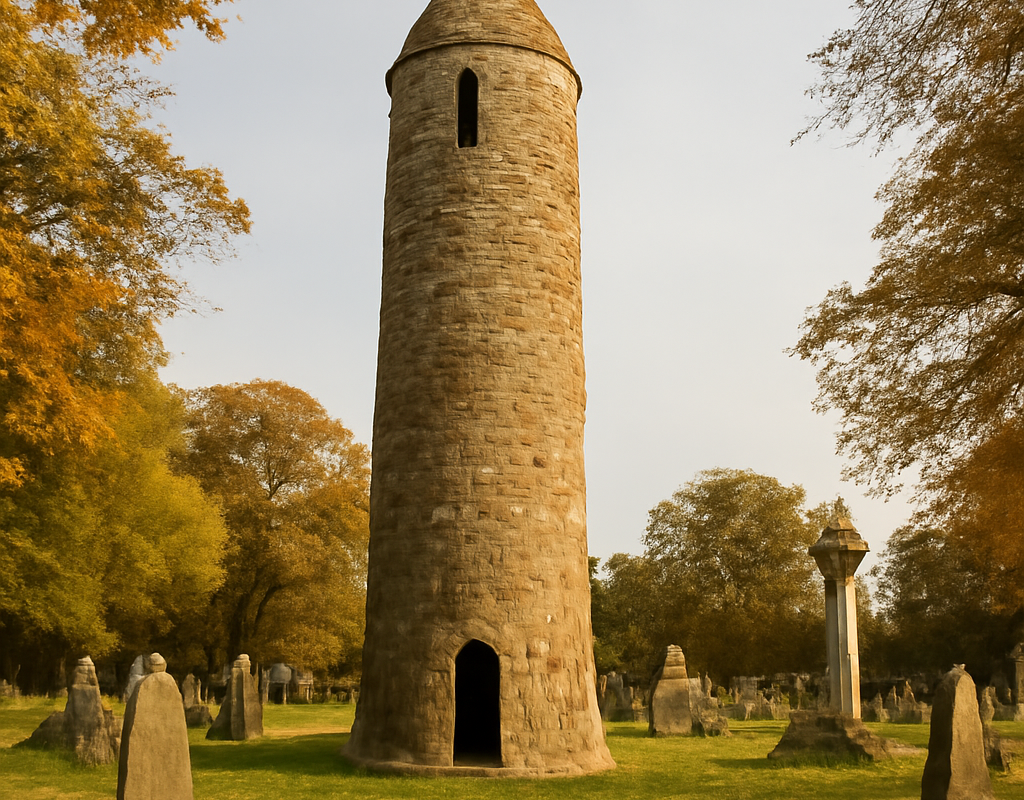
The Kells Round Tower has reached an important conservation milestone, with the Office of Public Works (OPW) confirming that specialist works at the historic monument in County Meath are now complete. The project protects one of Ireland’s best-known early medieval landmarks while preserving its authentic character for future generations.
Kells Round Tower conservation works completed
The OPW announced the completion of the conservation project on 29 October 2026. Work began after scaffolding was erected in February 2024, with extensive safety measures required because the tower stands beside a public footpath and a graveyard.
The fully boarded scaffolding included a pedestrian walkway, access stairs, vehicular access, a crash deck and public lighting. These arrangements enabled OPW craft workers to undertake repairs while protecting visitors, pedestrians and the surrounding historic site.
Traditional skills used to protect the monument
OPW National Monuments craft workers from the Trim District carried out the project, including stone masons trained in traditional conservation techniques. The completed works included:
- Removal of vegetation from the structure
- Localised repointing of masonry
- Careful stone cleaning
- Stone repair and consolidation
- Installation of a removable steel floor at entrance level to support maintenance access
Minister of State with responsibility for the OPW, Kevin “Boxer” Moran, described the completion as a significant step in protecting Ireland’s architectural heritage. The project reflects the OPW’s approach of maintaining historic monuments while limiting intervention and retaining their authenticity.
History of Kells Round Tower and monastic site
The monastic settlement at Kells was founded by St Columba in the mid-sixth century and is associated with the history of the Book of Kells. The round tower is believed to have been built in the 10th century, while the earliest confirmed written reference dates to 1076, when the King of Tara, Murchadh O’Melaghlin, was murdered there.
The sandstone tower stands approximately 26 metres high. Its entrance is positioned around 1.5 metres above ground level, and the structure has five floors and five pointed windows near the top. Unlike the more typical four cardinal windows found on many Irish round towers, the windows at Kells are believed to face the town’s access roads and gate.
Why the tower will remain without public interior access
The project was designed to conserve the tower in its existing form rather than introduce a staircase or ladder. Public access would require substantial structural and archaeological interventions close to the High Crosses of St Patrick and St Columba.
The removable internal floor will allow OPW maintenance access without changing the historic appearance of the monument. This follows modern conservation principles, where work is kept to the minimum necessary to safeguard the fabric of an important national monument.
Read more: Irish heritage and government updates
Future protection for Kells heritage site
Kells graveyard contains three historically significant High Crosses and the base of a fourth. The Department of Housing, Local Government and Heritage is working towards bringing the three crosses into State care. Once that process is completed, condition surveys and further conservation measures will be needed to support their long-term protection.
The Kells project also highlights the wider role of public bodies, including the Office of Public Works, in protecting Ireland’s built heritage. Information on government services and official announcements is available through gov.ie.
Explore more: County Meath travel and local history
What the conservation project means
Completing the works ensures that Kells Round Tower remains a prominent landmark for residents and visitors. By combining traditional masonry skills, careful repairs and minimal intervention, the OPW has strengthened the monument without compromising its historic appearance.
The key takeaway is clear: the Kells Round Tower has been conserved for the future while its archaeological setting and authentic form remain protected.
Article/Image Courtesy: gov.ie