

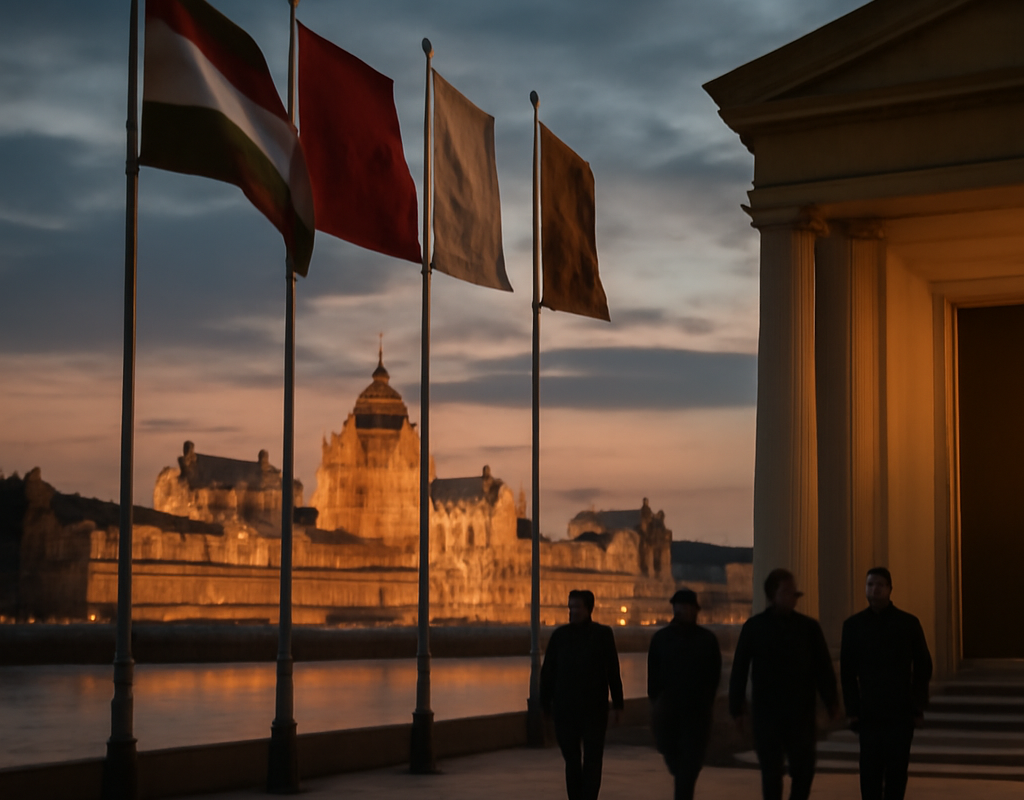
Hungary’s 70th-anniversary commemoration of the 1956 revolution brought European Commission President Ursula von der Leyen and European Council President António Costa to Budapest, but several prominent leaders stayed away after diplomatic tensions and late invitations.
The event, held on 23 October, was intended to showcase Hungary’s renewed relationship with Europe following Péter Magyar’s election victory and the end of Viktor Orbán’s tenure. Instead, the attendance list was notably smaller than the Hungarian government had hoped.
Senior EU figures attend Budapest ceremony
Von der Leyen and Costa were the most senior representatives of the European Union at the anniversary event. Their presence offered political backing for Magyar’s stated pro-European direction and placed the commemoration within a broader debate about Hungary’s role in European affairs.
Von der Leyen said that Hungarian voters had chosen “a new chapter” and described the change as an opportunity to move beyond division, weakened trust and concerns about civil liberties and prosperity.
The attendance of the two EU leaders had not initially been certain. Both had been expected to participate in a European Union–Gulf Cooperation Council meeting in Riyadh, but the postponement of that meeting allowed them to travel to Budapest.
Macron, Tusk and Zelenskyy absent
French President Emmanuel Macron, Polish Prime Minister Donald Tusk and Ukrainian President Volodymyr Zelenskyy were among the high-profile figures who did not attend.
Magyar had publicly discussed plans for an international gathering involving senior leaders from Europe and beyond. During visits to Paris and Warsaw in June, he personally invited Macron and Tusk. Invitations were also extended to Turkish President Recep Tayyip Erdoğan, Austrian Chancellor Christian Stocker and German Chancellor Friedrich Merz.
However, people close to the Hungarian government said that many official invitations were not sent until September. By that point, several leaders had already committed to other engagements. Tusk was scheduled to visit India, while Italian Prime Minister Giorgia Meloni had planned a trip to Kuwait.
A former diplomat and foreign-policy expert, István Szent-Iványi, said the government had created expectations that were difficult to meet. Around 40 countries sent delegations, but many EU member states were represented by ministers or parliamentary speakers rather than heads of government.
Comments on France deepen diplomatic tension
Relations with Paris were further strained by Magyar’s comments about unrest in France and migration. In a social media post, the Hungarian prime minister linked scenes of destruction and violence to Hungary’s tough position on migration.
The French embassy in Budapest later confirmed that Macron would not attend, while stressing that his visit had never been formally confirmed. Macron subsequently criticised foreign politicians who connected unrest in France with migration, calling such remarks inaccurate and offensive.
The episode illustrates how domestic political commentary can affect high-level diplomatic events. Analysts cited in the reporting said Magyar’s remarks could be interpreted as interference in French domestic politics and were unlikely to encourage Macron’s participation.
Dispute over invitation to Ukraine’s president
Ukraine was represented at the commemoration by the speaker of its parliament rather than President Volodymyr Zelenskyy. The Ukrainian president’s office said the parliamentary visit had been arranged independently and was not intended to replace Zelenskyy’s attendance.
The invitation became contentious after Zelenskyy indicated at an EU summit in Brussels that he was open to visiting Budapest. Magyar later appeared to downplay the possibility, prompting criticism from Zelenskyy’s adviser Dmytro Lytvyn.
The disagreement was particularly sensitive because the 1956 uprising is remembered as a struggle against Soviet domination. Ukraine’s presence at the ceremony nevertheless maintained a link between the commemoration and current European debates about sovereignty, security and support for Ukraine.
Georgia’s presence raises questions
Georgian Prime Minister Irakli Kobakhidze attended despite criticism from Brussels over the direction of Georgia’s governing Georgian Dream party. The European Union has expressed concern about the country’s ties with Russia, the slowing of its European integration process and measures affecting dissent.
Georgia’s Constitutional Court also began hearings during the week on a request from the governing party to ban five pro-Western political parties. That development added controversy to Kobakhidze’s appearance at an event commemorating resistance to Soviet rule.
Some Hungarian commentators questioned whether the Georgian prime minister’s attendance was consistent with the symbolism of the anniversary. Hungarian officials, however, maintained that invitations had been extended broadly and that Kobakhidze had accepted.
What the guest list means for Hungary
The limited number of attending heads of government does not, by itself, establish a breakdown in relations between Hungary and its European partners. Several leaders had scheduling conflicts, while political disagreements also played a role.
For Magyar’s government, the participation of von der Leyen and Costa provided an important European signal. It suggested that Brussels is prepared to engage with Hungary’s new leadership, even as questions remain about the country’s foreign-policy positioning and relationships with other European capitals.
The anniversary also showed the importance of diplomatic planning. A major state commemoration depends not only on political symbolism but also on early invitations, clear communication between government offices and careful handling of sensitive international issues.
Conclusion
Hungary’s 1956 commemoration ultimately combined European engagement with diplomatic friction. The presence of the European Commission and European Council presidents indicated support for a closer relationship with Budapest, while the absence of Macron, Tusk and Zelenskyy exposed the limits of the event’s international reach. For Hungary, the next challenge will be turning the pro-European message signalled in Budapest into stable working relationships across the European Union.