

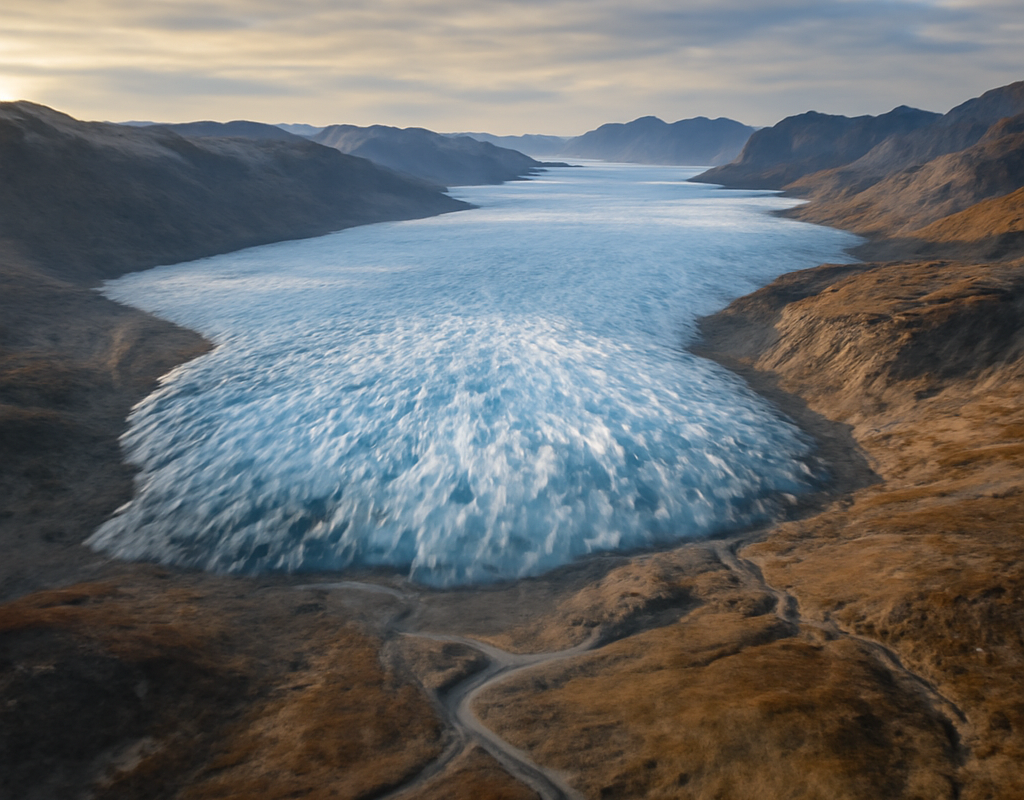
A new study of Canada’s Barnes Ice Cap suggests that a large-scale cooling process may have begun around 2,000 years ago but was interrupted by modern warming. The research offers a detailed look at how glaciers grow, shrink and influence the long-term climate system.
The findings do not mean that Earth was entering an ice age in the everyday sense of the term. Scientists distinguish between the broader Cenozoic Ice Age, which continues today, and shorter glacial periods that occur within it. The researchers argue that the renewed growth of the Laurentide ice sheet may represent the early phase of one such cold period.
What the study found
The research focused on the Barnes Ice Cap on Baffin Island in north-eastern Canada. Covering roughly 6,000 square kilometres, it is one of the last remaining fragments of the much larger Laurentide Ice Sheet, which once covered extensive areas of Canada and the northern United States.
Scientists examined organic material and vegetation near the ice margin. By measuring carbon-14 in these samples, they were able to estimate when plants were covered by advancing ice. This allowed the team to reconstruct changes in the glacier’s edge over thousands of years.
The evidence indicates that the ice sheet reached a minimum size approximately 3,000 years ago. Around 2,000 years ago, it began expanding again, suggesting that conditions had become cold enough for ice accumulation to resume.
- The Barnes Ice Cap is a surviving remnant of the Laurentide Ice Sheet.
- Carbon-14 dating helped researchers track the historic movement of the ice margin.
- The ice began expanding again around 2,000 years ago.
- Modern warming reversed that expansion during the 20th century.
Why researchers describe this as the start of a cold period
Ice ages are not single, uninterrupted periods of extreme cold. Earth’s current Cenozoic Ice Age began about 34 million years ago and includes warmer interglacial phases as well as colder glacial periods.
The study’s authors argue that the first sustained growth of the Barnes Ice Cap could mark the beginning of a new glacial phase. This interpretation differs from conventional model-based approaches, which often define the start of a glaciation by the later development of enormous continental ice sheets.
Under that traditional definition, the next major glaciation would not begin for thousands or tens of thousands of years. The researchers instead focus on the earliest measurable stage: the point at which ice starts to expand and creates conditions that can encourage further growth.
That distinction is important. The study does not suggest that a dramatic ice age was about to transform North America or Europe. Any natural cooling process would have unfolded over thousands of years, with effects developing gradually.
How climate change changed the trajectory
The researchers identify the 1960s as a major turning point. Historical records show that the summer of 1961 was among the hottest of the 20th century in the region. Since then, Canadian summers have generally become warmer, with northern areas warming especially quickly.
As summer temperatures rose, the Barnes Ice Cap began losing more ice during the melt season than it gained during winter. Its expansion stopped and was replaced by long-term retreat. The result is a striking example of how human-driven climate change can alter a process that would otherwise unfold over very long timescales.
The study therefore links two separate climate stories: evidence of an early natural cooling trend and the much faster modern warming that interrupted it. The research does not suggest that global warming is beneficial because it delayed glaciation. Instead, it demonstrates the scale of human influence on Earth’s climate system.
What could happen to the Barnes Ice Cap?
Some climate projections indicate that the remaining Laurentide ice could continue shrinking over the coming centuries and may eventually disappear. If that happens, the Barnes Ice Cap would lose its role as a potential starting point for renewed ice growth in the region.
Large ice masses influence climate through feedback effects. Ice reflects sunlight, stores freshwater and affects local atmospheric and surface conditions. As an ice sheet grows, these effects can support additional cooling and further expansion. If it disappears, that feedback is removed.
The researchers say the loss of the remaining ice could therefore have consequences beyond Baffin Island. It could change how future glacial cycles develop, although the precise effects remain a subject for further research.
Why this matters for climate research
The study provides rare evidence about the earliest stages of glacier expansion. Scientists have long used ice cores, geological records and climate models to understand past glaciations. Directly identifying the first advance of an ice margin offers another way to test those reconstructions.
It also highlights the difference between natural climate cycles and present-day warming. Natural glacial changes generally operate over thousands of years, while greenhouse-gas-driven warming has altered temperatures and glaciers within decades.
For Europe, the research is relevant because the loss of major ice reserves can affect global climate feedbacks and future projections. It should not be interpreted as evidence that a new European ice age is imminent. Rather, it shows how quickly human-induced warming can disrupt a long-term natural process.
What the findings mean
The central conclusion is that a possible early phase of renewed glaciation began around 2,000 years ago but was halted when modern warming intensified. The Barnes Ice Cap now provides evidence both of past cooling and of the rapid impact of human activity.
For climate researchers, the next step is to compare the carbon-14 record with other geological evidence and climate models. That work may clarify how common similar early ice-growth phases were and how the disappearance of remaining glaciers could affect future climate cycles.
The study’s broader lesson is clear: climate change does not simply add warmth to an otherwise unchanged system. It can interrupt processes that have been developing for centuries or millennia. Human-driven climate change may have postponed a natural cold period, but it has done so while accelerating glacier loss and reshaping the climate system in ways that will persist for generations.