

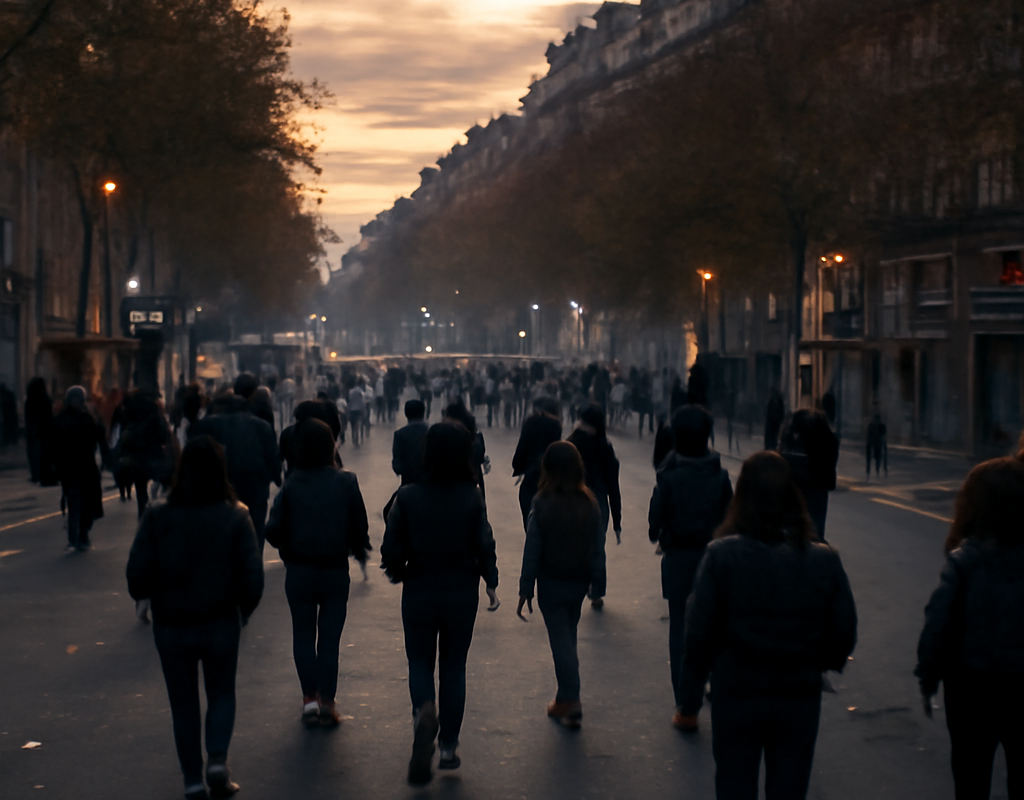
France’s third consecutive weekend of social protests drew fewer people than the previous two mobilisations, but tensions rose as demonstrations dispersed in several major cities. The Interior Ministry said authorised marches were generally peaceful, while police reported arrests and used tear gas during incidents in Lyon.
The demonstrations, initially led by high school students concerned about school conditions, teacher shortages and university admissions, have since attracted labour unions and other groups critical of President Emmanuel Macron. Similar gatherings and warnings about possible disorder were reported in Germany, Italy, Spain, the Netherlands and other European countries.
French protest turnout falls for a third weekend
According to France’s Interior Ministry, about 320,000 people took part in Saturday’s demonstrations nationwide, including approximately 70,000 in Paris. That was below the government’s estimates for the previous two Saturdays: 410,000 participants on 24 October and 550,000 on 17 October.
Organisers have provided substantially higher figures for the earlier mobilisations, saying that around 800,000 people attended on each of those two days. As with many large demonstrations, the competing estimates reflect different counting methods and remain politically contested.
Transport disruption may have affected attendance. In Lyon, tram and metro services were operating at reduced levels, while more than 40 Paris Metro stations were closed and tram services were also disrupted.
Arrests and clashes reported as marches dispersed
The Interior Ministry described the situation as generally calm earlier in the day. By 2pm, authorities had recorded 27 arrests, compared with 217 at the same point during the mobilisation on 24 October.
However, tensions increased as marches ended. In Lyon, tear gas was used near Place Jean-Macé after the demonstration reached the area. Officials warned that security forces would respond firmly to violence and property damage, amid concerns that Halloween gatherings could provide a setting for further clashes.
Previous demonstrations have included attacks on police with fireworks and projectiles, while some events developed into rioting and looting. Police responses have included tear gas, dispersion grenades and water cannon. The use of crowd-control measures has also prompted concern over serious injuries.
Authorities introduce restrictions in Paris
The French authorities introduced additional measures intended to reduce disorder and protect businesses. Saturday’s marches were kept away from central shopping areas, following a decision announced by the government.
Police restricted access to Place de la République and Les Halles overnight, with the measures running from 11pm to 6am. Unaccompanied minors were also subject to a 9pm curfew around the Champs-Élysées during the weekend.
The restrictions have faced legal scrutiny. A Paris court had previously suspended an earlier curfew affecting minors, finding that it represented a serious and unlawful interference with freedom of movement. The ruling underlines the legal limits facing emergency public-order measures, even during periods of unrest.
How the protests began
The mobilisation began last month as a student-led movement focused on neglected school buildings, staff shortages and concerns that university admissions procedures disadvantage students from poorer backgrounds.
Its demands have since broadened. Labour unions and other participants have added concerns about housing, social policy and the direction of the French government. The movement is therefore no longer limited to education, although student issues remain central to its origins.
The protests have become a significant national political and public-order challenge. The government must balance the right to peaceful assembly with the protection of residents, businesses, police officers and public infrastructure.
Demonstrations and security concerns spread across Europe
The French protests form part of a wider wave of youth-led and social mobilisation reported in several European countries. The issues vary between countries, but education, housing, living costs, climate policy and concerns about military service have featured prominently.
- Germany: The youth initiative “Gen Z regelt” called for greater investment in education and healthcare, stronger climate protection and more affordable living costs. It also opposed a return to compulsory military service. Organisers said more than 180,000 people had registered online, although only several thousand had joined marches by Saturday afternoon. Young protesters also gathered near Berlin’s Brandenburg Gate.
- The Netherlands: Police increased their presence in The Hague after online calls for demonstrations and fears of looting. By mid-afternoon, no major disturbances had been reported, although officers checked the identities of some groups. Several shops were boarded up as a precaution.
- Italy: Police remained on alert in cities including Milan, Turin and Bologna following earlier clashes.
- Spain: Catalan police prepared their highest-level alert in Barcelona after an anonymous TikTok network called for new gatherings. Rioting the previous weekend had led to about 130 arrests, most involving minors.
- Other countries: Online calls for protests also circulated in Belgium, Austria, Switzerland and Portugal.
What happens next?
The immediate priority for authorities is managing further gatherings without restricting lawful protest more than necessary. Police operations, transport closures and curfews are likely to remain politically and legally sensitive, particularly where minors and freedom of movement are involved.
The longer-term outcome will depend on whether governments address the concerns that helped drive the mobilisation. In France, the original education-related grievances have expanded into broader criticism of housing, social conditions and national politics. That makes the movement harder to resolve through a single policy announcement.
For the wider European context, the cross-border spread of similar demonstrations shows how quickly concerns about affordability, public services and young people’s prospects can travel through social media. Yet the scale and intensity of the protests remain different from country to country.
Conclusion
France’s latest social protests attracted fewer participants than the previous weekends, but the decline in turnout did not eliminate public-order tensions. The central challenge now is to protect peaceful assembly while responding lawfully to violence, and to determine whether governments across Europe can address the education, housing and social concerns driving young people onto the streets.